Department of Immunology, Laboratory of Transplantation Immunobiology, Institute of Biomedical Sciences IV, Universidade de São Paulo, São Paulo, Brazil.
Diabetes. 2012 Oct;61(10):2534-45. doi: 10.2337/db11-0844. Epub 2012 Jun 11.
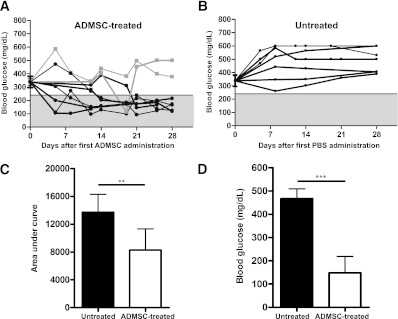
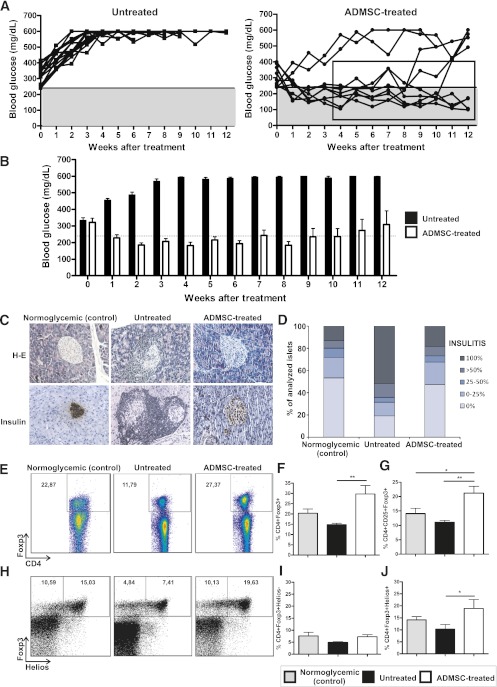
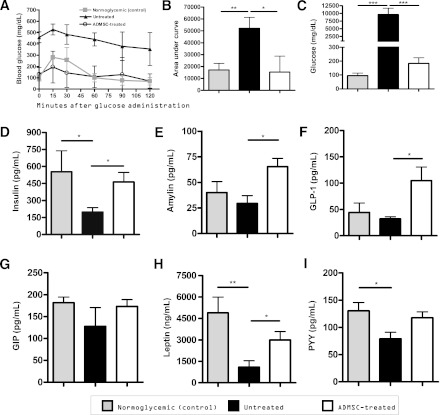
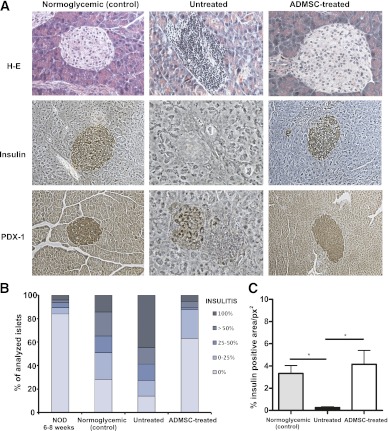
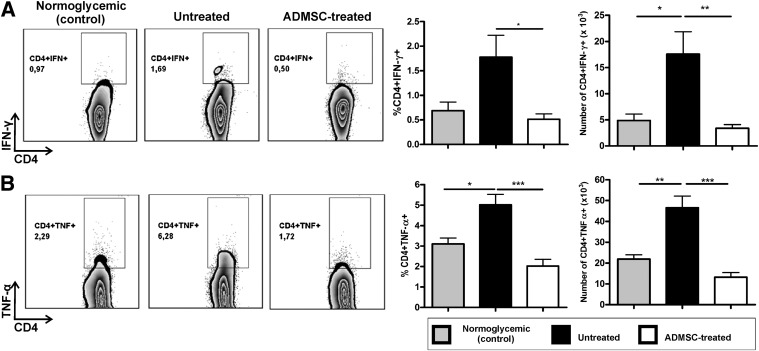
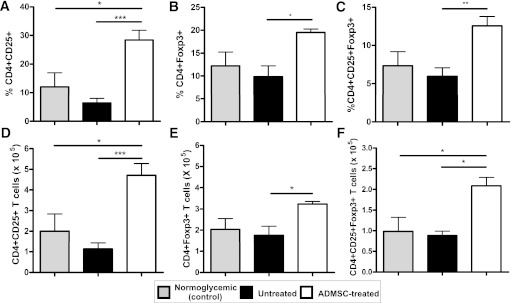
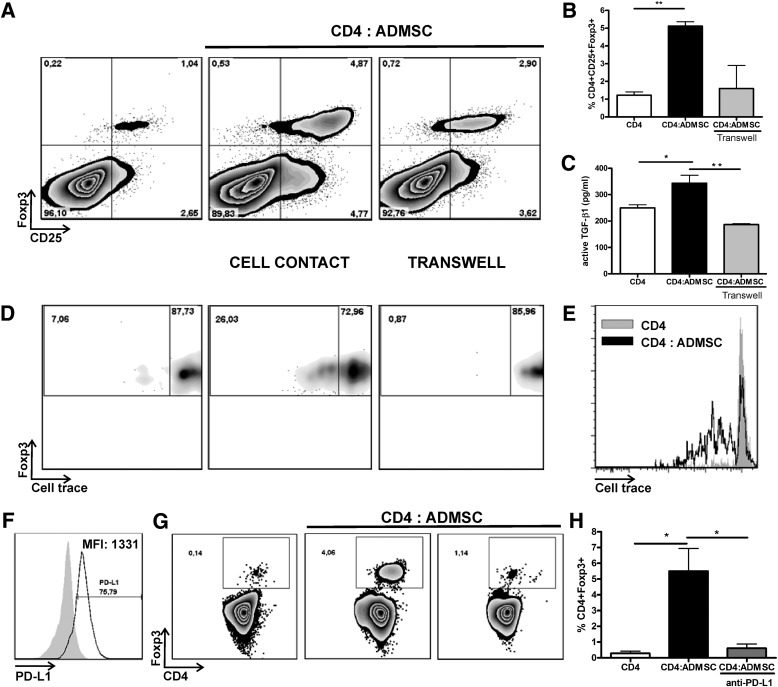
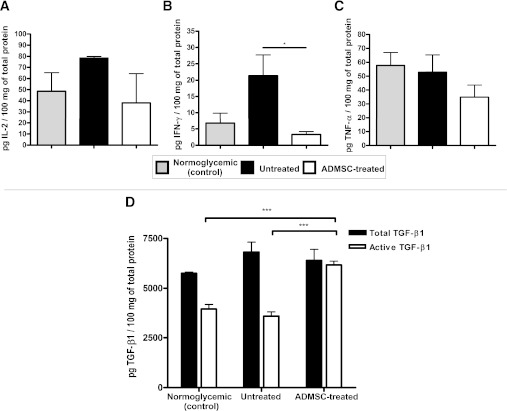
Adipose-derived mesenchymal stem cells (ADMSCs) display immunosuppressive properties, suggesting a promising therapeutic application in several autoimmune diseases, but their role in type 1 diabetes (T1D) remains largely unexplored. The aim of this study was to investigate the immune regulatory properties of allogeneic ADMSC therapy in T cell-mediated autoimmune diabetes in NOD mice. ADMSC treatment reversed the hyperglycemia of early-onset diabetes in 78% of diabetic NOD mice, and this effect was associated with higher serum insulin, amylin, and glucagon-like peptide 1 levels compared with untreated controls. This improved outcome was associated with downregulation of the CD4(+) Th1-biased immune response and expansion of regulatory T cells (Tregs) in the pancreatic lymph nodes. Within the pancreas, inflammatory cell infiltration and interferon-γ levels were reduced, while insulin, pancreatic duodenal homeobox-1, and active transforming growth factor-β1 expression were increased. In vitro, ADMSCs induced the expansion/proliferation of Tregs in a cell contact-dependent manner mediated by programmed death ligand 1. In summary, ADMSC therapy efficiently ameliorates autoimmune diabetes pathogenesis in diabetic NOD mice by attenuating the Th1 immune response concomitant with the expansion/proliferation of Tregs, thereby contributing to the maintenance of functional β-cells. Thus, this study may provide a new perspective for the development of ADMSC-based cellular therapies for T1D.
脂肪间充质干细胞(ADMSCs)具有免疫抑制特性,这表明它们在几种自身免疫性疾病的治疗中有很大的应用潜力,但它们在 1 型糖尿病(T1D)中的作用在很大程度上仍未得到探索。本研究旨在研究 ADMSC 治疗在 NOD 小鼠 T 细胞介导的自身免疫性糖尿病中的免疫调节特性。ADMSC 治疗使 78%的糖尿病 NOD 小鼠早期发病的高血糖得到逆转,与未治疗的对照组相比,其血清胰岛素、胰淀素和胰高血糖素样肽 1 水平更高。这种改善的结果与 CD4(+) Th1 偏向性免疫反应的下调和胰腺淋巴结中调节性 T 细胞(Tregs)的扩增有关。在胰腺中,炎症细胞浸润和干扰素-γ水平降低,而胰岛素、胰十二指肠同源盒-1 和活性转化生长因子-β1 的表达增加。在体外,ADMSCs 通过程序性死亡配体 1 介导的细胞接触依赖性方式诱导 Tregs 的扩增/增殖。总之,ADMSC 治疗通过减弱 Th1 免疫反应,同时扩增/增殖 Tregs,有效地改善了糖尿病 NOD 小鼠的自身免疫性糖尿病发病机制,从而有助于维持功能性β细胞。因此,这项研究可能为 T1D 的基于 ADMSC 的细胞治疗提供新的视角。