Xie Yao, Zhao Fang-Hui, Lu Si-Han, Huang He, Pan Xiong-Fei, Yang Chun-Xia, Qiao You-Lin
Department of Epidemiology, Sichuan University, Chengdu, Sichuan, People's Republic of China.
Chin J Cancer. 2013 May;32(5):275-82. doi: 10.5732/cjc.012.10047. Epub 2012 Jun 6.
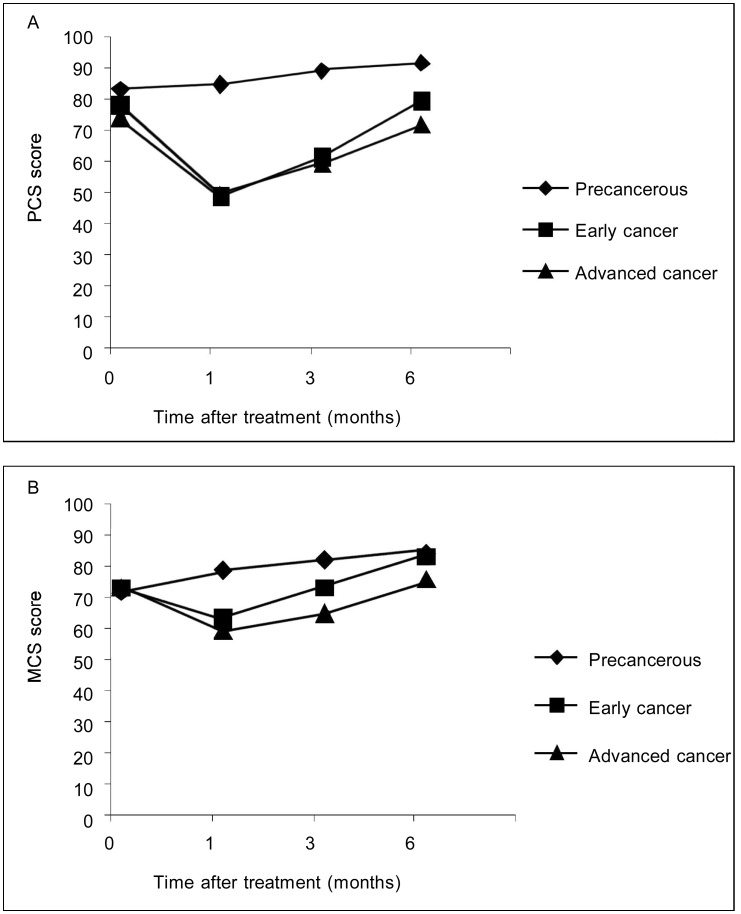
With improved overall survival of cervical cancer patients, the importance of the quality of life (QOL) is increasingly recognized. This study was conducted to compare the QOL of women with different stage cervical cancer before and after treatment to facilitate improved cervical cancer prevention and treatment. We used the generic Medical Outcomes Study Short Form-36 (MOS SF-36) to collect QOL information. Based on SF-36, we interviewed cervical cancer patients at West China Second Affiliated Hospital and Sichuan Cancer Hospital between May 2010 and January 2011. A total of 92 patients with precancerous lesions, 93 with early cancer, and 35 with advanced cancer responded to our survey. Average physical component summary (PCS) scores were significantly different between the three groups at every time point (P < 0.05). Average mental component summary (MCS) scores were significantly different between the three groups after treatment (P < 0.05). Average PCS and MCS scores increased gradually from the pretreatment to posttreatment period for patients with precancerous lesions. However, they reached the lowest at 1 month after treatment for patients with early and advanced cancers and rebounded between 1 and 6 months after treatment. Our results indicate that patients with precancerous lesions and early cervical cancer show better overall QOL than do those with advanced cervical cancer. Additionally, patients with early cancer recover more quickly than do those with advanced cancer in terms of both physical and mental functions. Thus, early detection and treatment initiatives may improve the QOL for patients with precancerous lesions and cervical cancer.
随着宫颈癌患者总体生存率的提高,生活质量(QOL)的重要性日益得到认可。本研究旨在比较不同分期宫颈癌女性患者治疗前后的生活质量,以促进宫颈癌预防和治疗的改善。我们使用通用的医学结局研究简表36(MOS SF - 36)来收集生活质量信息。基于SF - 36,我们于2010年5月至2011年1月期间对四川大学华西第二医院和四川省肿瘤医院的宫颈癌患者进行了访谈。共有92例癌前病变患者、93例早期癌症患者和35例晚期癌症患者回应了我们的调查。在每个时间点,三组患者的平均身体成分总结(PCS)得分均存在显著差异(P < 0.05)。治疗后,三组患者的平均心理成分总结(MCS)得分存在显著差异(P < 0.05)。癌前病变患者的平均PCS和MCS得分从治疗前到治疗后逐渐升高。然而,早期和晚期癌症患者在治疗后1个月时得分降至最低,并在治疗后1至6个月有所回升。我们的结果表明,癌前病变和早期宫颈癌患者的总体生活质量优于晚期宫颈癌患者。此外,早期癌症患者在身体和心理功能方面的恢复速度比晚期癌症患者更快。因此,早期发现和治疗措施可能会改善癌前病变和宫颈癌患者的生活质量。