Lee Seung Soo, Chung Ho Young, Kwon Oh Kyoung
Department of Surgery, School of Medicine, Kyungpook National University, Daegu, Korea.
Department of Surgery, Kyungpook National University Hospital, Daegu, Korea.
Chonnam Med J. 2020 May;56(2):108-114. doi: 10.4068/cmj.2020.56.2.108. Epub 2020 May 25.
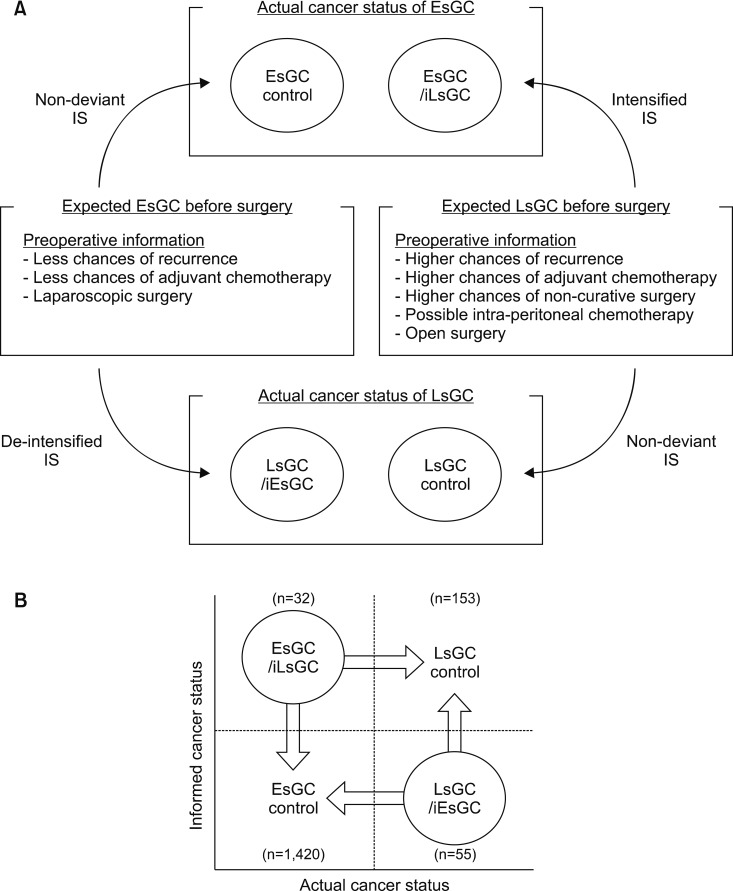
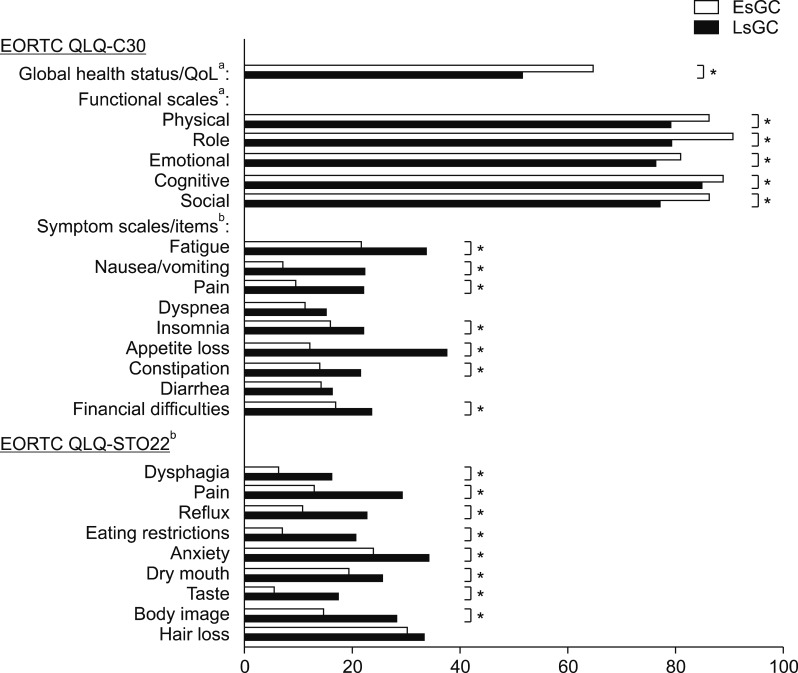
This study assessed preoperative quality of life (QoL) of gastric cancer patients exposed to inconsistent illness information by pre-post-operative stage discordance. The impact of information-stressors on patients' QoL was investigated to determine information processing as a potential target for QoL management. Early-stage gastric cancer (EsGC) and late-stage gastric cancer (LsGC) groups based on their final stage were categorized by the consistency of preoperative staging information that was being shared. Those with consistent preoperative staging information were rated as EsGC (n=1,420) and LsGC (n=153) controls. EsGC and LsGC patients with misdirected information about their LsGC and EsGC were categorized as EsGC/iLsGC (n=32) and LsGC/iEsGC (n=55), respectively. Preoperative QoL data was obtained using EORTC QLQ-C30 and -STO22. QoL outcomes of EsGC/iLsGC and LsGC/iEsGC were compared with those of the EsGC and LsGC controls. QoL outcomes of the EsGC/iLsGC group matched that of EsGC control, but were significantly better than those of LsGC control on multiple scales including global health status/QoL, physical/role/social-functioning, and ten symptom scales/items. On the other hand, QoL outcomes of LsGC/iEsGC group were significantly better than those of LsGC control on multiple scales (global health status/QoL, physical/role-functioning, and nine symptom scales/items) while they roughly matched with those of EsGC control. Intensified information-stressors did not exacerbate QoL beyond the influence of the patients' medical condition, while de-intensified information-stressor improved QoL. Fear of negatively impacting QoL should not prevent the sharing of stressful illness information. As the de-intensified information-stressor improves QoL, information processing is recommended as a potential target for QoL management in cancer patients.
本研究通过术前术后分期不一致评估了接触不一致疾病信息的胃癌患者的术前生活质量(QoL)。研究了信息压力源对患者生活质量的影响,以确定信息处理作为生活质量管理的潜在目标。根据最终分期,将早期胃癌(EsGC)和晚期胃癌(LsGC)组按照术前分期信息的一致性进行分类。术前分期信息一致的患者被评为EsGC(n = 1420)和LsGC(n = 153)对照组。关于其LsGC和EsGC信息误导的EsGC和LsGC患者分别归类为EsGC/iLsGC(n = 32)和LsGC/iEsGC(n = 55)。术前生活质量数据使用欧洲癌症研究与治疗组织(EORTC)QLQ - C30和 - STO22获得。将EsGC/iLsGC和LsGC/iEsGC的生活质量结果与EsGC和LsGC对照组的结果进行比较。EsGC/iLsGC组的生活质量结果与EsGC对照组匹配,但在包括总体健康状况/生活质量、身体/角色/社会功能以及十个症状量表/项目在内的多个量表上显著优于LsGC对照组。另一方面,LsGC/iEsGC组的生活质量结果在多个量表(总体健康状况/生活质量、身体/角色功能以及九个症状量表/项目)上显著优于LsGC对照组,而它们大致与EsGC对照组匹配。强化的信息压力源在患者病情影响之外并未加剧生活质量,而弱化的信息压力源改善了生活质量。担心对生活质量产生负面影响不应阻止分享压力性疾病信息。由于弱化的信息压力源改善了生活质量,建议将信息处理作为癌症患者生活质量管理的潜在目标。