Discipline of Pharmacology, School of Medical Sciences, University of Adelaide, Adelaide, Australia.
J Neurochem. 2012 Sep;122(5):976-94. doi: 10.1111/j.1471-4159.2012.07833.x. Epub 2012 Jul 9.
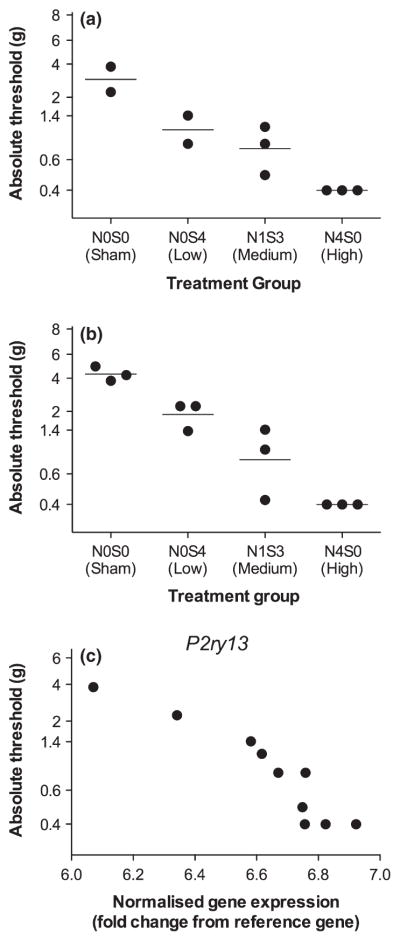
A quantitative, peripherally accessible biomarker for neuropathic pain has great potential to improve clinical outcomes. Based on the premise that peripheral and central immunity contribute to neuropathic pain mechanisms, we hypothesized that biomarkers could be identified from the whole blood of adult male rats, by integrating graded chronic constriction injury (CCI), ipsilateral lumbar dorsal quadrant (iLDQ) and whole blood transcriptomes, and pathway analysis with pain behavior. Correlational bioinformatics identified a range of putative biomarker genes for allodynia intensity, many encoding for proteins with a recognized role in immune/nociceptive mechanisms. A selection of these genes was validated in a separate replication study. Pathway analysis of the iLDQ transcriptome identified Fcγ and Fcε signaling pathways, among others. This study is the first to employ the whole blood transcriptome to identify pain biomarker panels. The novel correlational bioinformatics, developed here, selected such putative biomarkers based on a correlation with pain behavior and formation of signaling pathways with iLDQ genes. Future studies may demonstrate the predictive ability of these biomarker genes across other models and additional variables.
一种定量的、可用于外周的神经病理性疼痛生物标志物具有改善临床结果的巨大潜力。基于外周和中枢免疫有助于神经病理性疼痛机制的前提,我们假设通过整合分级慢性缩窄性损伤(CCI)、同侧腰椎背象限(iLDQ)和全血转录组以及疼痛行为的通路分析,从成年雄性大鼠的全血中可以鉴定出生物标志物。相关性生物信息学确定了一系列用于评估痛觉过敏强度的潜在生物标志物基因,其中许多基因编码在免疫/伤害感受机制中具有公认作用的蛋白质。这些基因中的一部分在单独的复制研究中得到了验证。iLDQ 转录组的通路分析确定了 Fcγ 和 Fcε 信号通路等。本研究首次采用全血转录组来鉴定疼痛生物标志物谱。这里开发的新相关性生物信息学方法是根据与疼痛行为的相关性以及与 iLDQ 基因形成的信号通路来选择这些潜在生物标志物的。未来的研究可能会证明这些生物标志物基因在其他模型和其他变量中的预测能力。