Department of Physiology, Division of Cardiovascular Medicine, University of Kentucky, A. B. Chandler Medical Center, Lexington, KY 40536, U.S.A.
Biosci Rep. 2012 Oct;32(5):479-90. doi: 10.1042/BSR20120036.
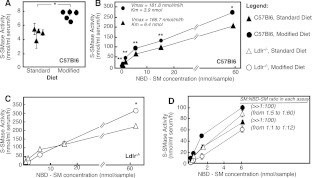
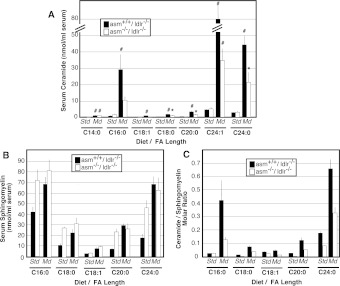
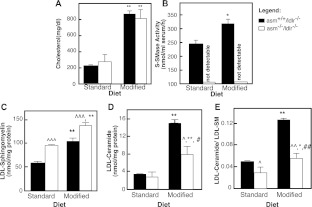
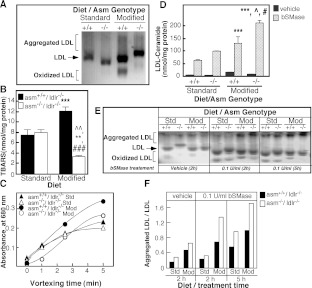
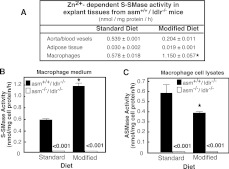
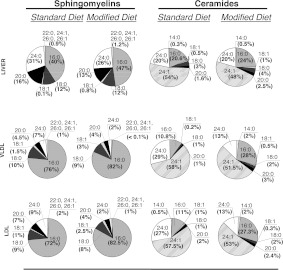
The propensity of LDLs (low-density lipoproteins) for aggregation and/or oxidation has been linked to their sphingolipid content, specifically the levels of SM (sphingomyelin) and ceramide. To investigate this association in vivo, ldlr (LDL receptor)-null mice (ldlr-/-) were fed on a modified (atherogenic) diet containing saturated fats and cholesterol. The diet led to significantly elevated SM content in all serum lipoproteins. In contrast, ceramide increased only in the LDL particles. MS-based analyses of the lipid acyl chain composition revealed a marked elevation in C16:0 fatty acid in SM and ceramide, consistent with the prevalence of palmitic acid in the modified diet. The diet also led to increased activity of the S-SMase [secretory SMase (sphingomyelinase)], a protein that is generated by ASMase (acid SMase) and acts on serum LDL. An increased macrophage secretion seemed to be responsible for the elevated S-SMase activity. ASMase-deficient mice (asm-/-/ldlr-/-) lacked S-SMase activity and were protected from diet-induced elevation in LDL ceramide. LDL from asm-/-/ldlr-/- mice fed on the modified diet were less aggregated and oxidized than LDL from asm+/+/ldlr-/- mice. When tested in vitro, the propensity for aggregation was dependent on the SM level: only LDL from animals on modified diet that have high SM content aggregated when treated with recombinant S-SMase. In conclusion, LDL-SM content and S-SMase activity are up-regulated in mice fed on an atherogenic diet. S-SMase mediates diet-induced changes in LDL ceramide content and aggregation. S-SMase effectiveness in inducing aggregation is dependent on diet-induced enrichment of LDL with SM, possibly through increased hepatic synthesis.
LDLs(低密度脂蛋白)的聚集和/或氧化倾向与其鞘脂含量有关,特别是鞘氨醇(SM)和神经酰胺的水平。为了在体内研究这种相关性,用含有饱和脂肪和胆固醇的改良(动脉粥样硬化)饮食喂养 LDLR(LDL 受体)缺失小鼠(ldlr-/-)。饮食导致所有血清脂蛋白中的 SM 含量显著升高。相比之下,神经酰胺仅在 LDL 颗粒中增加。基于 MS 的脂质酰链组成分析显示,SM 和神经酰胺中的 C16:0 脂肪酸显著升高,与改良饮食中棕榈酸的普遍存在一致。饮食还导致 S-SMase [分泌型 SMase(鞘氨醇酶)] 的活性增加,该蛋白由 ASMase(酸性 SMase)产生,作用于血清 LDL。增加的巨噬细胞分泌似乎是导致 S-SMase 活性升高的原因。缺乏 ASMase 的小鼠(asm-/-/ldlr-/-)缺乏 S-SMase 活性,并且免受饮食诱导的 LDL 神经酰胺升高的影响。用改良饮食喂养的 asm-/-/ldlr-/- 小鼠的 LDL 比 asm+/+/ldlr-/- 小鼠的 LDL 聚集和氧化程度更低。在体外测试时,聚集倾向取决于 SM 水平:只有在用重组 S-SMase 处理时,来自用改良饮食喂养的动物的 LDL 才会聚集,这些动物的 SM 含量高。总之,喂食动脉粥样硬化饮食的小鼠 LDL-SM 含量和 S-SMase 活性上调。S-SMase 介导饮食诱导的 LDL 神经酰胺含量和聚集变化。S-SMase 在诱导聚集中的有效性取决于 LDL 与 SM 的饮食诱导富集,可能通过增加肝合成。