Institute for Integrative Biology, ETH Zurich, 8092 Zurich, Switzerland.
BMC Evol Biol. 2012 Jun 21;12:93. doi: 10.1186/1471-2148-12-93.
Antagonistic species interactions can lead to coevolutionary genotype or phenotype frequency oscillations, with important implications for ecological and evolutionary processes. However, direct empirical evidence of such oscillations is rare. The rarity of observations is generally attributed to inherent difficulties of ecological and evolutionary long-term studies, to weak or absent interaction between species, or to the absence of negative frequency-dependence.
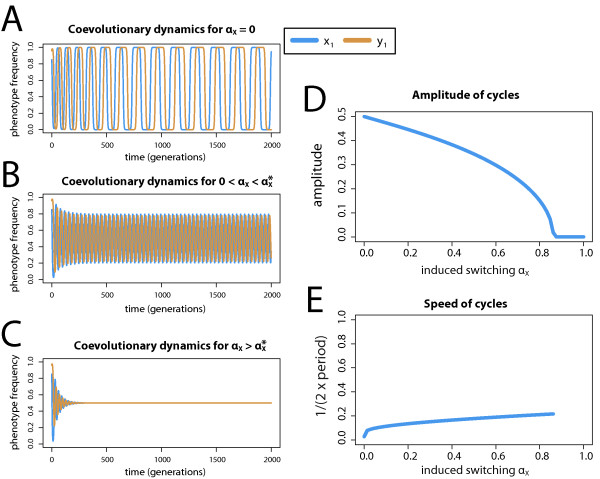
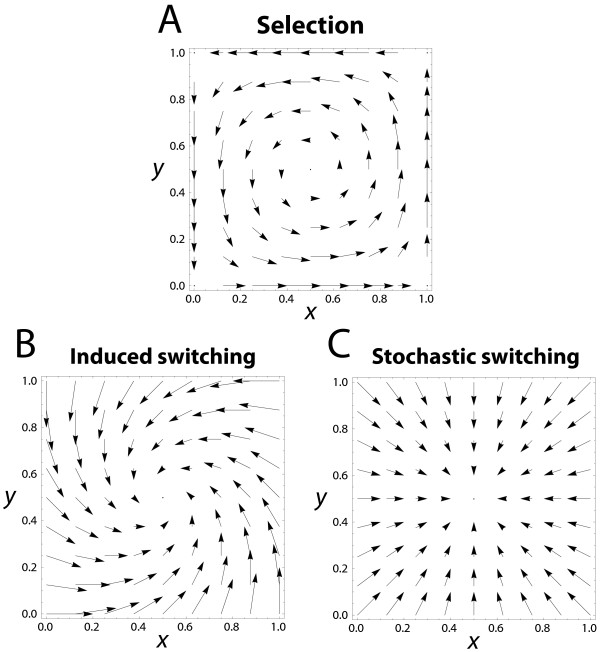
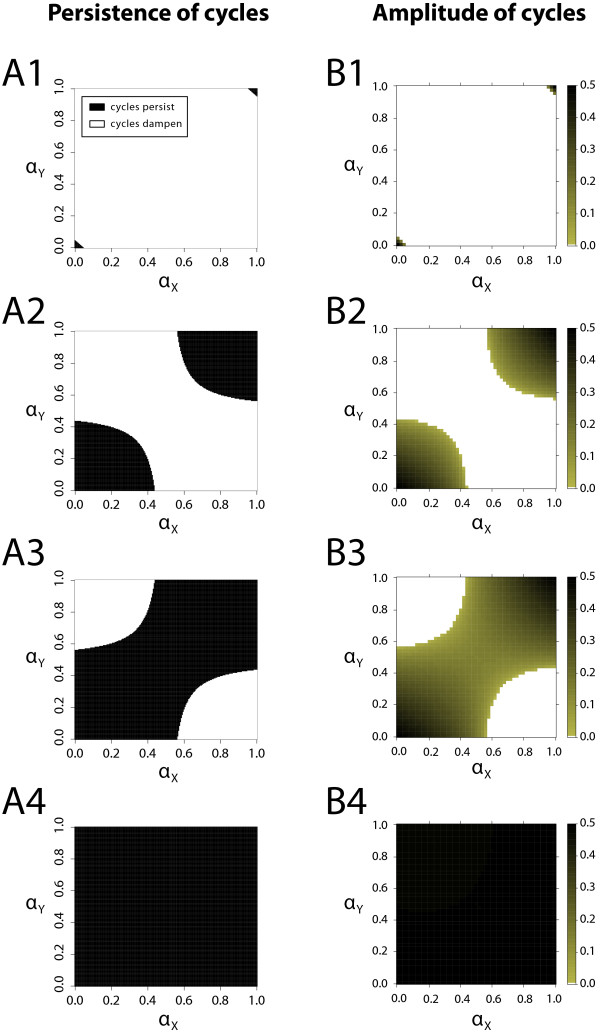
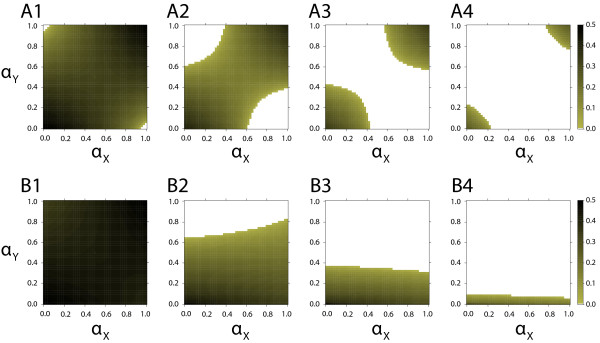
Here, we show that another factor - non-genetic inheritance, mediated for example by epigenetic mechanisms - can completely eliminate oscillations in the presence of such negative frequency dependence, even if only a small fraction of offspring are affected. We analytically derive the threshold value of this fraction at which the dynamics change from oscillatory to stable, and investigate how selection, mutation and generation times differences between the two species affect the threshold value. These results strongly suggest that the lack of phenotype frequency oscillations should not be attributed to the lack of strong interactions between antagonistic species.
Given increasing evidence of non-genetic effects on the outcomes of antagonistic species interactions, we suggest that these effects should be incorporated into ecological and evolutionary models of interacting species.
对抗性物种相互作用可能导致协同进化的基因型或表型频率振荡,这对生态和进化过程具有重要意义。然而,这种振荡的直接经验证据很少。观察的罕见通常归因于生态和进化长期研究固有的困难,物种之间的相互作用较弱或不存在,或者不存在负频率依赖性。
在这里,我们表明,另一个因素 - 非遗传继承,例如通过表观遗传机制介导 - 即使只有一小部分后代受到影响,也可以完全消除存在这种负频率依赖性时的振荡。我们分析得出了这种分数的阈值,在该阈值下,动力学从振荡变为稳定,并且研究了选择,突变和两个物种之间的世代时间差异如何影响阈值。这些结果强烈表明,缺乏表型频率振荡不应归因于对抗性物种之间缺乏强烈相互作用。
鉴于越来越多的证据表明非遗传效应对对抗性物种相互作用的结果有影响,我们建议将这些效应纳入相互作用物种的生态和进化模型中。