Curtin Health Innovation Research Institute and the School of Public Health, Curtin University, Perth, WA, Australia.
BMC Public Health. 2012 Jun 22;12:477. doi: 10.1186/1471-2458-12-477.
Increasing intakes of fruits and vegetables intake, in tandem with reducing consumption of energy-dense and nutrient poor foods and beverages are dietary priorities to prevent chronic disease. Although most adults do not eat enough fruit and vegetables, teenagers and young adults tend to have the lowest intakes. Young adults typically consume a diet which is inconsistent with the dietary recommendations. Yet little is known about the best approaches to improve dietary intakes and behaviours among this group. This randomised controlled trial aims to evaluate the effectiveness of using a mobile device to assess dietary intake, provide tailored dietary feedback and text messages to motivate changes in fruit, vegetable and junk food consumption among young adults.
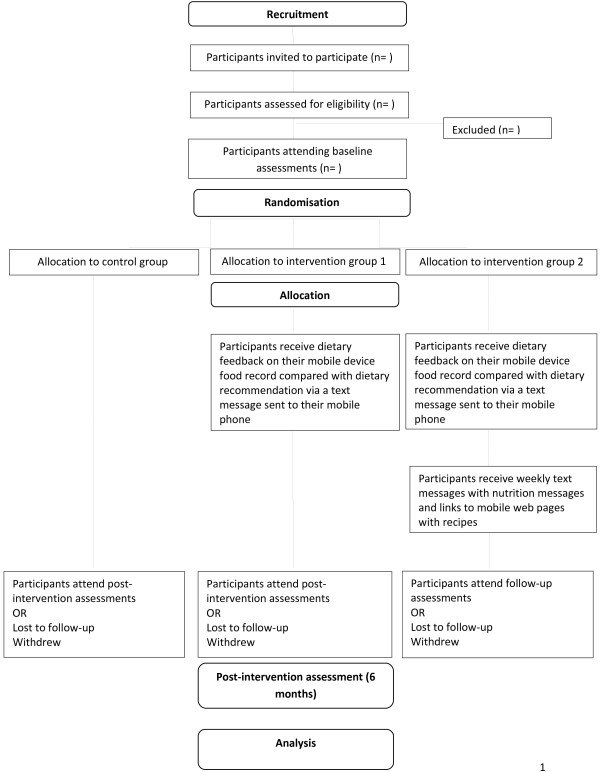
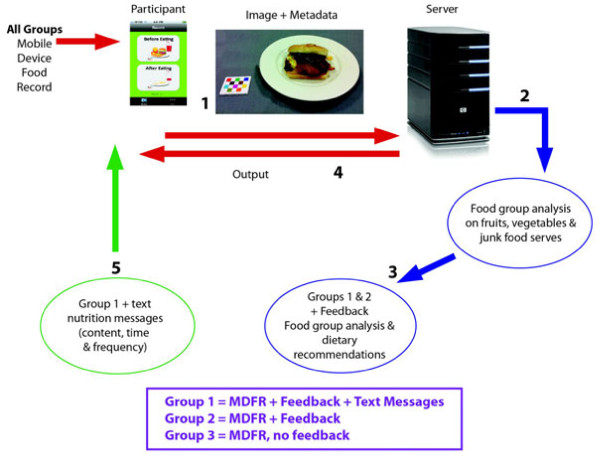
METHODS/DESIGN: The CHAT project will involve the development of the mobile device food record (MDFR), and evaluation of dietary feedback and implementation of a 6-month intervention in young adults aged 18 to 30 years. The participants will be randomly assigned to one of three groups (1) Intervention Group 1: MDFR + Text Messages + Dietary Feedback; (2) Intervention Group 2: MDFR + Dietary Feedback; (3) Control Group 3: MDFR, no feedback. All groups will undertake a 3-day dietary record using the MDFR but only the Intervention Groups 1 and 2 will receive tailored dietary feedback at baseline and at 6-months which will consist of assessment of serves of fruits, vegetables and junk food in comparison to dietary recommendations. Tailored nutrition text messages will be sent to Intervention Group 1 over the 6 months. Data will be collected at baseline and again at the 6-month completion.
This trial will test if applications running on mobile devices have potential to assess diet, provide tailored feedback and nutrition messages as an effective way of improving fruit and vegetable consumption and reducing energy-dense nutrient poor foods in young adults. The CHAT project will assess the impact of the intervention on behavioural intention to eat a more healthful diet. This innovative approach if successful may provide a means to deliver a low cost health promotion program that has the potential to reach large groups, particularly young adults.
Australian and New Zealand Clinical Trials Registry ACTRN12612000250831.
增加水果和蔬菜的摄入量,同时减少能量密集型和营养贫乏型食物和饮料的摄入,是预防慢性病的饮食重点。尽管大多数成年人的水果和蔬菜摄入量不足,但青少年和年轻人的摄入量往往最低。年轻人通常的饮食与饮食建议不一致。然而,对于改善这一人群的饮食摄入和行为,我们知之甚少。这项随机对照试验旨在评估使用移动设备评估饮食摄入、提供针对性饮食反馈和发送短信以激励年轻人增加水果、蔬菜和垃圾食品摄入量的有效性。
方法/设计:CHAT 项目将涉及开发移动设备食物记录(MDFR),并评估饮食反馈和在 18 至 30 岁的年轻人中实施 6 个月的干预措施。参与者将被随机分配到三个组之一:(1)干预组 1:MDFR+短信+饮食反馈;(2)干预组 2:MDFR+饮食反馈;(3)对照组 3:MDFR,无反馈。所有组将使用 MDFR 进行为期 3 天的饮食记录,但只有干预组 1 和 2 将在基线和 6 个月时收到针对水果、蔬菜和垃圾食品份量的量身定制的饮食反馈,这些反馈将与饮食建议进行比较。在 6 个月期间,将向干预组 1 发送定制的营养短信。数据将在基线和 6 个月完成时收集。
本试验将测试运行在移动设备上的应用程序是否有可能评估饮食、提供针对性的反馈和营养信息,作为改善年轻人水果和蔬菜摄入、减少能量密集型和营养贫乏型食物的有效方法。CHAT 项目将评估干预对更健康饮食行为意向的影响。如果这种创新方法取得成功,它可能为提供低成本的健康促进计划提供一种手段,有可能覆盖到大量人群,尤其是年轻人。
澳大利亚和新西兰临床试验注册 ACTRN12612000250831。