Department of Agrotechnology and Food Sciences, Division of Human Nutrition and Health, Wageningen University and Research, 6700 AA Wageningen, The Netherlands.
Nutrients. 2022 Mar 9;14(6):1156. doi: 10.3390/nu14061156.
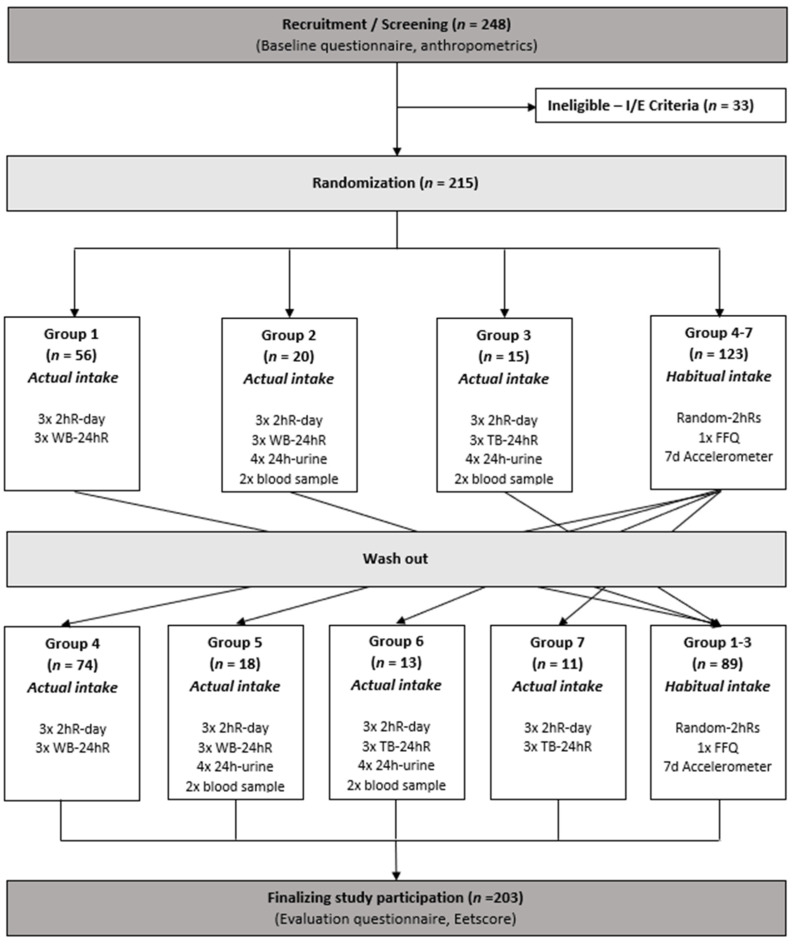
During recent years, the integration of technology has substantially improved self-reported dietary assessment methods, such as food frequency questionnaires (FFQ), food records, and 24-h recalls. To further reduce measurement error, additional innovations are urgently needed. Memory-related measurement error is one of the aspects that warrants attention, which is where new smartphone technologies and ecological momentary assessment (EMA) approaches provide a unique opportunity. In this article, we describe the DIASS study, which was designed to evaluate an innovative 2-h recall (2hR) smartphone-based methodology, against traditional 24-h recalls, FFQ, and biomarkers, to assess both actual and habitual dietary intake. It is hypothesized that a 2-h reporting window decreases reliance on memory and reporting burden, and increases data accuracy. We included 215 men (28%) and women (72%), with a mean ± SD age of 39 ± 19 years and a mean ± SD BMI of 23.8 ± 4.0. Most participants were highly educated (58%). Response rates for the various dietary assessment methods were >90%. Besides the evaluation of the accuracy, usability, and perceived burden of the 2hR methodology, the study set-up also allows for (further) evaluation of the other administrated dietary assessment tools.
近年来,技术的融合极大地改进了自我报告的饮食评估方法,如食物频率问卷 (FFQ)、食物记录和 24 小时回忆。为了进一步减少测量误差,迫切需要更多的创新。与记忆相关的测量误差是需要注意的一个方面,这正是新的智能手机技术和生态瞬时评估 (EMA) 方法提供独特机会的地方。在本文中,我们描述了 DIASS 研究,该研究旨在评估一种创新的 2 小时回忆 (2hR) 智能手机方法,该方法与传统的 24 小时回忆、FFQ 和生物标志物相结合,评估实际和习惯性的饮食摄入。研究假设 2 小时的报告窗口减少了对记忆的依赖和报告负担,并提高了数据的准确性。我们纳入了 215 名男性 (28%) 和女性 (72%),平均年龄 ± 标准差为 39 ± 19 岁,平均 BMI ± 标准差为 23.8 ± 4.0。大多数参与者受教育程度较高 (58%)。各种饮食评估方法的应答率>90%。除了评估 2hR 方法的准确性、可用性和感知负担外,该研究还允许 (进一步) 评估其他管理的饮食评估工具。