
连接健康与技术研究:一项为期6个月的随机对照试验,旨在通过移动食物记录和短信支持改善年轻人的营养行为。
The connecting health and technology study: a 6-month randomized controlled trial to improve nutrition behaviours using a mobile food record and text messaging support in young adults.
作者信息
Kerr Deborah A, Harray Amelia J, Pollard Christina M, Dhaliwal Satvinder S, Delp Edward J, Howat Peter A, Pickering Mark R, Ahmad Ziad, Meng Xingqiong, Pratt Iain S, Wright Janine L, Kerr Katherine R, Boushey Carol J
机构信息
School of Public Health, Curtin University, GPO Box U1987, Bentley, Perth, WA, 6845, Australia.
Public Health Division, Department of Health In Western Australia, 189 Royal Street, East Perth, 6004, WA, Australia.
出版信息
Int J Behav Nutr Phys Act. 2016 Apr 21;13:52. doi: 10.1186/s12966-016-0376-8.
BACKGROUND
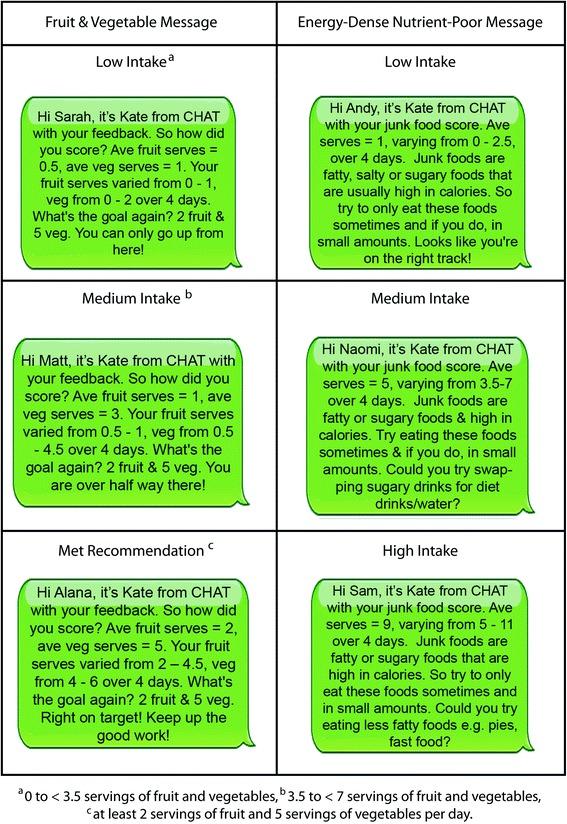
Early adulthood represents the transition to independent living which is a period when changes in diet and body weight are likely to occur. This presents an ideal time for health interventions to reduce the effect of health problems and risk factors for chronic disease in later life. As young adults are high users of mobile devices, interventions that use this technology may improve engagement. The Connecting Health and Technology study aimed to evaluate the effectiveness of tailored dietary feedback and weekly text messaging to improve dietary intake of fruit, vegetables and junk food over 6 months among a population-based sample of men and women (aged 18-30 years).
METHODS
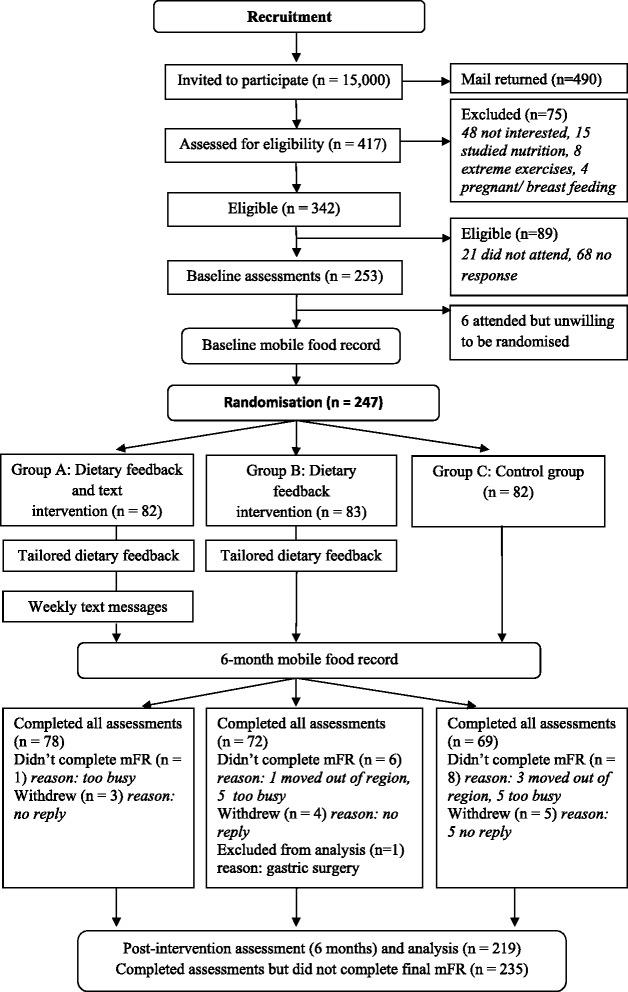
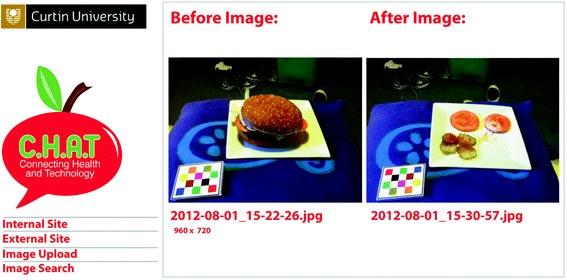
A three-arm, parallel, randomized control trial was conducted. After baseline assessments, participants were randomized to one of three groups: A) dietary feedback and weekly text messages, B) dietary feedback only or C) control group. Dietary intake was assessed using a mobile food record App (mFR) where participants captured images of foods and beverages consumed over 4-days at baseline and post-intervention. The primary outcomes were changes in serves of fruits, vegetables, energy-dense nutrient-poor (EDNP) foods and sugar-sweetened beverages (SSB). The intervention effects were assessed using linear mixed effect models for change in food group serves.
RESULTS
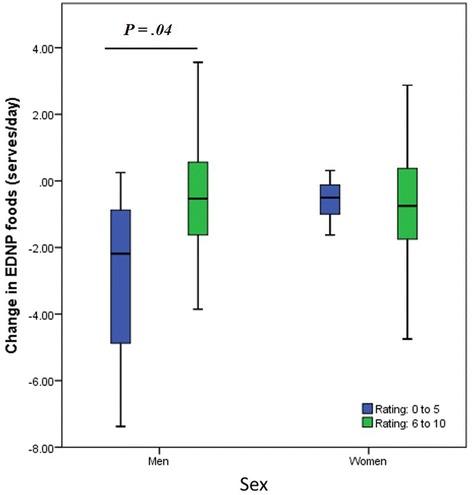
Young adults (n = 247) were randomized to group A (n = 82), group B (n = 83), or group C (n = 82). Overall, no changes in food group serves for either intervention groups were observed. An unanticipated outcome was a mean weight reduction of 1.7 kg (P = .02) among the dietary feedback only. Men who received dietary feedback only, significantly reduced their serves of EDNP foods by a mean of 1.4 serves/day (P = .02). Women who received dietary feedback only significantly reduced their intake of SSB (P = .04) by an average of 0.2 serves/day compared with controls.
CONCLUSIONS
Tailored dietary feedback only resulted in a decrease in EDNP foods in men and SSB in women, together with a reduction in body weight. Using a mobile food record for dietary assessment and tailored feedback has great potential for future health promotion interventions targeting diet and weight in young adults.
TRIAL REGISTRATION
Australian Clinical Trials Registry Registration number: ACTRN12612000250831 .
背景
成年早期是向独立生活过渡的阶段,在此期间饮食和体重可能会发生变化。这是进行健康干预以减少晚年健康问题和慢性病风险因素影响的理想时机。由于年轻人是移动设备的高用户,利用这项技术的干预措施可能会提高参与度。“连接健康与技术”研究旨在评估量身定制的饮食反馈和每周短信提醒对改善18至30岁的男性和女性人群样本在6个月内水果、蔬菜和垃圾食品的饮食摄入量的有效性。
方法
进行了一项三臂平行随机对照试验。在基线评估后,参与者被随机分为三组之一:A组)饮食反馈和每周短信提醒;B组)仅饮食反馈;C组)对照组。使用移动食物记录应用程序(mFR)评估饮食摄入量,参与者在基线和干预后拍摄4天内食用的食物和饮料的照片。主要结局是水果、蔬菜、能量密集型营养缺乏(EDNP)食物和含糖饮料(SSB)的摄入量变化。使用线性混合效应模型评估食物组摄入量变化的干预效果。
结果
247名年轻人被随机分为A组(n = 82)、B组(n = 83)或C组(n = 82)。总体而言,两个干预组的食物组摄入量均未观察到变化。一个意外的结果是,仅接受饮食反馈的人群平均体重减轻了1.7千克(P = 0.02)。仅接受饮食反馈的男性显著减少了EDNP食物的摄入量,平均每天减少1.4份(P = 0.02)。与对照组相比,仅接受饮食反馈的女性显著减少了SSB的摄入量(P = 0.04),平均每天减少0.2份。
结论
仅量身定制的饮食反馈导致男性的EDNP食物和女性的SSB减少,同时体重减轻。使用移动食物记录进行饮食评估和量身定制的反馈对于未来针对年轻人饮食和体重的健康促进干预具有巨大潜力。
试验注册
澳大利亚临床试验注册中心注册号:ACTRN12612000250831 。
 Zotero 插件