Centre on Behavioral Health, The University of Hong Kong, China.
Ann Behav Med. 2012 Oct;44(2):160-70. doi: 10.1007/s12160-012-9381-6.
Chronic fatigue is common in the general population. Complementary therapies are often used by patients with chronic fatigue or chronic fatigue syndrome to manage their symptoms.
This study aimed to assess the effect of a 4-month qigong intervention program among patients with chronic fatigue or chronic fatigue syndrome.
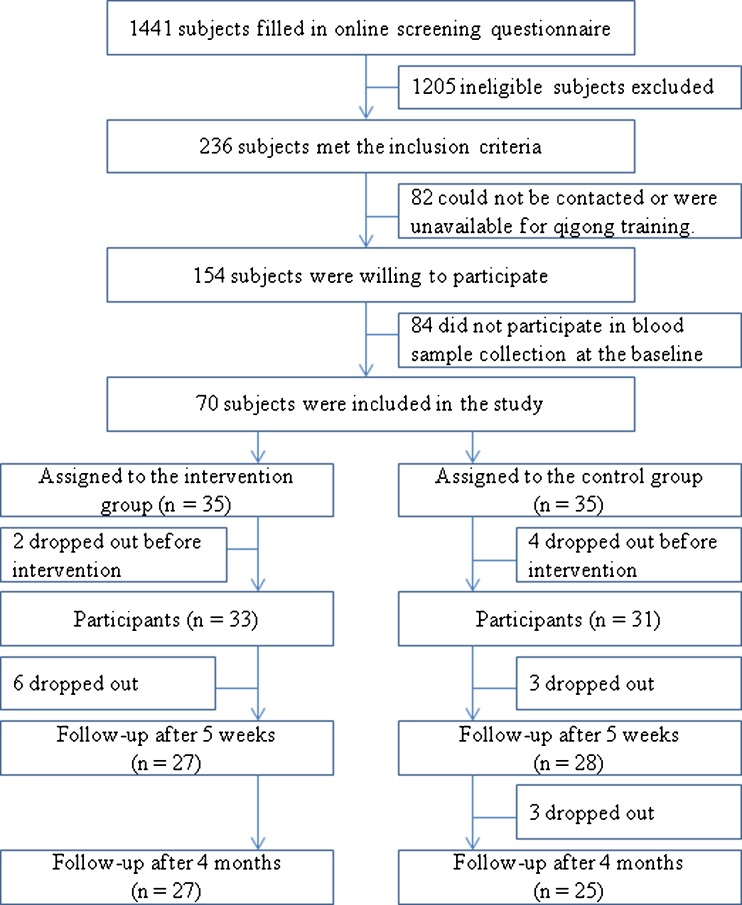
Sixty-four participants were randomly assigned to either an intervention group or a wait list control group. Outcome measures included fatigue symptoms, physical functioning, mental functioning, and telomerase activity.
Fatigue symptoms and mental functioning were significantly improved in the qigong group compared to controls. Telomerase activity increased in the qigong group from 0.102 to 0.178 arbitrary units (p < 0.05). The change was statistically significant when compared to the control group (p < 0.05).
Qigong exercise may be used as an alternative and complementary therapy or rehabilitative program for chronic fatigue and chronic fatigue syndrome.
慢性疲劳在普通人群中很常见。患有慢性疲劳或慢性疲劳综合征的患者常采用补充疗法来缓解症状。
本研究旨在评估气功干预方案对慢性疲劳或慢性疲劳综合征患者的影响。
64 名参与者被随机分配到干预组或候补名单对照组。评估指标包括疲劳症状、身体机能、心理机能和端粒酶活性。
与对照组相比,气功组的疲劳症状和心理机能显著改善。气功组的端粒酶活性从 0.102 增加到 0.178 个任意单位(p<0.05)。与对照组相比,这一变化具有统计学意义(p<0.05)。
气功锻炼可以作为慢性疲劳和慢性疲劳综合征的替代和补充疗法或康复方案。