School of Nursing, Li Ka Shing Faculty of Medicine, University of Hong Kong, Hong Kong, China.
School of Biomedical Sciences, Li Ka Shing Faculty of Medicine, University of Hong Kong, Hong Kong, China.
JAMA Netw Open. 2019 Jan 4;2(1):e186967. doi: 10.1001/jamanetworkopen.2018.6967.
Qigong is a mind-body exercise that may be an effective self-care intervention for improving the well-being of women survivors of intimate partner violence.
To test whether a qigong intervention would increase telomerase activity and improve mental health in Chinese women who survived intimate partner violence.
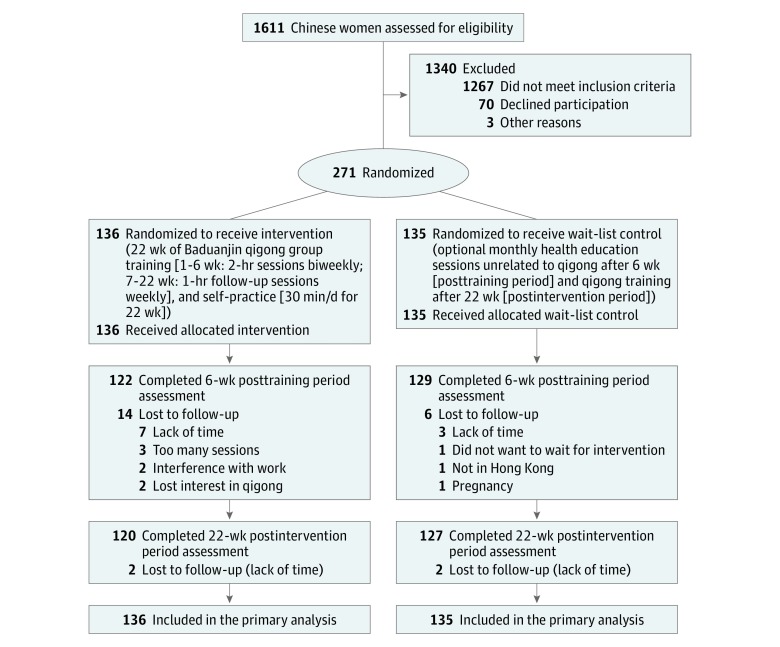
DESIGN, SETTING, AND PARTICIPANTS: A single-blind randomized clinical trial among Chinese women (N = 271) who survived intimate partner violence in the past 2 years recruited from a community center in Hong Kong, China. The trial was conducted from March 12, 2014, to May 26, 2016. Data analysis was by intention to treat and performed from June 7 to August 24, 2018.
Randomization (1:1) to a 22-week qigong intervention (n = 136) that included 22 weeks of Baduanjin qigong group training (1-6 weeks: 2-hour sessions biweekly; 7-22 weeks: 1-hour follow-up sessions weekly) and self-practice (30 minutes per day for 22 weeks) or to a wait-list control group (n = 135) that received optional monthly health education sessions unrelated to qigong after 6 weeks (posttraining period) and qigong training after 22 weeks (postintervention period).
The primary outcome was telomerase activity in peripheral blood mononuclear cells. The secondary outcomes included levels of proinflammatory cytokines (tumor necrosis factor and interleukin 6) in peripheral blood plasma, depressive symptoms (Beck Depression Inventory II score; score range, 0-63; higher scores represent more severe depressive symptoms), perceived stress (Perceived Stress Scale; score range, 0-40; higher scores represent higher stress), and perceived coping (Perceived Coping Scale; score range, 0-13; higher scores represent use of more coping strategies).
From 1611 Chinese women screened (mean [SD] age, 42.0 [8.8] years), 247 of 271 randomized participants completed the study (intervention group, 120; wait-list control group, 127). Telomerase activity of the intervention group participants after 22 weeks was not significantly different from that of the wait-list control group participants (5.18 U [95% CI, 5.05-5.31 U] in the intervention group vs 5.14 U [95% CI, 5.01-5.27 U] in the wait-list control group; P = .66). The mean change in telomerase activity from baseline was marginally significant in the intervention group (effect size [d], 0.13; 95% CI, 0.001-0.27) but not in the wait-list control group (d, -0.03; 95% CI, -0.16 to 0.10). Perceived stress and depressive symptoms were significantly lower in the intervention group than in the wait-list control group after 6 weeks (between-group differences: perceived stress: d, -1.81; 95% CI, -3.27 to -0.34; depressive symptoms: d, -3.57; 95% CI, -6.25 to -0.90), but not after 22 weeks (between-group differences: perceived stress: d, -1.03; 95% CI, -2.50 to 0.43; depressive symptoms: d, -1.78; 95% CI, -4.26 to 0.70).
The findings of this study do not support a significant benefit of Baduanjin qigong on telomerase activity in women who have survived intimate partner violence. However, outcomes related to mental health seem to be improved, which should be confirmed by additional studies.
ClinicalTrials.gov Identifier: NCT02060123.
气功是一种身心锻炼方法,可能是改善女性亲密伴侣暴力幸存者幸福感的有效自我保健干预措施。
测试气功干预是否会增加端粒酶活性并改善经历过亲密伴侣暴力的中国女性的心理健康。
设计、设置和参与者:这是一项在中国香港社区中心招募的经历过亲密伴侣暴力的中国女性(N=271)的单盲随机临床试验。该试验于 2014 年 3 月 12 日至 2016 年 5 月 26 日进行。数据分析采用意向治疗,并于 2018 年 6 月 7 日至 8 月 24 日进行。
随机(1:1)分配到 22 周的气功干预组(n=136),包括 22 周的八段锦气功组训练(1-6 周:每两周 2 小时课程;7-22 周:每周 1 小时随访课程)和自我练习(每天 30 分钟,共 22 周)或等待名单对照组(n=135),他们在 6 周后(培训后期间)接受可选的每月与气功无关的健康教育课程,在 22 周后(干预后期间)接受气功培训。
主要结果是外周血单核细胞中的端粒酶活性。次要结果包括外周血浆中促炎细胞因子(肿瘤坏死因子和白细胞介素 6)水平、抑郁症状(贝克抑郁量表 II 评分;评分范围为 0-63;分数越高表示抑郁症状越严重)、感知压力(感知压力量表;评分范围为 0-40;分数越高表示压力越大)和感知应对策略(感知应对量表;评分范围为 0-13;分数越高表示使用的应对策略越多)。
从 1611 名接受筛查的中国女性中(平均[SD]年龄,42.0[8.8]岁),271 名随机参与者中有 247 名完成了研究(干预组 120 名;等待名单对照组 127 名)。22 周后,干预组参与者的端粒酶活性与等待名单对照组参与者的端粒酶活性无显著差异(干预组 5.18 U [95%CI,5.05-5.31 U]与等待名单对照组 5.14 U [95%CI,5.01-5.27 U];P=0.66)。干预组的端粒酶活性从基线的平均变化在统计学上具有显著意义(效应大小[d],0.13;95%CI,0.001-0.27),但等待名单对照组则没有(d,-0.03;95%CI,-0.16 至 0.10)。6 周后,干预组的感知压力和抑郁症状明显低于等待名单对照组(组间差异:感知压力:d,-1.81;95%CI,-3.27 至-0.34;抑郁症状:d,-3.57;95%CI,-6.25 至-0.90),但 22 周后则没有(组间差异:感知压力:d,-1.03;95%CI,-2.50 至 0.43;抑郁症状:d,-1.78;95%CI,-4.26 至 0.70)。
这项研究的结果不支持八段锦气功对经历过亲密伴侣暴力的女性端粒酶活性的显著益处。然而,与心理健康相关的结果似乎有所改善,这需要通过进一步的研究来证实。
ClinicalTrials.gov 标识符:NCT02060123。