Department of Biological Sciences, Dartmouth College, Hanover, NH 03755, USA.
Nutr J. 2012 Jun 29;11:45. doi: 10.1186/1475-2891-11-45.
Dietary factors such as folate, vitamin B12, protein, and methionine are important for the excretion of arsenic via one-carbon metabolism in undernourished populations exposed to high levels of arsenic via drinking water. However, the effects of dietary factors on toenail arsenic concentrations in well-nourished populations exposed to relatively low levels of water arsenic are unknown.
As part of a population-based case-control study of skin and bladder cancer from the USA, we evaluated relationships between consumption of dietary factors and arsenic concentrations in toenail clippings. Consumption of each dietary factor was determined from a validated food frequency questionnaire. We used general linear models to examine the associations between toenail arsenic and each dietary factor, taking into account potentially confounding effects.
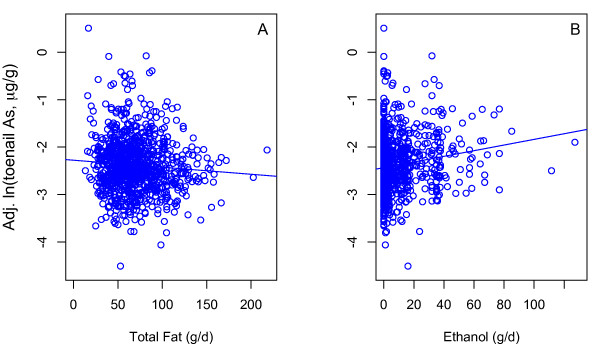
As expected, we found an inverse association between ln-transformed toenail arsenic and consumption of vitamin B12 (excluding supplements) and animal protein. Unexpectedly, there were also inverse associations with numerous dietary lipids (e.g., total fat, total animal fat, total vegetable fat, total monounsaturated fat, total polyunsaturated fat, and total saturated fat). Finally, increased toenail arsenic concentrations were associated with increased consumption of long chain n-3 fatty acids.
In a relatively well-nourished population exposed to relatively low levels of arsenic via water, consumption of certain dietary lipids may decrease toenail arsenic concentration, while long chain n-3 fatty acids may increase toenail arsenic concentration, possibly due to their association with arsenolipids in fish tissue.
在因饮用水摄入高浓度砷而处于营养匮乏状态的人群中,通过一碳代谢途径排泄砷,需要膳食因素(如叶酸、维生素 B12、蛋白质和蛋氨酸)的参与。然而,在摄入低浓度水砷的营养良好人群中,膳食因素对趾甲砷浓度的影响尚不清楚。
本研究在美国开展了一项基于人群的皮肤癌和膀胱癌病例对照研究,我们评估了膳食因素的摄入量与趾甲夹中砷浓度之间的关系。通过一份经验证的食物频率问卷来确定每种膳食因素的摄入量。我们使用一般线性模型来检验趾甲砷与每种膳食因素之间的关联,同时考虑潜在的混杂效应。
正如预期的那样,我们发现趾甲砷与维生素 B12(不包括补充剂)和动物蛋白的摄入量呈负相关。出乎意料的是,与多种膳食脂质(如总脂肪、总动物脂肪、总植物脂肪、总单不饱和脂肪、总多不饱和脂肪和总饱和脂肪)也存在负相关。最后,趾甲砷浓度的增加与长链 n-3 脂肪酸的摄入量增加有关。
在通过水摄入相对低浓度砷的营养良好的人群中,某些膳食脂质的摄入可能会降低趾甲砷浓度,而长链 n-3 脂肪酸可能会增加趾甲砷浓度,这可能是由于它们与鱼组织中的砷脂有关。