Lin Pi-I D, Bromage Sabri, Mostofa Md Golam, Allen Joseph, Oken Emily, Kile Molly L, Christiani David C
Department of Environmental Health, Harvard T.H. Chan School of Public Health, Boston, MA 02113, USA.
Research Center for Environmental Medicine, Kaohsiung Medical University, Kaohsiung 80709, Taiwan.
Nutrients. 2017 Apr 23;9(4):420. doi: 10.3390/nu9040420.
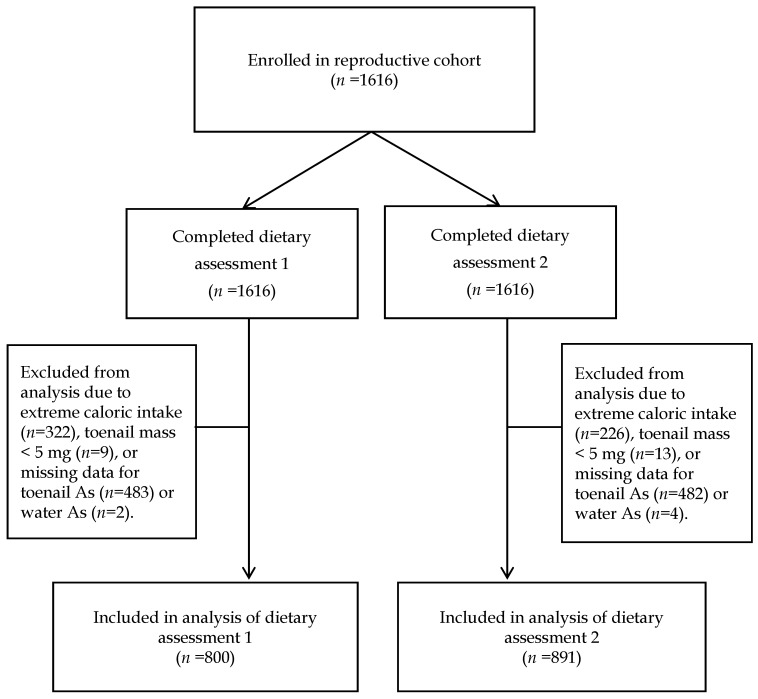
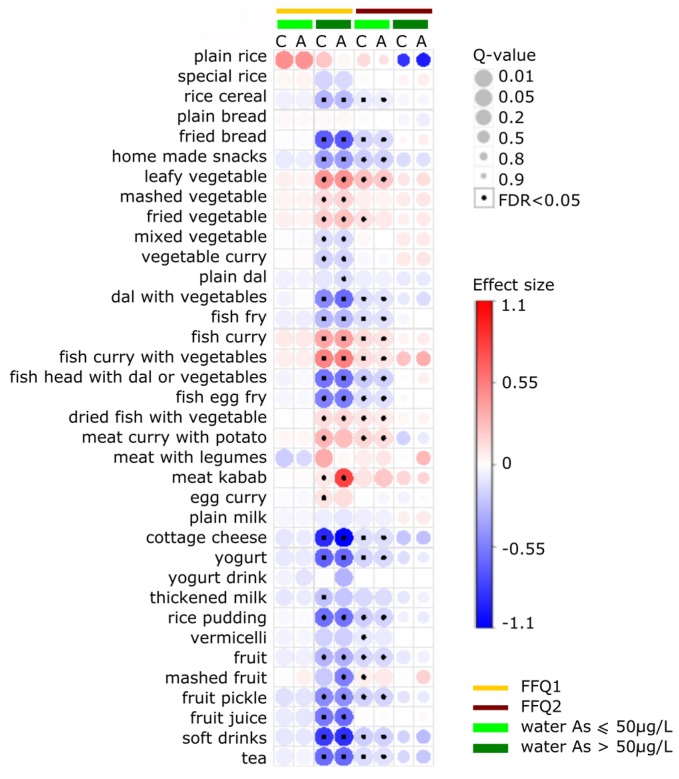
This prospective study evaluated the relationship between long-term dietary habits and total arsenic (As) concentration in toenail clippings in a cohort of 1616 pregnant women in the Bangladeshi administrative regions of Sirajdikhan and Pabna Sadar. Diet was assessed at Gestation Week 28 and at Postpartum Month 1, using a locally-validated dish-based semi-quantitative food-frequency questionnaire. Toenail As concentration was analyzed by microwave-assisted acid digestion and inductively coupled plasma mass spectrometry. Associations between natural log-transformed consumption of individual food items and temporally matched natural log-transformed toenail As concentration were quantified using general linear models that accounted for As concentration in the primary drinking water source and other potential confounders. The analysis was stratified by As in drinking water (≤50 μg/L versus >50 μg/L) and the time of dietary assessment (Gestation Week 28 versus Postpartum Week 1). Interestingly, toenail As was not significantly associated with consumption of plain rice as hypothesized. However, toenail As was positively associated with consumption of several vegetable, fish and meat items and was negatively associated with consumption of rice, cereal, fruits, and milk based food items. Further studies in pregnant women are needed to compare As metabolism at different levels of As exposure and the interaction between dietary composition and As absorption.
这项前瞻性研究评估了孟加拉国锡拉杰迪汗和帕布纳萨达尔行政区1616名孕妇队列中,长期饮食习惯与趾甲剪屑中总砷(As)浓度之间的关系。在妊娠第28周和产后第1个月,使用经过当地验证的基于菜肴的半定量食物频率问卷对饮食进行评估。通过微波辅助酸消解和电感耦合等离子体质谱法分析趾甲中的砷浓度。使用考虑了主要饮用水源中砷浓度和其他潜在混杂因素的一般线性模型,对个体食物自然对数转换后的摄入量与时间匹配的趾甲砷浓度自然对数转换值之间的关联进行量化。分析按饮用水中的砷含量(≤50μg/L与>50μg/L)和饮食评估时间(妊娠第28周与产后第1周)进行分层。有趣的是,趾甲中的砷与假设的白米摄入量没有显著关联。然而,趾甲中的砷与几种蔬菜、鱼类和肉类食物的摄入量呈正相关,与大米、谷物、水果和奶制品的摄入量呈负相关。需要对孕妇进行进一步研究,以比较不同砷暴露水平下的砷代谢以及饮食组成与砷吸收之间的相互作用。