Moitra Subhodeep, Tirupula Kalyan C, Klein-Seetharaman Judith, Langmead Christopher James
Computer Science Department, Carnegie Mellon University, Gates Hillman Center, 5000 Forbes Avenue, Pittsburgh, PA, USA.
Department of Structural Biology, University of Pittsburgh School of Medicine, Rm. 2051, Biomedical Science Tower 3, 3501 Fifth Avenue, Pittsburgh, PA, USA.
BMC Biophys. 2012 Jun 29;5:13. doi: 10.1186/2046-1682-5-13.
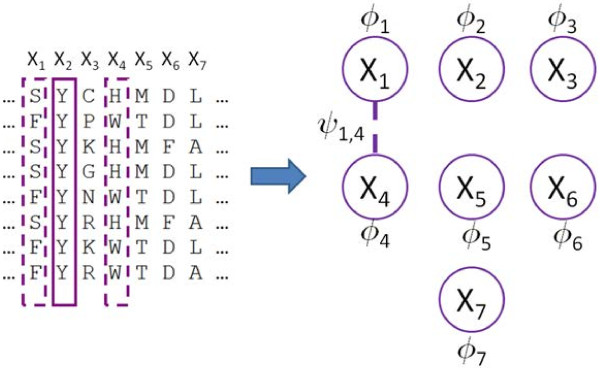
G protein coupled receptors (GPCRs) are seven helical transmembrane proteins that function as signal transducers. They bind ligands in their extracellular and transmembrane regions and activate cognate G proteins at their intracellular surface at the other side of the membrane. The relay of allosteric communication between the ligand binding site and the distant G protein binding site is poorly understood. In this study, GREMLIN 1, a recently developed method that identifies networks of co-evolving residues from multiple sequence alignments, was used to identify those that may be involved in communicating the activation signal across the membrane. The GREMLIN-predicted long-range interactions between amino acids were analyzed with respect to the seven GPCR structures that have been crystallized at the time this study was undertaken.
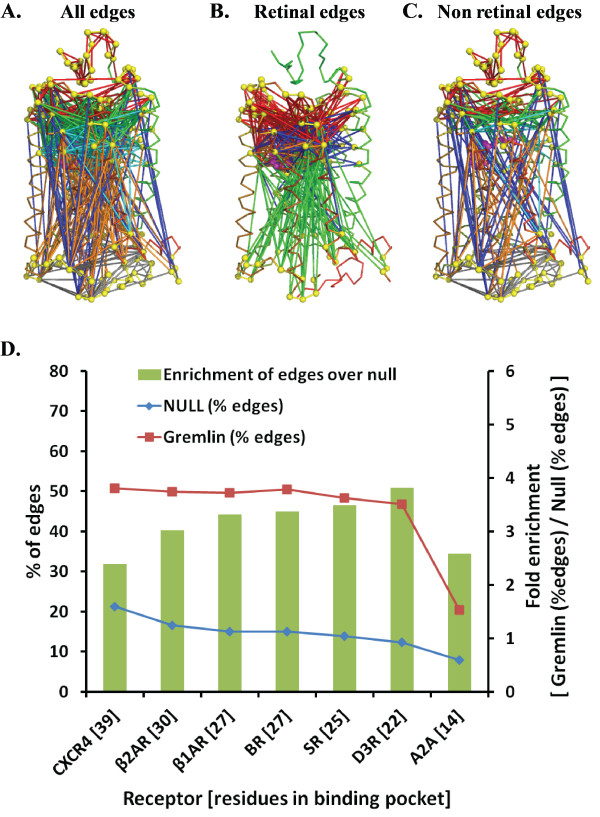
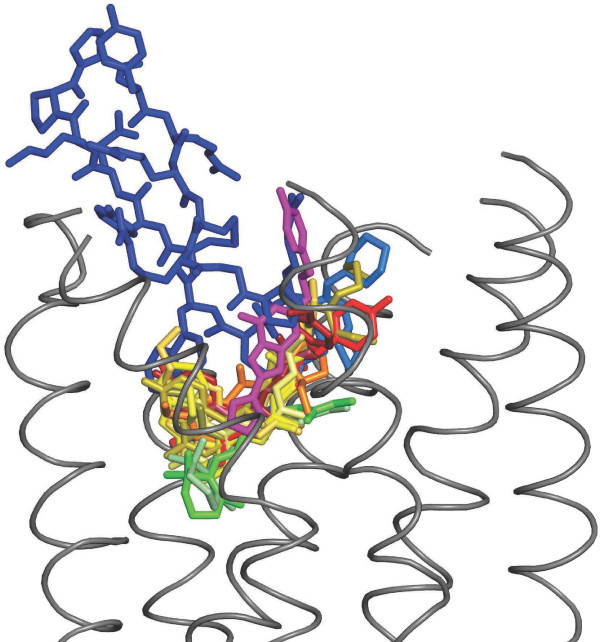
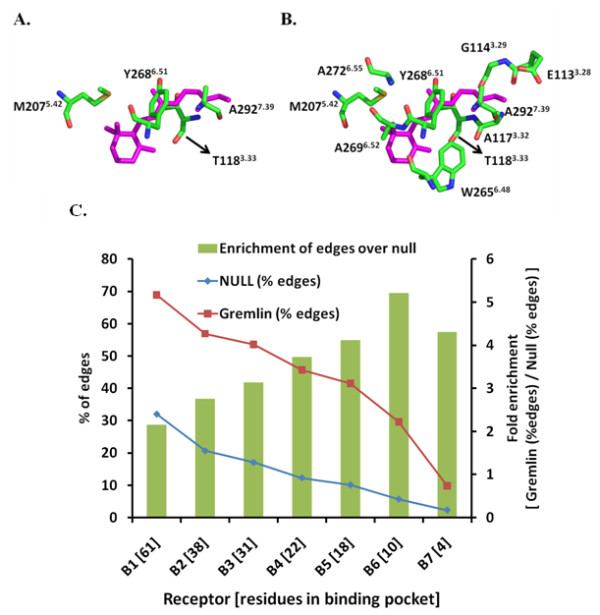
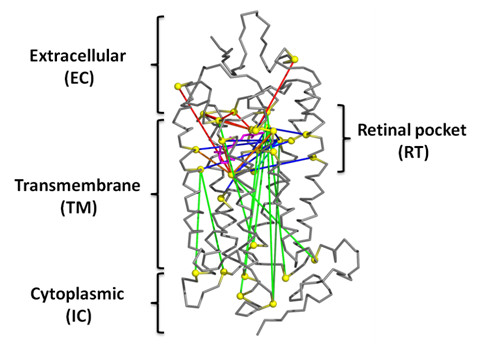
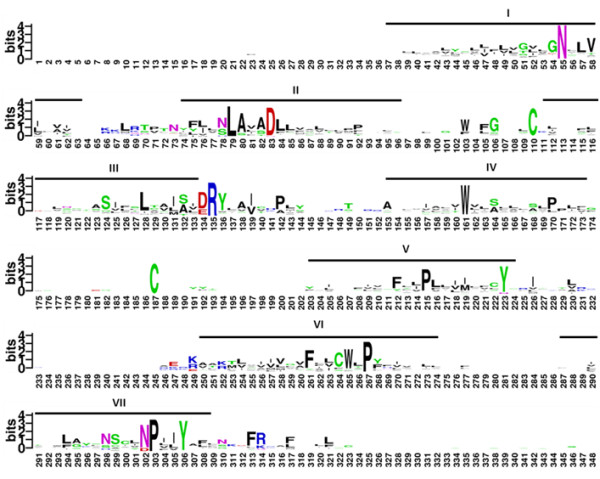
GREMLIN significantly enriches the edges containing residues that are part of the ligand binding pocket, when compared to a control distribution of edges drawn from a random graph. An analysis of these edges reveals a minimal GPCR binding pocket containing four residues (T1183.33, M2075.42, Y2686.51 and A2927.39). Additionally, of the ten residues predicted to have the most long-range interactions (A1173.32, A2726.55, E1133.28, H2115.46, S186EC2, A2927.39, E1223.37, G902.57, G1143.29 and M2075.42), nine are part of the ligand binding pocket.
We demonstrate the use of GREMLIN to reveal a network of statistically correlated and functionally important residues in class A GPCRs. GREMLIN identified that ligand binding pocket residues are extensively correlated with distal residues. An analysis of the GREMLIN edges across multiple structures suggests that there may be a minimal binding pocket common to the seven known GPCRs. Further, the activation of rhodopsin involves these long-range interactions between extracellular and intracellular domain residues mediated by the retinal domain.
G蛋白偶联受体(GPCRs)是七螺旋跨膜蛋白,作为信号转导器发挥作用。它们在细胞外和跨膜区域结合配体,并在膜另一侧的细胞内表面激活同源G蛋白。配体结合位点与远处G蛋白结合位点之间的变构通讯传递机制尚不清楚。在本研究中,GREMLIN 1(一种最近开发的从多序列比对中识别共同进化残基网络的方法)被用于识别那些可能参与跨膜传递激活信号的残基。针对本研究开展时已结晶的七个GPCR结构,分析了GREMLIN预测的氨基酸之间的长程相互作用。
与从随机图绘制的边的对照分布相比,GREMLIN显著富集了包含配体结合口袋一部分残基的边。对这些边的分析揭示了一个最小的GPCR结合口袋,包含四个残基(T1183.33、M2075.42、Y2686.51和A2927.39)。此外,在预测具有最长程相互作用的十个残基(A1173.32、A2726.55、E1133.28、H2115.46、S186EC2、A2927.39、E1223.37、G902.57、G1143.29和M2075.42)中,九个是配体结合口袋的一部分。
我们展示了使用GREMLIN来揭示A类GPCR中具有统计学相关性和功能重要性的残基网络。GREMLIN确定配体结合口袋残基与远端残基广泛相关。对多个结构上GREMLIN边的分析表明,七个已知GPCR可能存在一个最小的共同结合口袋。此外,视紫红质的激活涉及由视黄醛结构域介导的细胞外和细胞内结构域残基之间的这些长程相互作用。