Internal Medicine Department, Medical School of Ribeirão Preto, Universidade de São Paulo, Ribeirão Preto, SP, Brazil.
Clinics (Sao Paulo). 2012;67(6):615-22. doi: 10.6061/clinics/2012(06)12.
The potential influence of magnesium on exercise performance is a subject of increasing interest. Magnesium has been shown to have bronchodilatatory properties in asthma and chronic obstructive pulmonary disease patients. The aim of this study was to investigate the effects of acute magnesium IV loading on the aerobic exercise performance of stable chronic obstructive pulmonary disease patients.
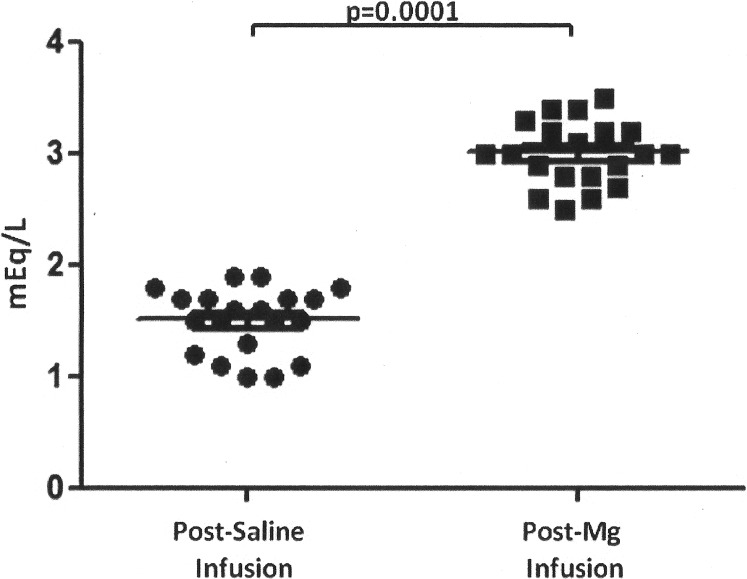
Twenty male chronic obstructive pulmonary disease patients (66.2 + 8.3 years old, FEV1: 49.3+19.8%) received an IV infusion of 2 g of either magnesium sulfate or saline on two randomly assigned occasions approximately two days apart. Spirometry was performed both before and 45 minutes after the infusions. A symptom-limited incremental maximal cardiopulmonary test was performed on a cycle ergometer at approximately 100 minutes after the end of the infusion.
Magnesium infusion was associated with significant reductions in the functional residual capacity (-0.41 l) and residual volume (-0.47 l), the mean arterial blood pressure (-5.6 mmHg) and the cardiac double product (734.8 mmHg.bpm) at rest. Magnesium treatment led to significant increases in the maximal load reached (+8 w) and the respiratory exchange ratio (0.06) at peak exercise. The subgroup of patients who showed increases in the work load equal to or greater than 5 w also exhibited significantly greater improvements in inspiratory capacity (0.29 l).
The acute IV loading of magnesium promotes a reduction in static lung hyperinflation and improves the exercise performance in stable chronic obstructive pulmonary disease patients. Improvements in respiratory mechanics appear to be responsible for the latter finding.
镁对运动表现的潜在影响是一个日益受到关注的话题。镁已被证明对哮喘和慢性阻塞性肺疾病(COPD)患者具有支气管扩张作用。本研究旨在探讨急性静脉内镁负荷对稳定期 COPD 患者有氧运动表现的影响。
20 名男性 COPD 患者(66.2+8.3 岁,FEV1:49.3+19.8%)在大约两天的时间内两次随机接受 2 克硫酸镁或生理盐水静脉输注。在输注前后均进行了肺量测定。在输注结束后约 100 分钟,在自行车测力计上进行了症状限制的递增最大心肺测试。
镁输注与功能残气量(-0.41 升)和残气量(-0.47 升)、平均动脉血压(-5.6mmHg)和心脏双乘积(734.8mmHg.bpm)在静息时的显著降低相关。镁治疗导致在峰值运动时达到的最大负荷(+8w)和呼吸交换比(0.06)的显著增加。在负荷增加等于或大于 5w 的患者亚组中,吸气量(0.29 升)也显著改善。
急性静脉内镁负荷可减少静态肺过度充气,并改善稳定期 COPD 患者的运动表现。呼吸力学的改善似乎是后者的原因。