Department of Neurosurgery and Brain Repair, University of South Florida College of Medicine, Tampa, FL 33612, USA.
Exp Neurol. 2012 Sep;237(1):142-6. doi: 10.1016/j.expneurol.2012.06.024. Epub 2012 Jun 27.
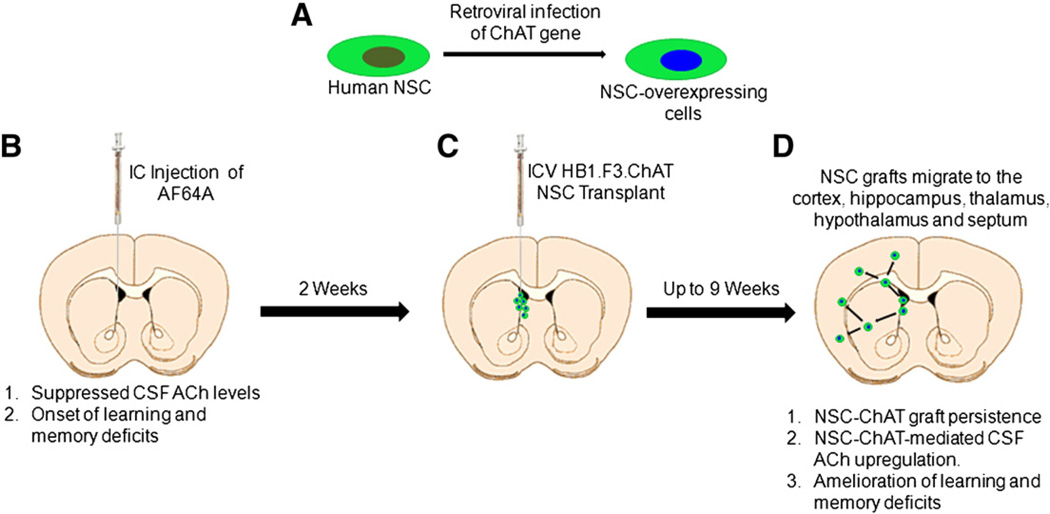
Alzheimer's disease (AD) causes brain degeneration, primarily depleting cholinergic cells, and leading to cognitive and learning dysfunction. Logically, to augment the cholinergic cell loss, a viable treatment for AD has been via drugs boosting brain acetylcholine production. However, this is not a curative measure. To this end, nerve growth factor (NGF) has been examined as a possible preventative treatment against cholinergic neuronal death while enhancing memory capabilities; however, NGF brain bioavailability is challenging as it does not cross the blood-brain barrier. Investigations into stem cell- and gene-based therapy have been explored in order to enhance NGF potency in the brain. Along this line of research, a genetically modified cell line, called HB1.F3 transfected with the cholinergic acetyltransferase or HB1.F3.ChAT cells, has shown safety and efficacy profiles in AD models. This stem cell transplant therapy for AD is an extension of the neural stem cells' use in other neurological treatments, such as Parkinson's disease and stroke, and recently extended to cancer. The HB1 parent cell and its associated cell lines have been used as a vehicle to deliver genes of interest in various neurological models, and are highly effective as they can differentiate into neurons and glial cells. A focus of this mini-review is the recent demonstration that the transplantation of HB1.F3.ChAT cells in an AD animal model increases cognitive function coinciding with upregulation of acetylcholine levels in the cerebrospinal fluid. In addition, there is a large dispersion throughout the brain of the transplanted stem cells which is important to repair the widespread cholinergic cell loss in AD. Some translational caveats that need to be satisfied prior to initiating clinical trials of HB1.F3.ChAT cells in AD include regulating the host immune response and the possible tumorigenesis arising from the transplantation of this genetically modified cell line. Further studies are warranted to test the safety and effectiveness of these cells in AD transgenic animal models. This review highlights the recent progress of stem cell therapy in AD, not only emphasizing the significant basic science strides made in this field, but also providing caution on remaining translational issues necessary to advance this novel treatment to the clinic.
阿尔茨海默病(AD)导致大脑退化,主要是耗尽胆碱能细胞,导致认知和学习功能障碍。从逻辑上讲,为了增加胆碱能细胞的损失,一种可行的 AD 治疗方法是通过药物促进大脑乙酰胆碱的产生。然而,这不是一种治愈措施。为此,神经生长因子(NGF)已被作为一种可能的预防治疗方法,以防止胆碱能神经元死亡,同时增强记忆能力;然而,NGF 脑内生物利用度是具有挑战性的,因为它不能穿过血脑屏障。为了增强 NGF 在大脑中的效力,已经探索了基于干细胞和基因的治疗方法。沿着这条研究路线,一种称为 HB1.F3 的基因修饰细胞系,通过转染胆碱乙酰转移酶或 HB1.F3.ChAT 细胞,在 AD 模型中显示出安全性和疗效。这种用于 AD 的干细胞移植治疗是神经干细胞在其他神经治疗(如帕金森病和中风)中应用的延伸,最近已扩展到癌症。HB1 亲本细胞及其相关细胞系已被用作在各种神经模型中传递感兴趣基因的载体,并且非常有效,因为它们可以分化为神经元和神经胶质细胞。本篇综述的重点是最近的研究表明,在 AD 动物模型中移植 HB1.F3.ChAT 细胞可提高认知功能,同时增加脑脊液中乙酰胆碱的水平。此外,移植的干细胞在大脑中广泛分散,这对于修复 AD 中广泛的胆碱能细胞损失非常重要。在开始 AD 患者中进行 HB1.F3.ChAT 细胞临床试验之前,需要满足一些转化方面的注意事项,包括调节宿主免疫反应和来自移植这种基因修饰细胞系的可能肿瘤发生。需要进一步的研究来测试这些细胞在 AD 转基因动物模型中的安全性和有效性。本综述强调了干细胞治疗在 AD 中的最新进展,不仅强调了该领域取得的重要基础科学进展,还对将这种新型治疗方法推进临床应用所必需的转化问题提出了警告。