Division of Biology, Sir Alexander Fleming Building, Imperial College London, Exhibition Road, London, SW7 2AZ, UK.
Nucleic Acids Res. 2012 Oct;40(18):9139-52. doi: 10.1093/nar/gks661. Epub 2012 Jul 5.
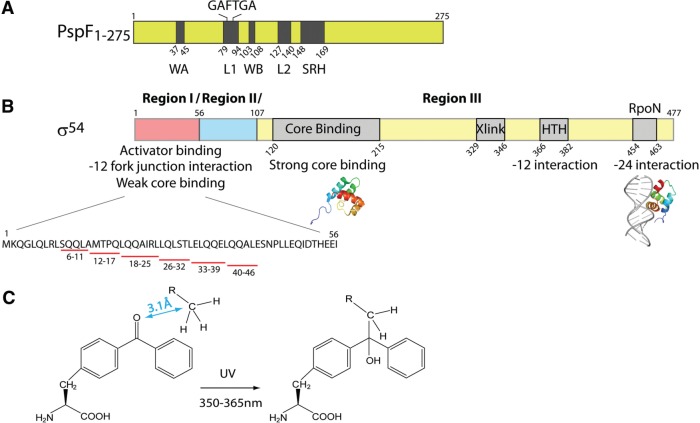
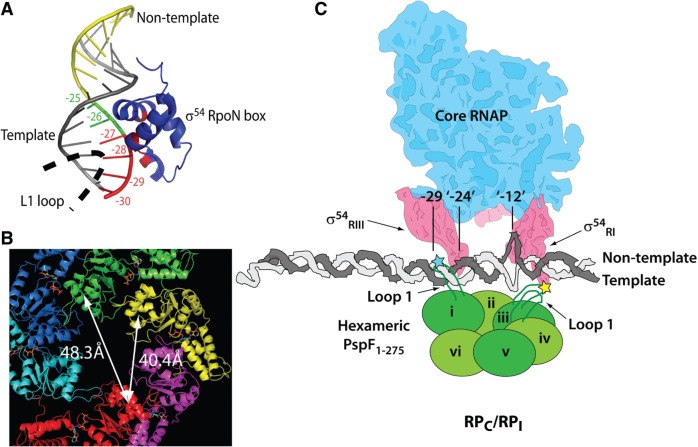
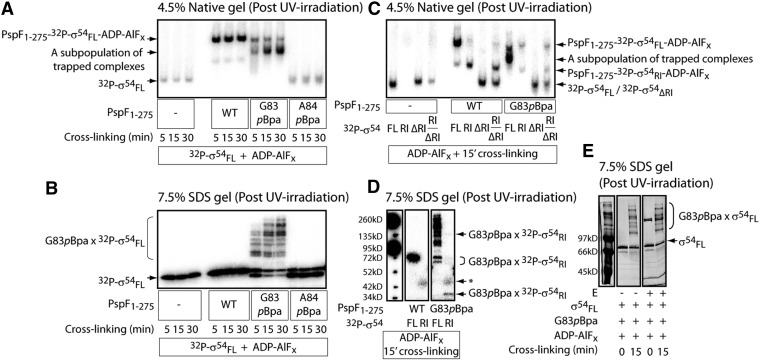
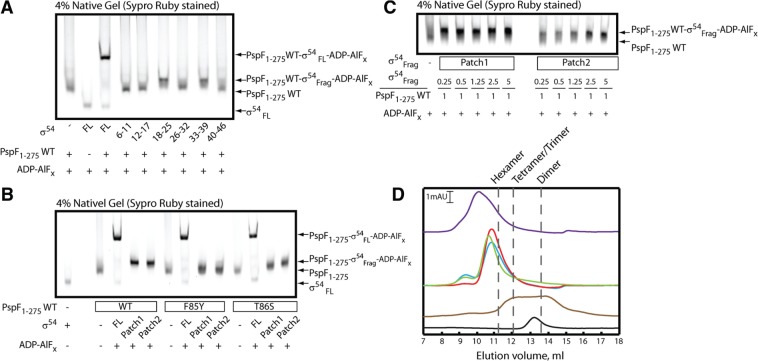
Initiation of σ(54)-dependent transcription requires assistance to melt DNA at the promoter site but is impeded by numerous protein-protein and nucleo-protein interactions. To alleviate these inhibitory interactions, hexameric bacterial enhancer binding proteins (bEBP), a subset of the ATPases associated with various cellular activities (AAA+) protein family, are required to remodel the transcription complex using energy derived from ATP hydrolysis. However, neither the process of energy conversion nor the internal architecture of the closed promoter complex is well understood. Escherichia coli Phage shock protein F (PspF), a well-studied bEBP, contains a surface-exposed loop 1 (L1). L1 is key to the energy coupling process by interacting with Region I of σ(54) (σ(54)(RI)) in a nucleotide dependent manner. Our analyses uncover new levels of complexity in the engagement of a multimeric bEBP with a basal transcription complex via several L1s. The mechanistic implications for these multivalent L1 interactions are elaborated in the light of available structures for the bEBP and its target complexes.
启动 σ(54)依赖性转录需要在启动子位点协助 DNA 解链,但会受到许多蛋白质-蛋白质和核蛋白相互作用的阻碍。为了减轻这些抑制性相互作用,需要六聚体细菌增强子结合蛋白(bEBP),这是与各种细胞活动相关的 ATP 酶(AAA+)蛋白家族的一部分,利用源自 ATP 水解的能量重塑转录复合物。然而,能量转换过程和封闭启动子复合物的内部结构都还没有得到很好的理解。大肠杆菌噬菌体休克蛋白 F(PspF)是一种研究得很好的 bEBP,它含有一个表面暴露的环 1(L1)。L1 通过与 σ(54)的区域 I(σ(54)(RI))以核苷酸依赖的方式相互作用,是能量偶联过程的关键。我们的分析揭示了通过几个 L1,多聚体 bEBP 与基础转录复合物结合的新的复杂性水平。根据 bEBP 及其靶复合物的现有结构,详细阐述了这些多价 L1 相互作用的机制意义。