Dennis Elizabeth A, Potter Kerry L, Estabrooks Paul A, Davy Brenda M
Department of Human Nutrition, Foods and Exercise, Virginia Tech, 221 Wallace Hall (0430), Blacksburg, VA 24061, USA.
J Obes. 2012;2012:803769. doi: 10.1155/2012/803769. Epub 2012 Jun 12.
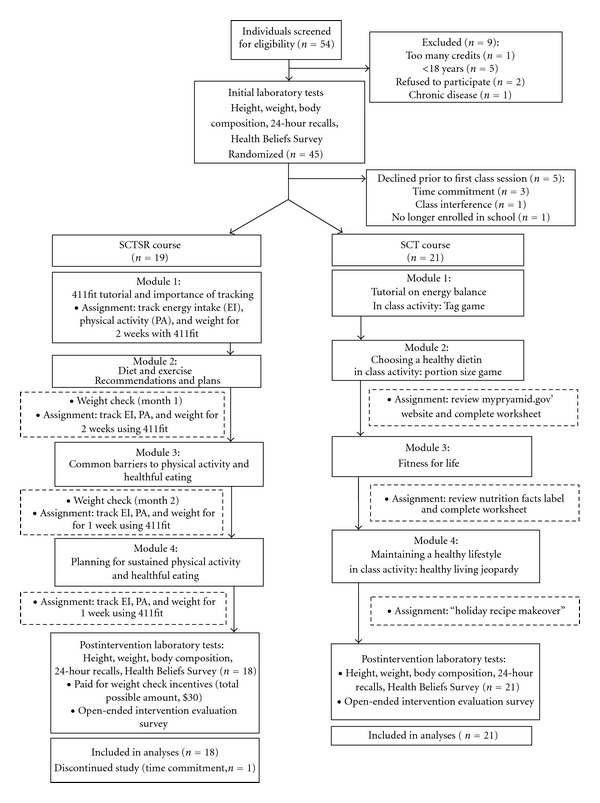
The college transition represents a critical period for maintaining a healthy weight, yet intervention participation and retention represent significant challenges. The objective of this investigation was to evaluate the preliminary efficacy and acceptability of two interventions to prevent freshman weight gain. One intervention provided opportunities to improve outcome expectations and self-efficacy within a social cognitive theory framework (SCT), while the other targeted the same variables but focused on explicit training in self-regulation skills (SCTSR). Methods. Freshmen (n = 45) aged >18 years were randomized to a 14-week intervention, SCT or SCTSR; both included online modules and in-class meetings. Of the 45 students randomized, 5 withdrew before the classes began and 39 completed pre- and posttesting. Primary outcomes included body weight/composition, health behaviors, and program acceptability. Analyses included independent sample t-tests, repeated measures ANOVA, and bivariate correlational analyses. Results. Body weight increased over the 14-week period, but there was no group difference. Percent body fat increased in SCTSR but not SCT (mean difference: SCTSR, +1.63 ± 0.52%; SCT, -0.25 ± 0.45%; P = 0.01). Class attendance was 100% (SCTSR) and 98% (SCT); SCTSR students (>50%) remarked that the online tracking required "too much time." Conclusions. The intervention was well received, although there were no improvements in weight outcomes.
大学过渡阶段是维持健康体重的关键时期,但参与和坚持干预措施是重大挑战。本研究的目的是评估两种预防大一新生体重增加的干预措施的初步疗效和可接受性。一种干预措施在社会认知理论框架(SCT)内提供了改善结果期望和自我效能的机会,而另一种针对相同变量,但侧重于自我调节技能的明确训练(SCTSR)。方法。年龄大于18岁的大一新生(n = 45)被随机分配到为期14周的干预措施中,即SCT或SCTSR;两者都包括在线模块和课堂会议。在随机分配的45名学生中,5名在课程开始前退出,39名完成了前后测试。主要结果包括体重/身体成分、健康行为和项目可接受性。分析包括独立样本t检验、重复测量方差分析和双变量相关分析。结果。在14周内体重增加,但两组之间没有差异。SCTSR组的体脂百分比增加,而SCT组没有(平均差异:SCTSR,+1.63±0.52%;SCT,-0.25±0.45%;P = 0.01)。SCTSR组的上课出勤率为100%,SCT组为98%;SCTSR组的学生(>50%)表示在线跟踪需要“太多时间”。结论。尽管体重结果没有改善,但干预措施受到了好评。