Thomas J E, Whatmore A M, Barer M R, Eastham E J, Kehoe M A
Department of Child Health, University of Newcastle-upon-Tyne, United Kingdom.
J Clin Microbiol. 1990 Dec;28(12):2641-6. doi: 10.1128/jcm.28.12.2641-2646.1990.
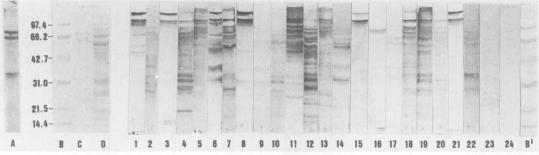
Sera from 100 children (ages, 6 to 16 years) presenting with upper gastrointestinal symptoms were examined for antibodies to Helicobacter pylori by enzyme-linked immunosorbent assay (ELISA) based on crude, loosely cell-associated antigens and a partially purified urease antigen preparation. All children underwent endoscopy, and 20 children were shown to have H. pylori infection by histology or direct culture. Serum anti-H. pylori immunoglobulin G (IgG) levels (crude antigen) were clearly raised in the infected group, particularly after preabsorption of sera against a Campylobacter jejuni antigen preparation, while IgM and IgA ELISA determinations did not discriminate between infected and H. pylori-negative patients. Only 14 children in the infected group had raised anti-urease IgG levels. Two patients in whom the organism was not demonstrated or cultured had raised specific IgG levels against both crude and urease antigens and pathological features consistent with H. pylori disease. Immunoblotting studies did not reveal any single protein antigen or simple combination of antigens that could be considered as a candidate for a more defined serodiagnostic reagent. Anti-H. pylori antibody determinations (crude antigen) performed on posttreatment samples from children in whom the organism could no longer be demonstrated suggested that sustained IgG levels may not be a reliable index of treatment failure. An IgG ELISA based on crude, loosely cell-associated antigens of H. pylori can be used for the serodiagnosis of H. pylori infection in childhood.
对100名出现上消化道症状的儿童(年龄6至16岁)的血清进行检测,采用基于粗制、松散细胞相关抗原和部分纯化脲酶抗原制剂的酶联免疫吸附测定(ELISA)法检测幽门螺杆菌抗体。所有儿童均接受了内镜检查,其中20名儿童经组织学检查或直接培养显示有幽门螺杆菌感染。感染组血清抗幽门螺杆菌免疫球蛋白G(IgG)水平(粗抗原)明显升高,尤其是在用空肠弯曲菌抗原制剂对血清进行预吸收后,而IgM和IgA ELISA测定无法区分感染患者和幽门螺杆菌阴性患者。感染组中只有14名儿童的抗脲酶IgG水平升高。两名未检测到或培养出该菌的患者,其针对粗抗原和脲酶抗原的特异性IgG水平升高,且病理特征与幽门螺杆菌病相符。免疫印迹研究未发现任何单一蛋白质抗原或简单的抗原组合可被视为更明确的血清学诊断试剂的候选物。对不再能检测到该菌的儿童治疗后样本进行的抗幽门螺杆菌抗体测定(粗抗原)表明,持续的IgG水平可能不是治疗失败的可靠指标。基于幽门螺杆菌粗制、松散细胞相关抗原的IgG ELISA可用于儿童幽门螺杆菌感染的血清学诊断。