Department of Clinical Psychology, Medisch Spectrum Twente, P.O. Box 50.000, 7500, KA, Enschede, The Netherlands,
Int J Behav Med. 2013 Sep;20(3):425-33. doi: 10.1007/s12529-012-9244-3.
Personality factors and psychiatric history may help explain individual differences in risk of psychological morbidity and poor health outcomes in patients with an implantable cardioverter defibrillator (ICD).
We examined associations between previous anxiety and depressive disorder, type D personality, anxiety or depressive symptoms, and health status in ICD patients prior to ICD implantation.
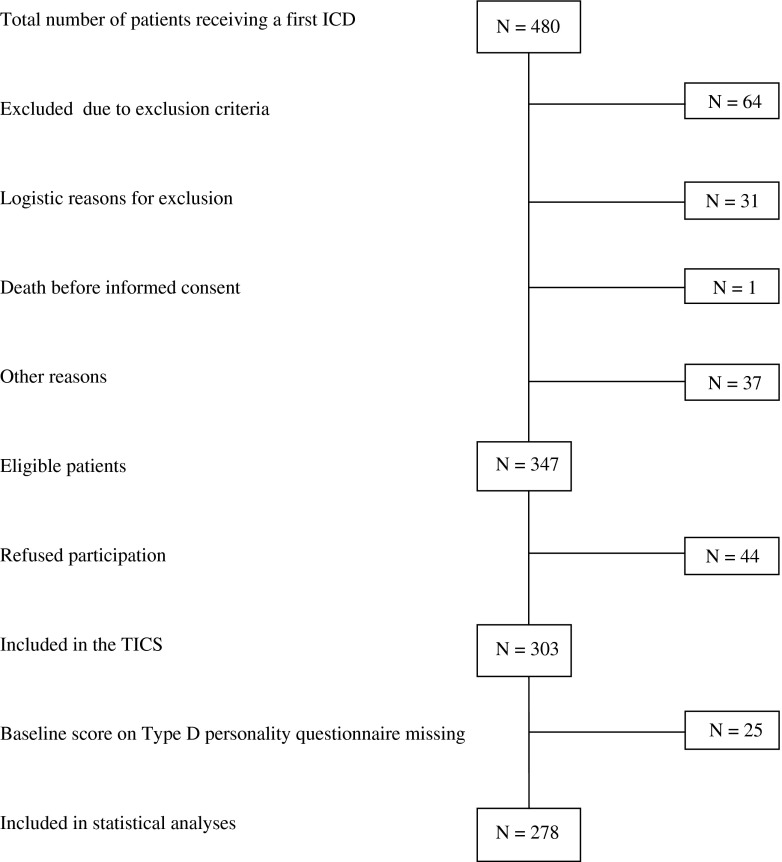
Patients (N = 278; 83 % men; mean age = 62.2 years ±11) receiving a first ICD from September 2007 through April 2010 at the Medisch Spectrum Twente, The Netherlands completed validated questionnaires before implantation assessing type D personality (14-item Type D Scale), anxiety and depressive symptoms (Hospital Anxiety and Depression Scale), and health status (36-item Short Form Health Survey). History of anxiety or depressive disorder was assessed with the Mini International Neuropsychiatric Interview structural interview.
Previous anxiety or depressive disorder was prevalent in 8 and 19 % of patients, respectively. Type D personality was present in 21 %, depressive symptoms in 15 %, and anxiety in 24 %. In adjusted analyses, type D personality was a dominant correlate of previous depressive disorder (odds ratio (OR) 6.2, p < 0.001) and previous anxiety disorder (OR 3.9, p = 0.004). Type D personality (OR 4.0, p < 0.001), age (OR 1.03, p = 0.043), and gender (OR 2.5, p = 0.013) were associated with anxiety symptoms at baseline. Type D personality (OR 5.9. p < 0.001) was also associated with increased depressive symptoms at baseline. Heart failure and type D personality were related to poorer health status.
In ICD patients, prior to ICD implantation, a previous anxiety or depressive disorder, type D personality, and anxiety and depressive symptoms were associated with poorer health status. Type D personality was also independently associated with increased anxiety and depression symptoms.
人格因素和精神病史可能有助于解释植入式心脏复律除颤器(ICD)患者心理发病率和健康结果不良的个体差异。
我们研究了 ICD 植入前患者先前的焦虑和抑郁障碍、D 型人格、焦虑或抑郁症状与健康状况之间的关系。
2007 年 9 月至 2010 年 4 月,荷兰特温特医疗中心的 278 名(83%为男性;平均年龄 62.2 岁±11 岁)首次接受 ICD 的患者在植入前完成了评估 D 型人格(14 项 D 型量表)、焦虑和抑郁症状(医院焦虑和抑郁量表)和健康状况(36 项简明健康调查问卷)的有效问卷。焦虑或抑郁障碍史通过迷你国际神经精神访谈结构访谈进行评估。
分别有 8%和 19%的患者有焦虑或抑郁障碍病史。21%的患者存在 D 型人格,15%的患者存在抑郁症状,24%的患者存在焦虑症状。在调整后的分析中,D 型人格是先前抑郁障碍(优势比(OR)6.2,p<0.001)和先前焦虑障碍(OR 3.9,p=0.004)的主要相关因素。D 型人格(OR 4.0,p<0.001)、年龄(OR 1.03,p=0.043)和性别(OR 2.5,p=0.013)与基线时的焦虑症状相关。D 型人格(OR 5.9,p<0.001)也与基线时抑郁症状的增加有关。心力衰竭和 D 型人格与较差的健康状况相关。
在 ICD 患者中,在植入 ICD 之前,先前的焦虑或抑郁障碍、D 型人格以及焦虑和抑郁症状与较差的健康状况相关。D 型人格也与焦虑和抑郁症状的增加独立相关。