Kim Betty E, Seligman Darryl, Kable Joseph W
Department of Psychology, University of Pennsylvania Philadelphia, PA, USA.
Front Neurosci. 2012 Jul 19;6:109. doi: 10.3389/fnins.2012.00109. eCollection 2012.
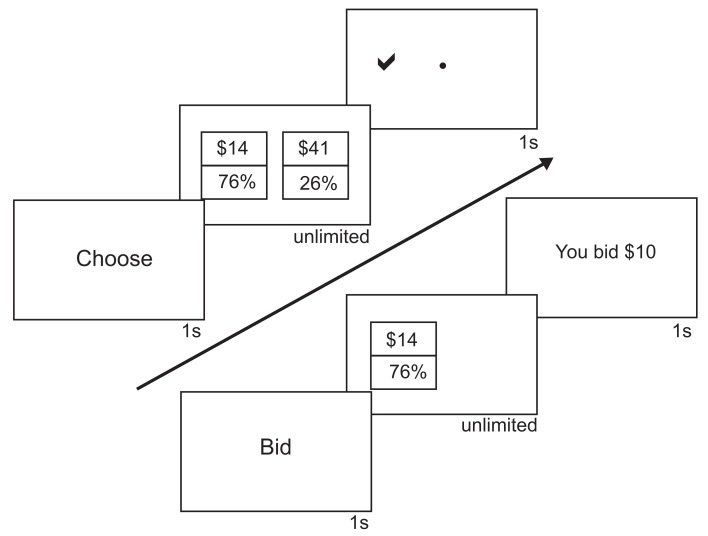
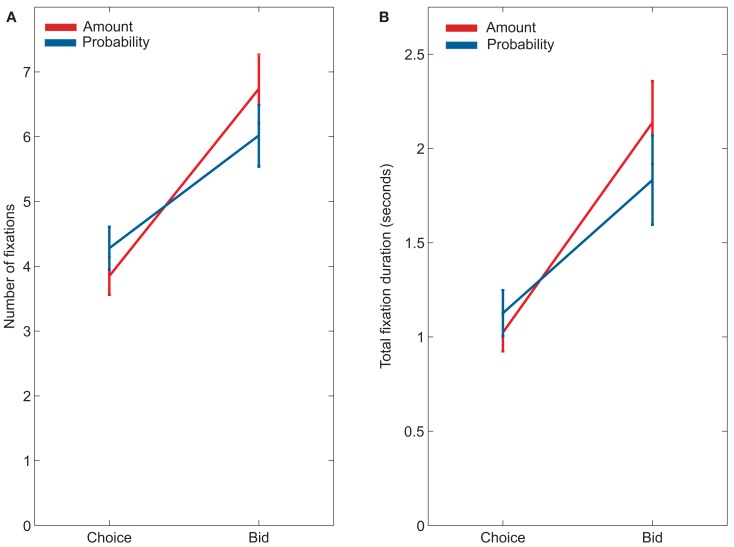
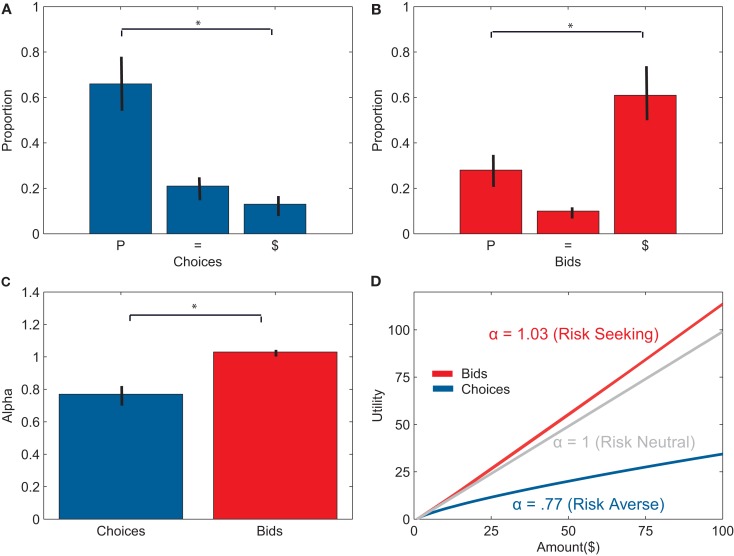
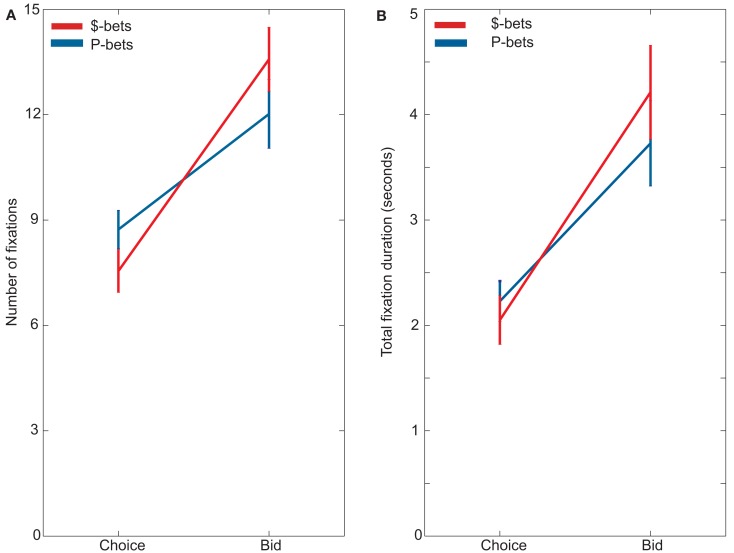
Recent work has shown that visual fixations reflect and influence trial-to-trial variability in people's preferences between goods. Here we extend this principle to attribute weights during decision making under risk. We measured eye movements while people chose between two risky gambles or bid on a single gamble. Consistent with previous work, we found that people exhibited systematic preference reversals between choices and bids. For two gambles matched in expected value, people systematically chose the higher probability option but provided a higher bid for the option that offered the greater amount to win. This effect was accompanied by a shift in fixations of the two attributes, with people fixating on probabilities more during choices and on amounts more during bids. Our results suggest that the construction of value during decision making under risk depends on task context partly because the task differentially directs attention at probabilities vs. amounts. Since recent work demonstrates that neural correlates of value vary with visual fixations, our results also suggest testable hypotheses regarding how task context modulates the neural computation of value to generate preference reversals.
近期研究表明,视觉注视反映并影响人们在商品偏好上的逐次试验变异性。在此,我们将这一原理扩展至风险决策过程中的属性权重。我们在人们在两个风险赌博之间进行选择或对单个赌博进行出价时测量了眼动。与先前研究一致,我们发现人们在选择和出价之间表现出系统性的偏好逆转。对于两个预期价值匹配的赌博,人们系统性地选择概率更高的选项,但对提供更高获胜金额的选项出价更高。这种效应伴随着对两个属性注视的转移,人们在选择时更多地注视概率,在出价时更多地注视金额。我们的结果表明,风险决策过程中的价值构建部分取决于任务背景,因为任务以不同方式引导对概率与金额的关注。由于近期研究表明价值的神经关联随视觉注视而变化,我们的结果还提出了关于任务背景如何调节价值的神经计算以产生偏好逆转的可检验假设。