School of Materials Science and Engineering, Georgia Institute of Technology, Atlanta, GA 30332, USA.
Biomaterials. 2012 Oct;33(30):7386-93. doi: 10.1016/j.biomaterials.2012.06.066. Epub 2012 Jul 24.
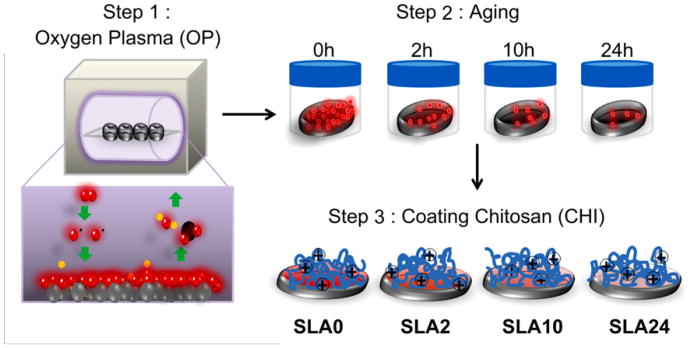
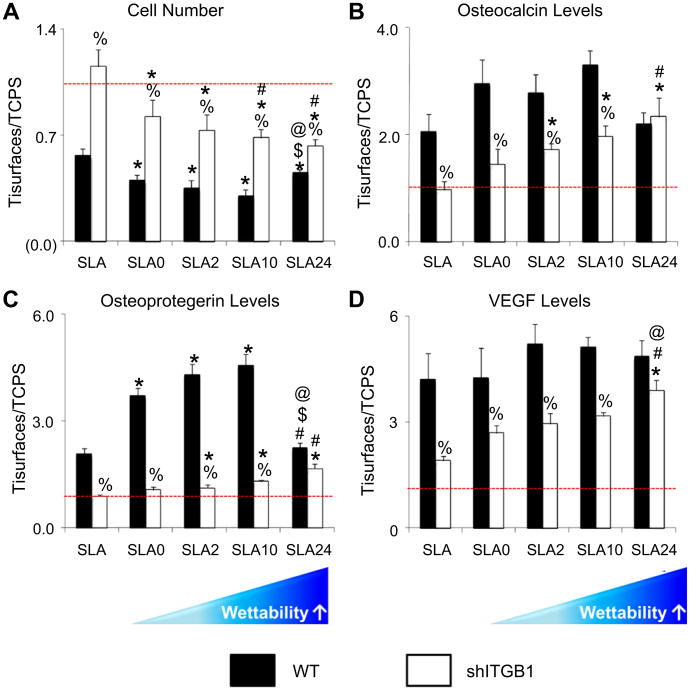
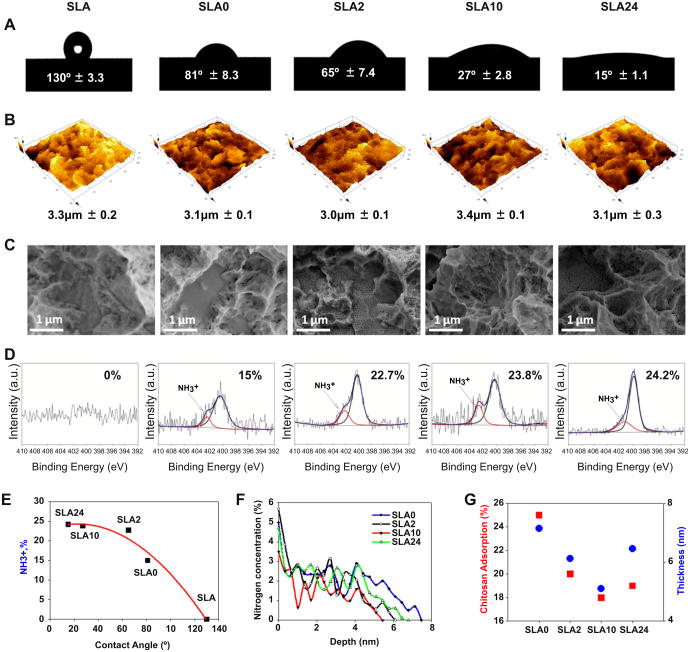
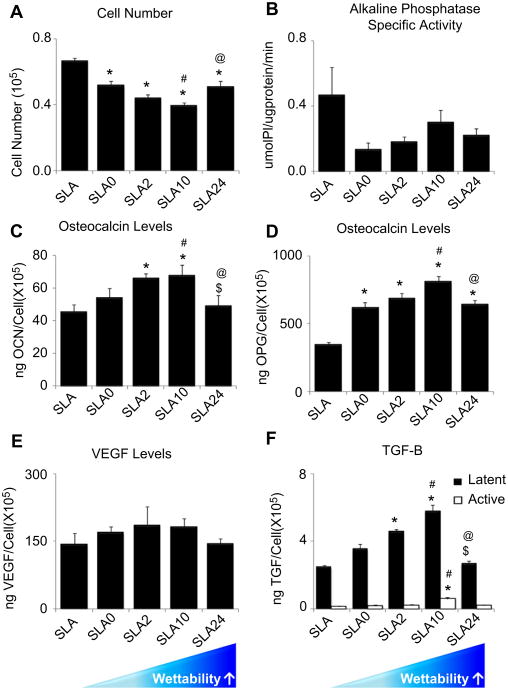
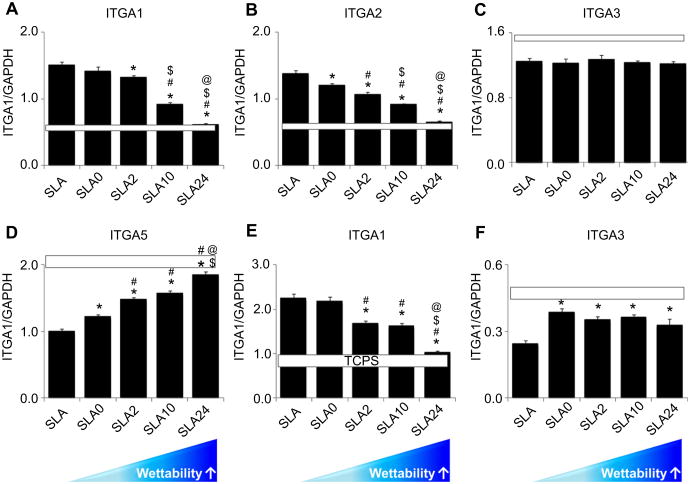
Microtexture and chemistry of implant surfaces are important variables for modulating cellular responses. Surface chemistry and wettability are connected directly. While each of these surface properties can influence cell response, it is difficult to decouple their specific contributions. To address this problem, the aims of this study were to develop a surface wettability gradient with a specific chemistry without altering micron scale roughness and to investigate the role of surface wettability on osteoblast response. Microtextured sandblasted/acid-etched (SLA, Sa = 3.1 μm) titanium disks were treated with oxygen plasma to increase reactive oxygen density on the surface. At 0, 2, 6, 10, and 24 h after removing them from the plasma, the surfaces were coated with chitosan for 30 min, rinsed and dried. Modified SLA surfaces are denoted as SLA/h in air prior to coating. Surface characterization demonstrated that this process yielded differing wettability (SLA0 < SLA2 < SLA10 < SLA24) without modifying the micron scale features of the surface. Cell number was reduced in a wettability-dependent manner, except for the most water-wettable surface, SLA24. There was no difference in alkaline phosphatase activity with differing wettability. Increased wettability yielded increased osteocalcin and osteoprotegerin production, except on the SLA24 surfaces. mRNA for integrins α1, α2, α5, β1, and β3 was sensitive to surface wettability. However, surface wettability did not affect mRNA levels for integrin α3. Silencing β1 increased cell number with reduced osteocalcin and osteoprotegerin in a wettability-dependent manner. Surface wettability as a primary regulator enhanced osteoblast differentiation, but integrin expression and silencing β1 results indicate that surface wettability regulates osteoblast through differential integrin expression profiles than microtexture does. The results may indicate that both microtexture and wettability with a specific chemistry have important regulatory effects on osseointegration. Each property had different effects, which were mediated by different integrin receptors.
种植体表面的微观结构和化学成分是调节细胞反应的重要变量。表面化学性质和润湿性直接相关。虽然这些表面特性都可以影响细胞反应,但很难将它们的特定贡献分开。为了解决这个问题,本研究的目的是开发具有特定化学性质的表面润湿性梯度,而不改变微米级粗糙度,并研究表面润湿性对成骨细胞反应的作用。经过喷砂/酸蚀处理(Sa = 3.1 μm)的钛盘表面进行了氧等离子体处理,以增加表面的活性氧密度。在从等离子体中取出后 0、2、6、10 和 24 小时,将表面用壳聚糖处理 30 分钟,冲洗并干燥。在涂层之前,将改性的 SLA 表面标记为 SLA/h 在空气中。表面特性表明,此过程产生了不同的润湿性(SLA0 < SLA2 < SLA10 < SLA24),而不会改变表面的微米级特征。细胞数量呈润湿性依赖性减少,除了最亲水的 SLA24 表面。不同润湿性对碱性磷酸酶活性没有影响。增加润湿性会增加骨钙素和骨保护素的产生,除了 SLA24 表面。整合素 α1、α2、α5、β1 和 β3 的 mRNA 对表面润湿性敏感。然而,表面润湿性并不影响整合素 α3 的 mRNA 水平。沉默 β1 以润湿性依赖性方式增加细胞数量,同时减少骨钙素和骨保护素的产生。表面润湿性作为主要调节因子增强成骨细胞分化,但整合素表达和沉默β1 的结果表明,表面润湿性通过与微纹理不同的整合素表达谱来调节成骨细胞,而不是通过微纹理来调节。结果可能表明,微纹理和具有特定化学性质的润湿性对骨整合都有重要的调节作用。每种特性都有不同的影响,这些影响是由不同的整合素受体介导的。