Institute of Cancer, Xinqiao Hospital,Third Military Medical University, Chongqing, China.
PLoS One. 2012;7(7):e41546. doi: 10.1371/journal.pone.0041546. Epub 2012 Jul 23.
Evidence suggests that MDM2 T309G polymorphism may be a risk factor for several cancers. Increasing investigations have been conducted on the association of MDM2 T309G polymorphisms with lung cancer risk and have yielded conflicting results. Previous meta-analyses on this issue have reported inconclusive data. The aim of the present study was to derive a more precise estimation of the relationship.
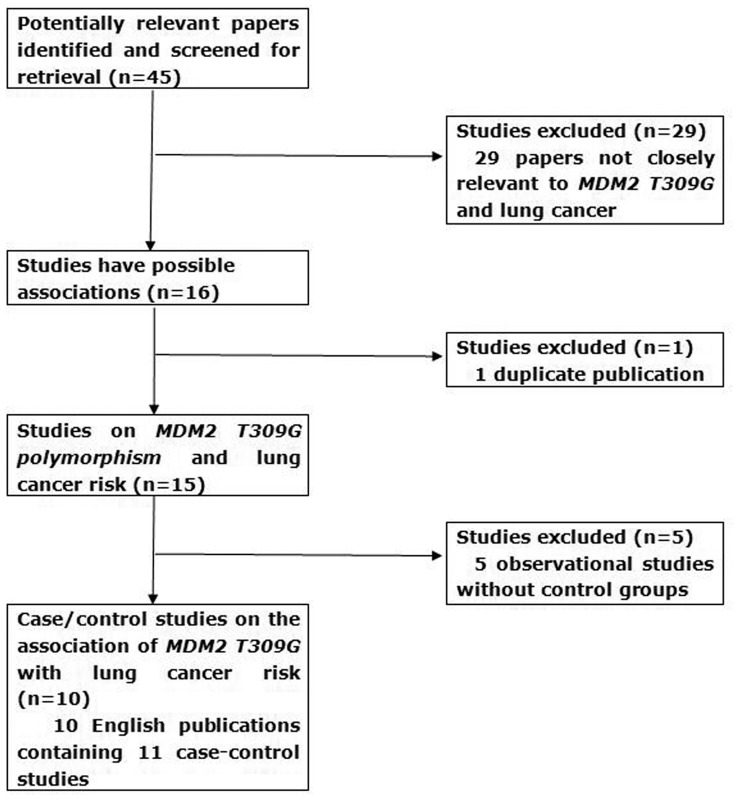
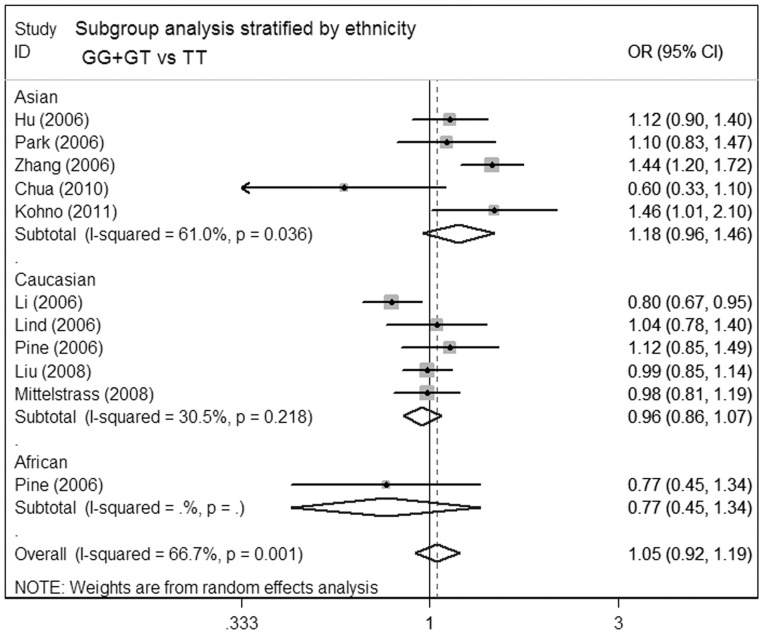
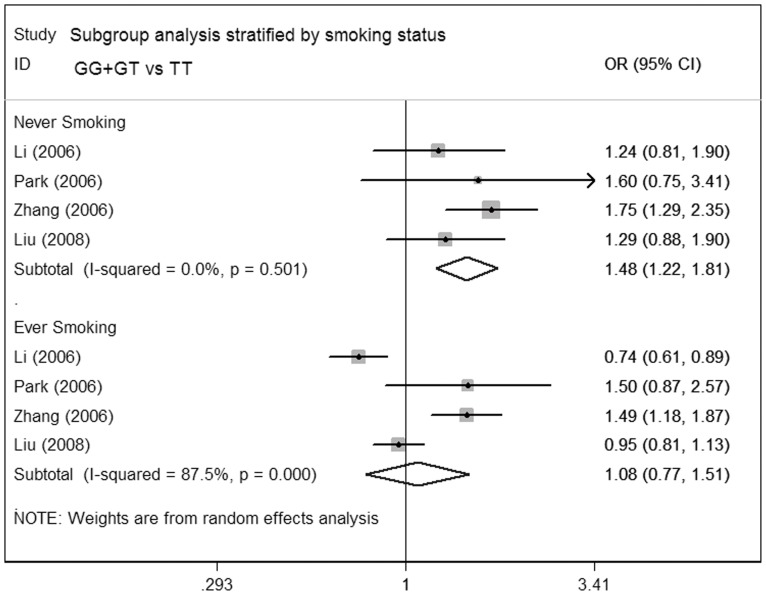
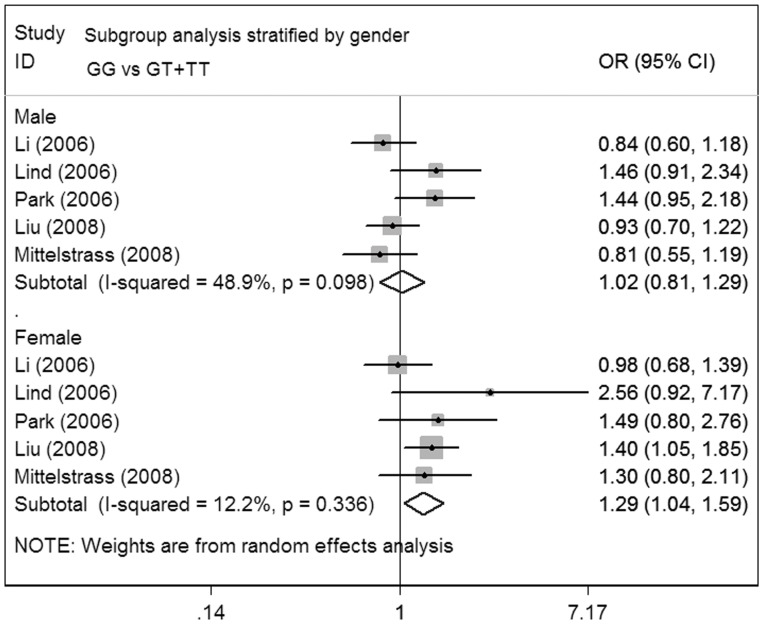
Updated meta-analyses examining the association between MDM2 T309G polymorphism and lung cancer risk were performed. Separate analyses on ethnicity, smoking status, histological types and gender as well as source of controls were also implemented. Eligible studies were identified for the period up to Feb 2012. Lastly, ten publications including eleven case-control studies were selected for analysis. The overall data failed to indicate a significant association between MDM2 T309G polymorphism and lung cancer risk (GG vs TT OR = 1.14; 95%CI = 0.95-1.37; dominant model: OR = 1.05; 95%CI = 0.92-1.19; recessive model: OR = 1.12; 95%CI = 0.99-1.27). In a subgroup analysis by smoking status, increased lung cancer risk was shown among never-smokers (GG vs TT: OR = 1.76; 95%CI = 1.36-2.29; dominant model: OR = 1.48; 95%CI = 1.22-1.81; recessive model: OR = 1.37; 95%CI = 1.11-1.69). In subgroup analysis by gender, elevated risk was presented among women under a recessive model (OR = 1.29; 95%CI = 1.04-1.59). In the subgroup analysis by ethnicity, histological types and source of controls, no marked associations were observed.
Compared to the previous meta-analyses, the results of this study confirmed that MDM2 T309G polymorphism might be a risk factor for lung cancer among never-smokers. However, the data failed to suggest a marked association between the G allele of MDM2 T309G and lung cancer risk among Asians. More interestingly, subgroup analysis by gender indicated that homozygous GG alleles might raise lung cancer risk among females.
有证据表明,MDM2 T309G 多态性可能是多种癌症的风险因素。越来越多的研究已经在 MDM2 T309G 多态性与肺癌风险之间的相关性进行了研究,但结果存在矛盾。之前关于这个问题的荟萃分析报告的数据没有定论。本研究的目的是更准确地评估这种关系。
对 MDM2 T309G 多态性与肺癌风险之间的相关性进行了更新的荟萃分析。还分别对种族、吸烟状况、组织学类型和性别以及对照来源进行了分析。截止到 2012 年 2 月,确定了符合条件的研究。最后,选择了 10 篇文献(包括 11 项病例对照研究)进行分析。总体数据表明,MDM2 T309G 多态性与肺癌风险之间没有显著关联(GG 与 TT 的 OR=1.14;95%CI=0.95-1.37;显性模型:OR=1.05;95%CI=0.92-1.19;隐性模型:OR=1.12;95%CI=0.99-1.27)。在按吸烟状况进行的亚组分析中,从不吸烟者的肺癌风险增加(GG 与 TT:OR=1.76;95%CI=1.36-2.29;显性模型:OR=1.48;95%CI=1.22-1.81;隐性模型:OR=1.37;95%CI=1.11-1.69)。在按性别进行的亚组分析中,在隐性模型中,女性的风险增加(OR=1.29;95%CI=1.04-1.59)。在按种族、组织学类型和对照来源进行的亚组分析中,没有发现明显的相关性。
与之前的荟萃分析相比,本研究的结果证实,MDM2 T309G 多态性可能是从不吸烟者肺癌的一个危险因素。然而,数据并没有表明 MDM2 T309G 中的 G 等位基因与亚洲人群的肺癌风险之间有明显的关联。更有趣的是,按性别进行的亚组分析表明,纯合 GG 等位基因可能会增加女性患肺癌的风险。