Division of Pediatric Allergy, Jaffe Food Allergy Institute, Mount Sinai School of Medicine, New York, NY 10029, USA.
J Allergy Clin Immunol. 2012 Aug;130(2):473-80.e1. doi: 10.1016/j.jaci.2012.06.006.
Baked egg is tolerated by a majority of egg-allergic children.
To characterize immunologic changes associated with ingestion of baked egg and evaluate the role that baked egg diets play in the development of tolerance to regular egg.
Egg-allergic subjects who tolerated baked egg challenge incorporated baked egg into their diet. Immunologic parameters were measured at follow-up visits. A comparison group strictly avoiding egg was used to evaluate the natural history of the development of tolerance.
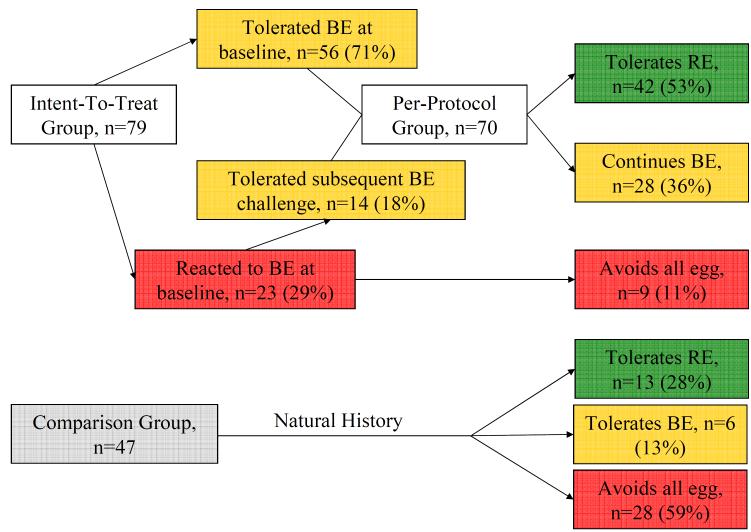
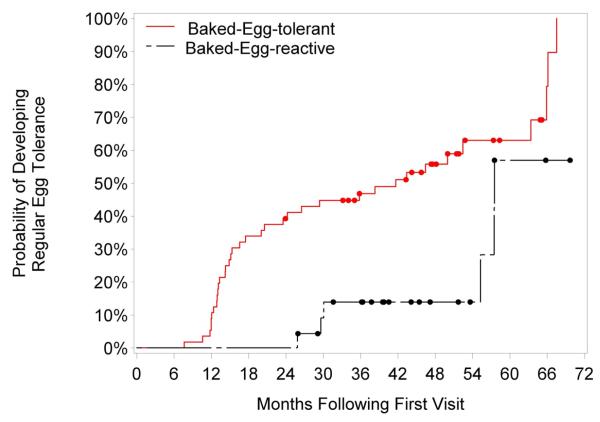
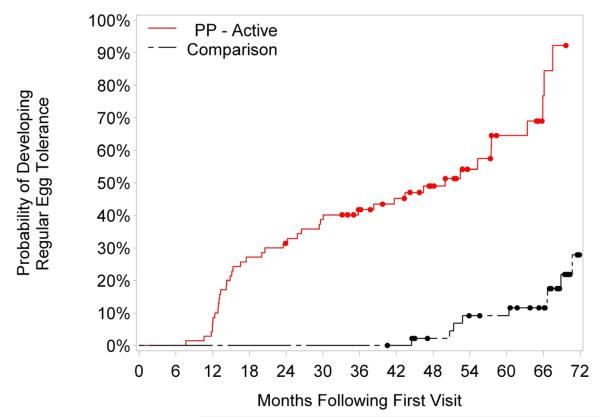
Of the 79 subjects in the intent-to-treat group followed for a median of 37.8 months, 89% now tolerate baked egg and 53% now tolerate regular egg. Of 23 initially baked egg-reactive subjects, 14 (61%) subsequently tolerated baked egg and 6 (26%) now tolerate regular egg. Within the initially baked egg-reactive group, subjects with persistent reactivity to baked egg had higher median baseline egg white (EW)-specific IgE levels (13.5 kU(A)/L) than those who subsequently tolerated baked egg (4.4 kU(A)/L; P= .04) and regular egg (3.1 kU(A)/L; P= .05). In subjects ingesting baked egg, EW-induced skin prick test wheal diameter and EW-, ovalbumin-, and ovomucoid-specific IgE levels decreased significantly, while ovalbumin- and ovomucoid-specific IgG(4) levels increased significantly. Subjects in the per-protocol group were 14.6 times more likely than subjects in the comparison group (P< .0001) to develop regular egg tolerance, and they developed tolerance earlier (median 50.0 vs 78.7 months; P< .0001).
Initiation of a baked egg diet accelerates the development of regular egg tolerance compared with strict avoidance. Higher serum EW-specific IgE level is associated with persistent baked and regular egg reactivity, while initial baked egg reactivity is not.
大多数鸡蛋过敏的儿童可以耐受烘焙蛋。
描述与摄入烘焙蛋相关的免疫学变化,并评估烘焙蛋饮食在发展对常规鸡蛋的耐受性中的作用。
对耐受烘焙蛋挑战的鸡蛋过敏患者将烘焙蛋纳入其饮食。在随访时测量免疫学参数。使用严格避免鸡蛋的对照组来评估自然史中对常规鸡蛋的耐受性发展。
在接受中位随访 37.8 个月的 79 名意向治疗组患者中,89%的患者现在可耐受烘焙蛋,53%的患者现在可耐受常规鸡蛋。在 23 名最初对烘焙蛋有反应的患者中,14 名(61%)随后耐受了烘焙蛋,6 名(26%)现在耐受了常规鸡蛋。在最初对烘焙蛋有反应的患者中,持续对烘焙蛋有反应的患者的中位基线蛋清(EW)特异性 IgE 水平(13.5 kU(A)/L)高于随后耐受烘焙蛋(4.4 kU(A)/L;P=.04)和常规鸡蛋(3.1 kU(A)/L;P=.05)。在摄入烘焙蛋的患者中,EW 诱导的皮肤点刺试验风团直径和 EW、卵白蛋白和卵类黏蛋白特异性 IgE 水平显著降低,而卵白蛋白和卵类黏蛋白特异性 IgG(4)水平显著增加。在符合方案组的患者中,他们比对照组的患者(P<.0001)更有可能发展出对常规鸡蛋的耐受性,并且他们更早地发展出耐受性(中位时间为 50.0 与 78.7 个月;P<.0001)。
与严格避免食用鸡蛋相比,开始食用烘焙蛋饮食可加速常规鸡蛋的耐受性发展。较高的血清 EW 特异性 IgE 水平与持续的烘焙和常规鸡蛋反应有关,而最初的烘焙蛋反应则无关。