Institute for Parasitology and Tropical Veterinary Medicine, Freie Universität Berlin, Königsweg 67, D-14163 Berlin, Germany.
Parasit Vectors. 2012 Aug 1;5:155. doi: 10.1186/1756-3305-5-155.
Tsetse fly-transmitted African animal trypanosomosis causes annual losses that run into billions of dollars. The disease is assumed to cause hunger and poverty in most sub-Saharan countries since it represents a serious impediment to sustainable livestock production. Both a cross-sectional and a longitudinal study were carried out from November to December 2007 to evaluate trypanosomosis risk and susceptibility of trypanosomes to trypanocidal drug treatment in village cattle populations in south-east Mali.
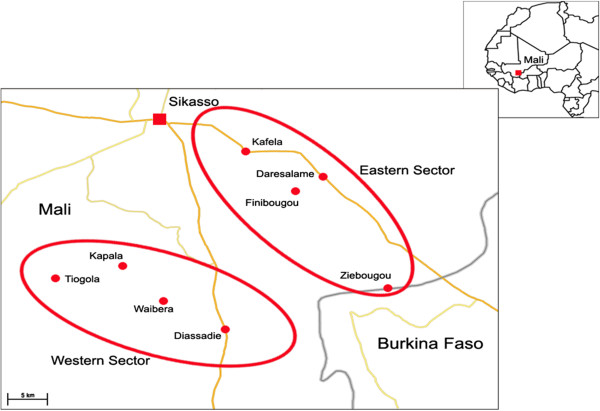
Eight purposively selected villages participated in the study. In each village, eight traps deployed along drainage lines over 24 hour duration were used to catch tsetse. One hundred systematically selected cattle in the study villages were examined for trypanosomes. All trypanosome-positive cattle were randomly allocated into two treatment groups: a group treated with 0.5 mg/kg bw. isometamidium chloride (ISMM) and a group treated with 3.5 mg/kg bw. diminazene aceturate (DIM). The cattle were monitored for trypanosomes at day 14 and 28 post-treatment.
Of the 796 cattle examined, 125 (15.7%) were trypanosome-positive. Village trypanosome prevalences ranged between 11% and 19%. There were no significant (p > 0.05) differences in the village trypanosome prevalences. Trypanosoma congolense was the dominant trypanosome species accounting for 73% (91/125) of the infections and T. vivax the remainder. Twenty (31.7%) of the 63 cattle on 0.5 mg/kg bw. ISMM treatment were still positive14 days post-treatment. Of the 43 aparasitaemic cattle monitored to day 28, 25.6% (11) became parasitaemic, resulting in a cumulative failure rate of 49.2% (31/63). Trypanosoma congolense accounted for 77.4% (24/31) of failed ISMM treatments. The 62 cattle treated with 3.5 mg/kg bw. DIM resulted in 30.6% (19/62) failed treatments. Although 42.2% (19/45) of T. congolense positive cattle did not respond to DIM treatment, all T. vivax positive cattle responded positively to DIM treatment.
The overreliance on trypanocides in the control of trypanosomosis will ultimately lead to multiple drug-resistant trypanosome populations as detected in villages in south-east Mali rendering the use of drugs doubtful. Effective alternative methods for trypanosomosis control ought to substitute chemotherapy to ensure sustainable cattle production in these villages. Since there is no single strategy for containing trypanocidal drug resistance, promotion of an integrated approach combining proven trypanosomosis control approaches in high trypanosomosis risk areas is most desirous. The best-bet strategy this study recommended for areas with multiple drug resistance included area-wide community tsetse control, control of co-infections to exploit self-cure against resistant trypanosome populations and the rational use of trypanocidal drugs which should be urgently promoted at all levels as a way of containing or reversing resistance.
采采蝇传播的非洲动物锥虫病每年造成数十亿美元的损失。由于它严重阻碍了可持续的牲畜生产,因此人们认为它是撒哈拉以南大多数国家饥饿和贫困的根源。本研究于 2007 年 11 月至 12 月在马里东南部的 8 个村庄进行了横断面和纵向研究,以评估锥虫病风险和锥虫对杀锥虫药物治疗的敏感性。
8 个有目的地选择的村庄参加了这项研究。在每个村庄,沿着排水线放置 8 个陷阱,持续 24 小时,以捕捉采采蝇。在研究村庄中,对 100 头系统选择的牛进行了锥虫检查。所有阳性的锥虫牛被随机分配到两个治疗组:一组用 0.5mg/kg bw. 异咪脒(ISMM)治疗,一组用 3.5mg/kg bw. 苯并咪唑乙酰脲(DIM)治疗。在治疗后第 14 天和第 28 天监测牛的锥虫情况。
在检查的 796 头牛中,有 125 头(15.7%)呈锥虫阳性。村庄锥虫病患病率在 11%至 19%之间。村庄锥虫病患病率无显著差异(p>0.05)。优势种为锥虫刚果种,占感染的 73%(91/125),其余为锥虫 vivax。在接受 0.5mg/kg bw. ISMM 治疗的 63 头牛中,20 头(31.7%)在治疗后 14 天仍为阳性。在监测至第 28 天的 43 头 aparasitaemic 牛中,有 25.6%(11 头)出现寄生虫血症,累积失败率为 49.2%(31/63)。锥虫刚果种占 77.4%(24/31)的失败 ISMM 治疗。用 3.5mg/kg bw. DIM 治疗的 62 头牛中有 30.6%(19/62)治疗失败。虽然 42.2%(19/45)的锥虫刚果种阳性牛对 DIM 治疗无反应,但所有锥虫 vivax 阳性牛均对 DIM 治疗有反应。
过度依赖杀锥虫剂来控制锥虫病最终将导致在马里东南部的村庄中检测到多药耐药的锥虫种群,使药物的使用变得可疑。应该用有效的替代方法来替代化疗,以确保这些村庄的可持续牛生产。由于没有单一的策略来控制杀锥虫药物的耐药性,因此最理想的方法是推广一种结合了高锥虫病风险地区经过验证的锥虫病控制方法的综合方法。本研究推荐的多药耐药地区的最佳策略包括在整个地区进行社区采采蝇控制、控制合并感染以利用对耐药锥虫种群的自我治愈以及合理使用杀锥虫药物,这应该在各级紧急推广,作为控制或逆转耐药性的一种方式。
