Department of Medicine, Faculty of Medicine, University of Malaya, Malaya 50603, Kuala Lumpur, Malaysia.
BMC Public Health. 2012 Aug 3;12:601. doi: 10.1186/1471-2458-12-601.
Hepatitis B (HBV) is the leading cause of cirrhosis and hepatocellular carcinoma worldwide. This study assessed the knowledge, attitudes and practices of people with chronic HBV and the associated factors.
This cross-sectional study was conducted at an outpatient adult hepatology clinic at a tertiary hospital in Kuala Lumpur. A self-administered questionnaire was administered on a one-to-one basis to assess knowledge, attitudes, and lifestyle practices of people with chronic HBV.
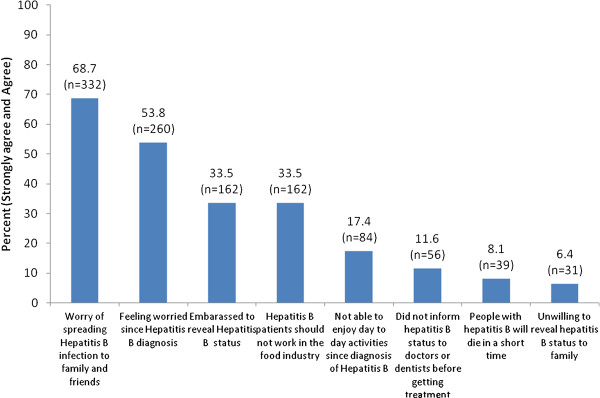
The response rate was 89% (n = 483/543). Participants had a mean age of 46.3 (±14.7) years and the mean duration of HBV from time of diagnosis was 12.2 (±8.8) years. The mean knowledge score was 12.57/20 (standard deviation: ±4.4, range: 0-19). Participants aged 30-39 years, with higher educational attainment, employed in professional jobs, longer duration of diagnosis and those without cirrhosis had significantly higher knowledge scores. Age, education level and duration of diagnosis were significant predictors of the knowledge score on standard multiple regression analysis. More than half of the participants were worried of spreading HBV infection to family and friends and worried since the diagnosis. A third of the participants (33.5%) were embarrassed to reveal their diagnosis to the public but most of them (93.6%) would inform their family. Those who reported feeling worried since their diagnosis were more likely to be middle-aged, of Malay ethnicity, have shorter duration of diagnosis of less than 10 years and have received therapy. About half of the participants (50.6%) did not share dining utensils and the majority (93.2%) believed that HBV can be transmitted by sharing of eating and drinking utensils. Older patients were significantly less likely to share utensils. Those who felt worried since diagnosis had significant higher knowledge of HBV.
The findings highlight the stigma and misconceptions that still exist among the HBV patients. More patient and public education about HBV and its prevention are essential to increase awareness and to demystify the disease.
乙型肝炎(HBV)是全球肝硬化和肝细胞癌的主要原因。本研究评估了慢性 HBV 患者的知识、态度和实践及其相关因素。
本横断面研究在吉隆坡一家三级医院的成人肝病门诊进行。通过一对一的方式进行自我管理问卷调查,评估慢性 HBV 患者的知识、态度和生活方式实践。
应答率为 89%(n=483/543)。参与者的平均年龄为 46.3(±14.7)岁,从诊断到 HBV 的平均时间为 12.2(±8.8)年。平均知识得分为 12.57/20(标准差:±4.4,范围:0-19)。30-39 岁、受教育程度较高、从事专业工作、诊断时间较长且无肝硬化的参与者的知识得分明显较高。年龄、教育水平和诊断时间是标准多元回归分析中知识得分的显著预测因素。超过一半的参与者担心将 HBV 感染传播给家人和朋友,并自诊断以来一直感到担忧。三分之一的参与者(33.5%)对向公众透露自己的诊断感到尴尬,但他们中的大多数(93.6%)会告知家人。那些自诊断以来感到担忧的人更有可能是中年、马来族裔、诊断时间不到 10 年且接受过治疗的人。大约一半的参与者(50.6%)没有共用餐具,大多数(93.2%)人认为 HBV 可以通过共用餐饮具传播。年长的患者明显不太可能共用餐具。那些自诊断以来感到担忧的人对 HBV 的了解明显更高。
研究结果突出了 HBV 患者中仍然存在的耻辱感和误解。需要对 HBV 及其预防进行更多的患者和公众教育,以提高认识并消除对该疾病的神秘感。