Centre for Infection and Immunity, School of Medicine, Dentistry and Biomedical Sciences, Queen's University, Belfast, United Kingdom.
PLoS One. 2012;7(7):e41480. doi: 10.1371/journal.pone.0041480. Epub 2012 Jul 30.
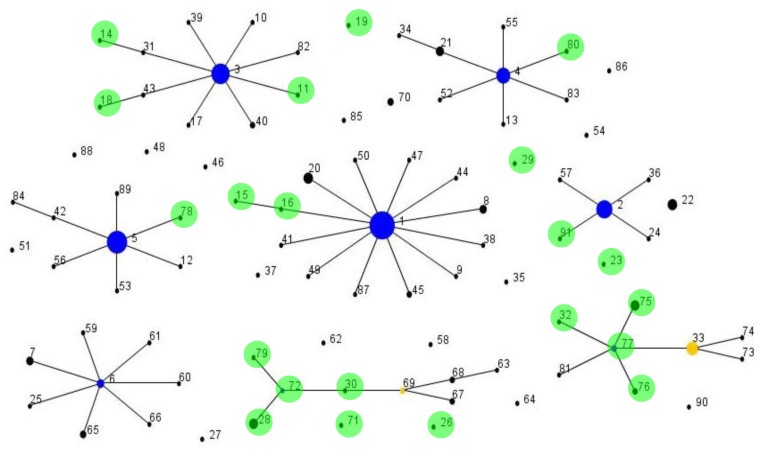
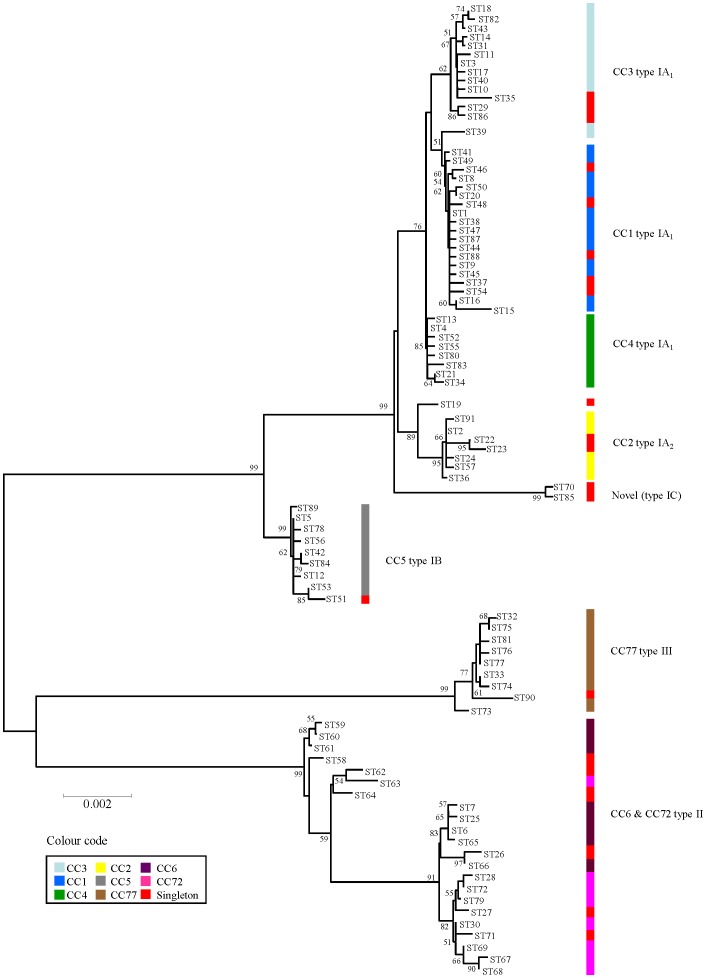
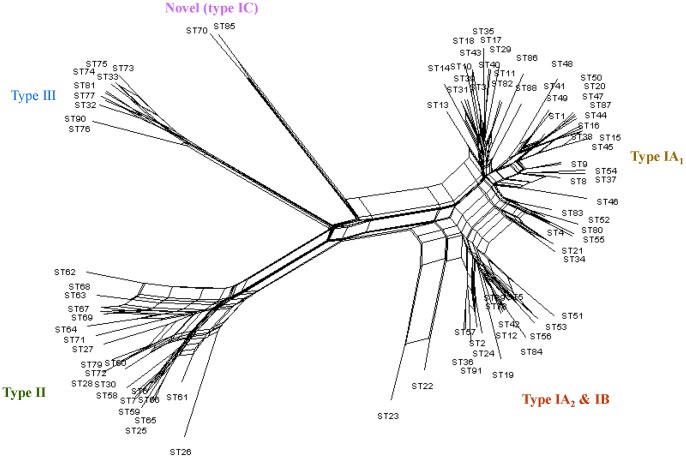
The Gram-positive bacterium Propionibacterium acnes is a member of the normal human skin microbiota and is associated with various infections and clinical conditions. There is tentative evidence to suggest that certain lineages may be associated with disease and others with health. We recently described a multilocus sequence typing scheme (MLST) for P. acnes based on seven housekeeping genes (http://pubmlst.org/pacnes). We now describe an expanded eight gene version based on six housekeeping genes and two 'putative virulence' genes (eMLST) that provides improved high resolution typing (91eSTs from 285 isolates), and generates phylogenies congruent with those based on whole genome analysis. When compared with the nine gene MLST scheme developed at the University of Bath, UK, and utilised by researchers at Aarhus University, Denmark, the eMLST method offers greater resolution. Using the scheme, we examined 208 isolates from disparate clinical sources, and 77 isolates from healthy skin. Acne was predominately associated with type IA(1) clonal complexes CC1, CC3 and CC4; with eST1 and eST3 lineages being highly represented. In contrast, type IA(2) strains were recovered at a rate similar to type IB and II organisms. Ophthalmic infections were predominately associated with type IA(1) and IA(2) strains, while type IB and II were more frequently recovered from soft tissue and retrieved medical devices. Strains with rRNA mutations conferring resistance to antibiotics used in acne treatment were dominated by eST3, with some evidence for intercontinental spread. In contrast, despite its high association with acne, only a small number of resistant CC1 eSTs were identified. A number of eSTs were only recovered from healthy skin, particularly eSTs representing CC72 (type II) and CC77 (type III). Collectively our data lends support to the view that pathogenic versus truly commensal lineages of P. acnes may exist. This is likely to have important therapeutic and diagnostic implications.
痤疮丙酸杆菌是革兰氏阳性菌,是正常人体皮肤微生物群的成员,与各种感染和临床情况有关。有初步证据表明,某些谱系可能与疾病有关,而其他谱系则与健康有关。我们最近描述了一种基于 7 个看家基因的痤疮丙酸杆菌多位点序列分型方案(MLST)(http://pubmlst.org/pacnes)。我们现在描述了一种基于 6 个看家基因和 2 个“假定毒力”基因的扩展的 8 个基因版本(eMLST),它提供了更高分辨率的分型(285 个分离株中有 91 个 eST),并生成与全基因组分析一致的系统发育树。与英国巴斯大学开发的 9 个基因 MLST 方案和丹麦奥胡斯大学研究人员使用的方案相比,eMLST 方法具有更高的分辨率。使用该方案,我们检查了来自不同临床来源的 208 个分离株和来自健康皮肤的 77 个分离株。痤疮主要与 IA(1)型克隆复合体 CC1、CC3 和 CC4 相关;eST1 和 eST3 谱系高度代表。相比之下,IA(2)型菌株的回收率与 IB 和 II 型相似。眼部感染主要与 IA(1)和 IA(2)型菌株相关,而 IB 和 II 型则更常从软组织和回收的医疗器械中分离出来。具有赋予对抗痤疮治疗中使用的抗生素抗性的 rRNA 突变的菌株主要由 eST3 主导,有一些证据表明存在洲际传播。相比之下,尽管其与痤疮高度相关,但只鉴定出少数具有抗性的 CC1 eST。一些 eST 仅从健康皮肤中分离出来,特别是代表 II 型的 eSTs 和 III 型的 eSTs。总的来说,我们的数据支持这样一种观点,即痤疮丙酸杆菌的致病谱系与真正的共生谱系可能存在。这可能具有重要的治疗和诊断意义。