Instituto Murciano de Investigación y Desarrollo Agrario y Alimentario, La Alberca, Murcia, Spain.
PLoS One. 2012;7(7):e42271. doi: 10.1371/journal.pone.0042271. Epub 2012 Jul 31.
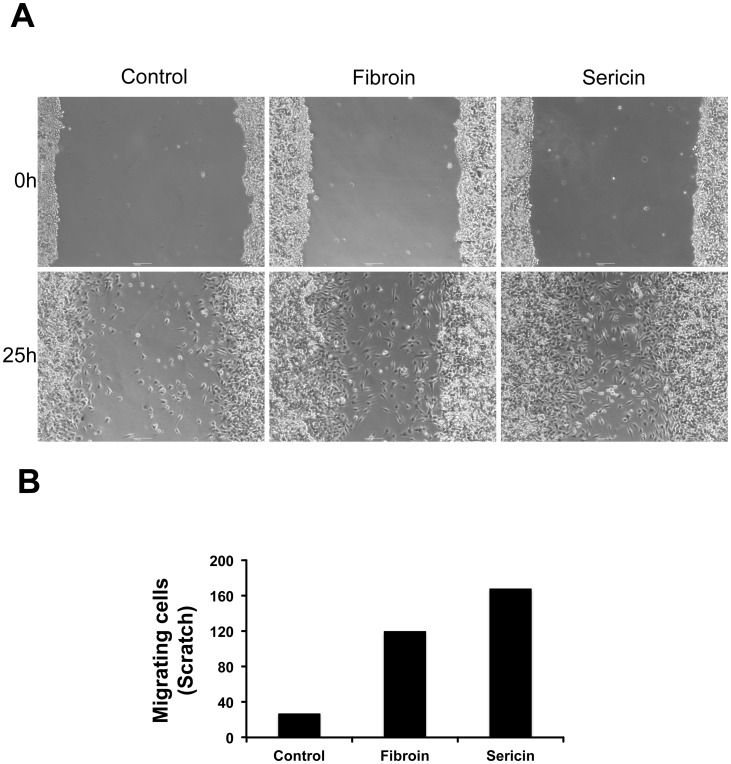
Wound healing is a biological process directed to the restoration of tissue that has suffered an injury. An important phase of wound healing is the generation of a basal epithelium able to wholly replace the epidermis of the wound. A broad range of products derived from fibroin and sericin from Bombyx mori silk are used to stimulate wound healing. However, so far the molecular mechanism underlying this phenomenon has not been elucidated. The aim of this work was to determine the molecular basis underlying wound healing properties of silk proteins using a cell model. For this purpose, we assayed fibroin and sericin in a wound healing scratch assay using MDA-MB-231 and Mv1Lu cells. Both proteins stimulated cell migration. Furthermore, treatment with sericin and fibroin involved key factors of the wound healing process such as upregulation of c-Jun and c-Jun protein phosphorylation. Moreover, fibroin and sericin stimulated the phosphorylation of ERK 1/2 and JNK 1/2 kinases. All these experiments were done in the presence of specific inhibitors for some of the cell signalling pathways referred above. The obtained results revealed that MEK, JNK and PI3K pathways are involved in fibroin and sericin stimulated cells migration. Inhibition of these three kinases prevented c-Jun upregulation and phosphorylation by fibroin or sericin. Fibroin and sericin were tested in the human keratinocyte cell line, HaCaT, with similar results. Altogether, our results showed that fibroin and sericin initiate cell migration by activating the MEK, JNK and PI3K signalling pathways ending in c-Jun activation.
伤口愈合是一个旨在修复受损组织的生物学过程。伤口愈合的一个重要阶段是生成能够完全替代伤口表皮的基底上皮。广泛使用丝素和丝胶等来源于家蚕(Bombyx mori)丝的产物来刺激伤口愈合。然而,到目前为止,这种现象的分子机制尚未阐明。本工作旨在使用细胞模型来确定丝蛋白促进伤口愈合特性的分子基础。为此,我们在 MDA-MB-231 和 Mv1Lu 细胞的划痕愈合试验中检测了丝素和丝胶。这两种蛋白都能刺激细胞迁移。此外,丝胶和丝素的处理涉及伤口愈合过程中的关键因素,如 c-Jun 和 c-Jun 蛋白磷酸化的上调。此外,丝素和丝胶还能刺激 ERK 1/2 和 JNK 1/2 激酶的磷酸化。所有这些实验都是在上述某些细胞信号通路的特定抑制剂存在下进行的。获得的结果表明,MEK、JNK 和 PI3K 通路参与了丝素和丝胶刺激的细胞迁移。这三种激酶的抑制阻止了丝素或丝胶对 c-Jun 的上调和磷酸化。丝素和丝胶在人角质形成细胞系 HaCaT 中的测试也得到了类似的结果。总之,我们的结果表明,丝素和丝胶通过激活 MEK、JNK 和 PI3K 信号通路来启动细胞迁移,最终激活 c-Jun。