Health Information Research Unit, Department of Clinical Epidemiology and Biostatistics, McMaster University, CRL-139 1280 Main Street, West Hamilton, ON L8S 4 K1, Canada.
Implement Sci. 2012 Aug 3;7:72. doi: 10.1186/1748-5908-7-72.
This project engages patients and physicians in the development of Decision Boxes, short clinical topic summaries covering medical questions that have no single best answer. Decision Boxes aim to prepare the clinician to communicate the risks and benefits of the available options to the patient so they can make an informed decision together.
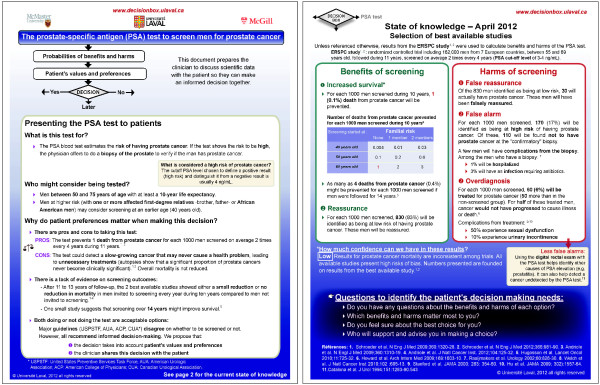
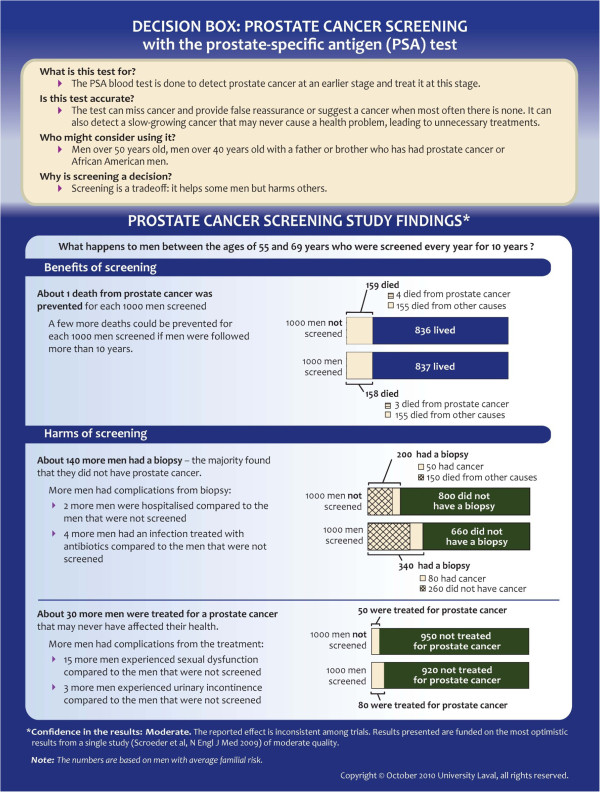
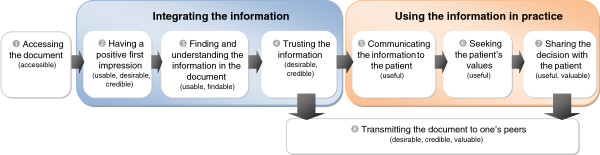
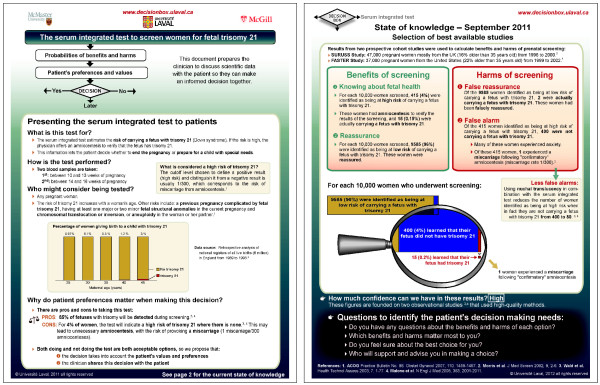
Seven researchers (including four practicing family physicians) selected 10 clinical topics relevant to primary care practice through a Delphi survey. We then developed two one-page prototypes on two of these topics: prostate cancer screening with the prostate-specific antigen test, and prenatal screening for trisomy 21 with the serum integrated test. We presented the prototypes to purposeful samples of family physicians distributed in two focus groups, and patients distributed in four focus groups. We used the User Experience Honeycomb to explore barriers and facilitators to the communication design used in Decision Boxes. All discussions were transcribed, and three researchers proceeded to thematic content analysis of the transcriptions. The coding scheme was first developed from the Honeycomb's seven themes (valuable, usable, credible, useful, desirable, accessible, and findable), and included new themes suggested by the data. Prototypes were modified in light of our findings.
Three rounds were necessary for a majority of researchers to select 10 clinical topics. Fifteen physicians and 33 patients participated in the focus groups. Following analyses, three sections were added to the Decision Boxes: introduction, patient counseling, and references. The information was spread to two pages to try to make the Decision Boxes less busy and improve users' first impression. To try to improve credibility, we gave more visibility to the research institutions involved in development. A statement on the boxes' purpose and a flow chart representing the shared decision-making process were added with the intent of clarifying the tool's purpose. Information about the risks and benefits according to risk levels was added to the Decision Boxes, to try to ease the adaptation of the information to individual patients.
Results will guide the development of the eight remaining Decision Boxes. A future study will evaluate the effect of Decision Boxes on the integration of evidence-based and shared decision making principles in clinical practice.
本项目使患者和医生共同参与决策盒的制定,决策盒是对没有单一最佳答案的医学问题的简短临床主题总结。决策盒旨在使临床医生能够向患者传达可用选择的风险和益处,以便他们共同做出明智的决策。
通过德尔菲调查,七名研究人员(包括四名执业家庭医生)选择了 10 个与初级保健实践相关的临床主题。然后,我们在其中两个主题上开发了两个一页的原型:前列腺特异性抗原检测的前列腺癌筛查,以及血清综合检测的 21 三体产前筛查。我们向分布在两个焦点小组的家庭医生和分布在四个焦点小组的患者展示了这些原型。我们使用用户体验蜂巢来探索决策盒中使用的沟通设计的障碍和促进因素。所有讨论都被转录,然后由三名研究人员对转录内容进行主题内容分析。该编码方案首先是从蜂巢的七个主题(有价值、可用、可信、有用、可取、可访问和可发现)中开发的,并包括数据中提出的新主题。根据我们的发现,对原型进行了修改。
多数研究人员需要三轮才能选择 10 个临床主题。15 名医生和 33 名患者参加了焦点小组。经过分析,在决策盒中添加了三个部分:引言、患者咨询和参考文献。信息扩展到两页,以尝试使决策盒不那么繁忙并改善用户的第一印象。为了提高可信度,我们增加了参与开发的研究机构的可见度。添加了关于盒子目的的声明和代表共享决策过程的流程图,旨在阐明工具的目的。根据风险水平添加了关于风险和益处的信息,以尝试使信息更容易适应个别患者。
结果将指导其余 8 个决策盒的开发。未来的研究将评估决策盒对将循证和共享决策原则整合到临床实践中的影响。