Chesterfield Village Research Center, Monsanto Company, 700 Chesterfield Parkway, North Chesterfield, MO 63017, USA.
BMC Genomics. 2012 Aug 8;13:381. doi: 10.1186/1471-2164-13-381.
Plants contain significant quantities of small RNAs (sRNAs) derived from various sRNA biogenesis pathways. Many of these sRNAs play regulatory roles in plants. Previous analysis revealed that numerous sRNAs in corn, rice and soybean seeds have high sequence similarity to animal genes. However, exogenous RNA is considered to be unstable within the gastrointestinal tract of many animals, thus limiting potential for any adverse effects from consumption of dietary RNA. A recent paper reported that putative plant miRNAs were detected in animal plasma and serum, presumably acquired through ingestion, and may have a functional impact in the consuming organisms.
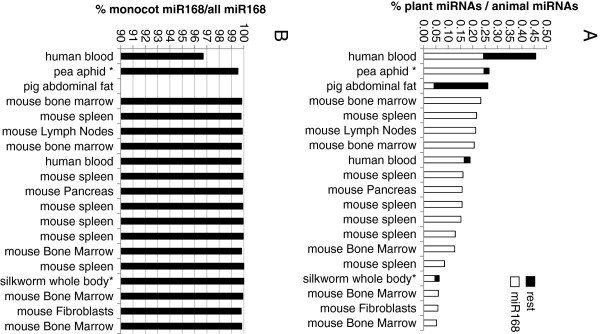
To address the question of how common this phenomenon could be, we searched for plant miRNAs sequences in public sRNA datasets from various tissues of mammals, chicken and insects. Our analyses revealed that plant miRNAs were present in the animal sRNA datasets, and significantly miR168 was extremely over-represented. Furthermore, all or nearly all (>96%) miR168 sequences were monocot derived for most datasets, including datasets for two insects reared on dicot plants in their respective experiments. To investigate if plant-derived miRNAs, including miR168, could accumulate and move systemically in insects, we conducted insect feeding studies for three insects including corn rootworm, which has been shown to be responsive to plant-produced long double-stranded RNAs.
Our analyses suggest that the observed plant miRNAs in animal sRNA datasets can originate in the process of sequencing, and that accumulation of plant miRNAs via dietary exposure is not universal in animals.
植物中含有大量来源于各种 sRNA 生物发生途径的小 RNA(sRNA)。这些 sRNA 中的许多在植物中发挥着调控作用。先前的分析表明,玉米、水稻和大豆种子中的许多 sRNA 与动物基因具有很高的序列相似性。然而,外源 RNA 被认为在许多动物的胃肠道内不稳定,从而限制了饮食 RNA 摄入可能产生的任何不良影响。最近的一篇论文报道,在动物血浆和血清中检测到了假定的植物 miRNA,推测是通过摄入获得的,并且可能对摄入的生物体产生功能影响。
为了解决这种现象可能有多普遍的问题,我们在来自哺乳动物、鸡和昆虫的各种组织的公共 sRNA 数据集搜索植物 miRNA 序列。我们的分析表明,植物 miRNA 存在于动物 sRNA 数据集中,并且 miR168 显著过度表达。此外,对于大多数数据集,包括在其各自实验中用双子叶植物饲养的两种昆虫的数据集,所有或几乎所有 (>96%) miR168 序列均来自单子叶植物。为了研究包括 miR168 在内的植物源性 miRNA 是否可以在昆虫中积累并在体内系统移动,我们对包括玉米根虫在内的三种昆虫进行了昆虫喂养研究,玉米根虫已被证明对植物产生的长双链 RNA 有反应。
我们的分析表明,在动物 sRNA 数据集中观察到的植物 miRNA 可能起源于测序过程,并且通过饮食暴露积累植物 miRNA 并不是动物中的普遍现象。