Chen Connie, Haddad David, Selsky Joshua, Hoffman Julia E, Kravitz Richard L, Estrin Deborah E, Sim Ida
School of Medicine, Department of Medicine, University of California San Francisco, San Francisco, CA 94143-0320, United States.
J Med Internet Res. 2012 Aug 9;14(4):e112. doi: 10.2196/jmir.2152.
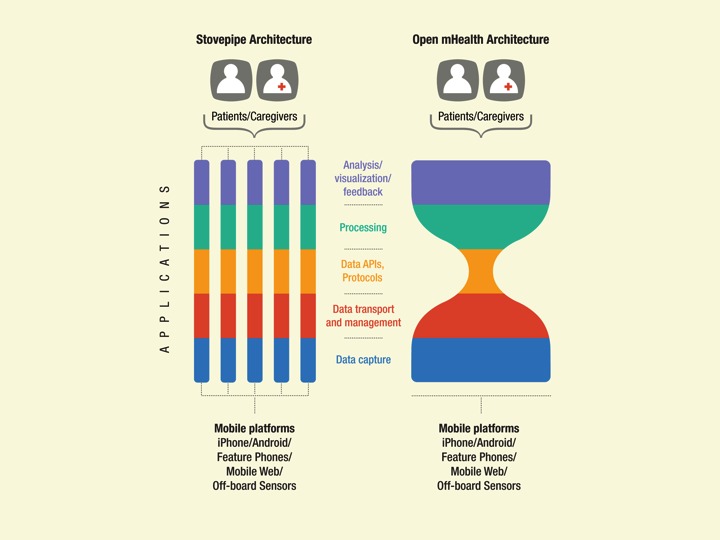
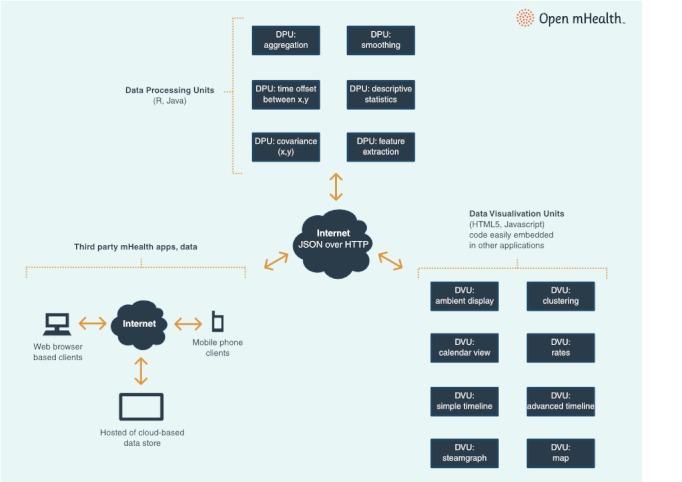
Mobile phones and devices, with their constant presence, data connectivity, and multiple intrinsic sensors, can support around-the-clock chronic disease prevention and management that is integrated with daily life. These mobile health (mHealth) devices can produce tremendous amounts of location-rich, real-time, high-frequency data. Unfortunately, these data are often full of bias, noise, variability, and gaps. Robust tools and techniques have not yet been developed to make mHealth data more meaningful to patients and clinicians. To be most useful, health data should be sharable across multiple mHealth applications and connected to electronic health records. The lack of data sharing and dearth of tools and techniques for making sense of health data are critical bottlenecks limiting the impact of mHealth to improve health outcomes. We describe Open mHealth, a nonprofit organization that is building an open software architecture to address these data sharing and "sense-making" bottlenecks. Our architecture consists of open source software modules with well-defined interfaces using a minimal set of common metadata. An initial set of modules, called InfoVis, has been developed for data analysis and visualization. A second set of modules, our Personal Evidence Architecture, will support scientific inferences from mHealth data. These Personal Evidence Architecture modules will include standardized, validated clinical measures to support novel evaluation methods, such as n-of-1 studies. All of Open mHealth's modules are designed to be reusable across multiple applications, disease conditions, and user populations to maximize impact and flexibility. We are also building an open community of developers and health innovators, modeled after the open approach taken in the initial growth of the Internet, to foster meaningful cross-disciplinary collaboration around new tools and techniques. An open mHealth community and architecture will catalyze increased mHealth efficiency, effectiveness, and innovation.
移动电话及设备因其随时可用、具备数据连接功能以及多种内置传感器,能够支持与日常生活相结合的全天候慢性病预防与管理。这些移动健康(mHealth)设备可产生大量包含丰富位置信息的实时高频数据。不幸的是,这些数据往往充满偏差、噪声、变异性和缺口。目前尚未开发出强大的工具和技术来使移动健康数据对患者和临床医生更具意义。为发挥最大效用,健康数据应能在多个移动健康应用程序之间共享,并与电子健康记录相连。缺乏数据共享以及用于理解健康数据的工具和技术匮乏,是限制移动健康改善健康结果影响力的关键瓶颈。我们介绍了开放移动健康组织,这是一个非营利组织,正在构建一个开放软件架构来解决这些数据共享和“理解数据”的瓶颈问题。我们的架构由具有明确定义接口的开源软件模块组成,使用最少的一组通用元数据。已开发出一组初始模块,称为信息可视化(InfoVis),用于数据分析和可视化。第二组模块,即我们的个人证据架构,将支持从移动健康数据进行科学推断。这些个人证据架构模块将包括标准化、经过验证的临床测量方法,以支持新颖的评估方法,如单病例研究。开放移动健康组织的所有模块都设计为可在多个应用程序、疾病状况和用户群体中重复使用,以最大限度地提高影响力和灵活性。我们还在构建一个由开发者和健康创新者组成的开放社区,效仿互联网初期发展所采用的开放方式,以促进围绕新工具和技术开展有意义的跨学科合作。一个开放的移动健康社区和架构将促进移动健康提高效率、增强效果并推动创新。