Laboratory Medicine, University of California San Francisco, 2340 Sutter Street Box 0808, San Francisco, CA 94115, USA.
Breast Cancer Res Treat. 2012 Sep;135(2):505-17. doi: 10.1007/s10549-012-2188-0. Epub 2012 Aug 9.
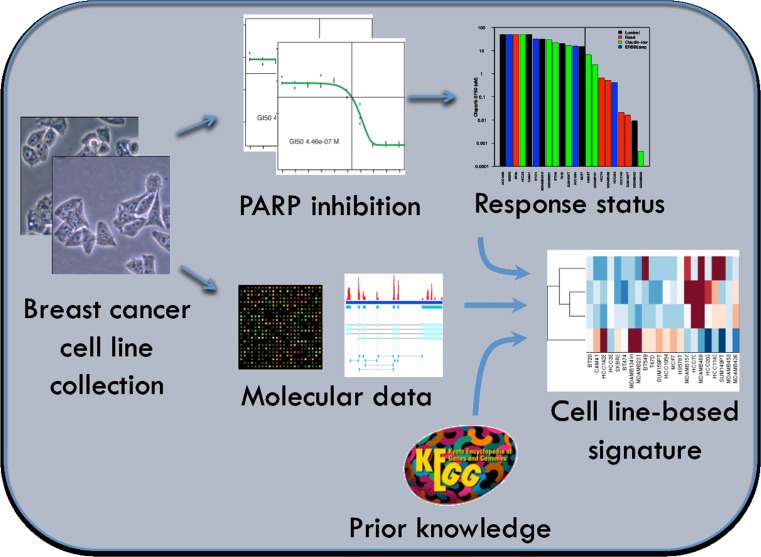
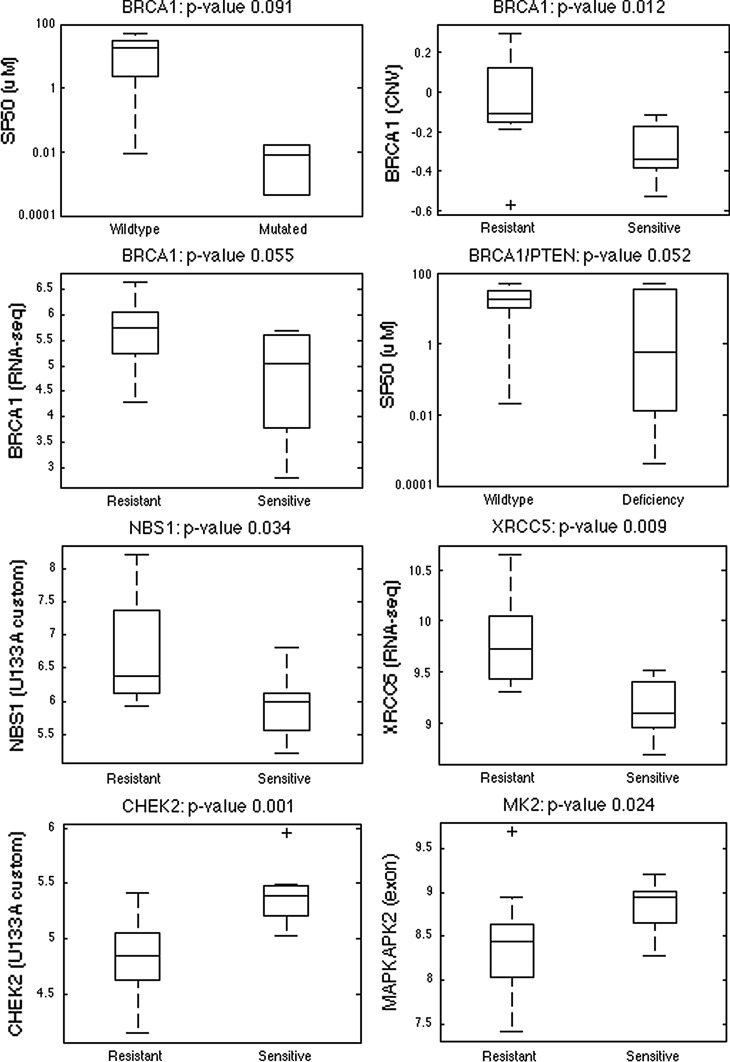
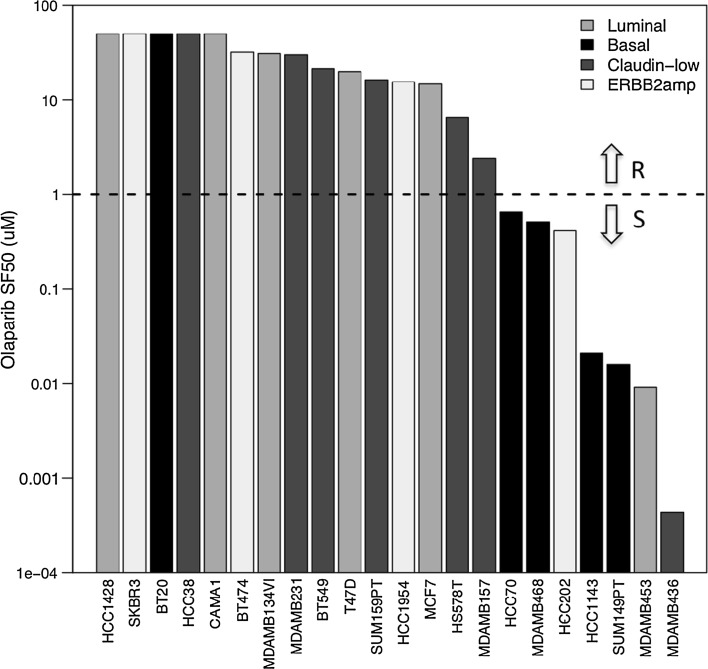
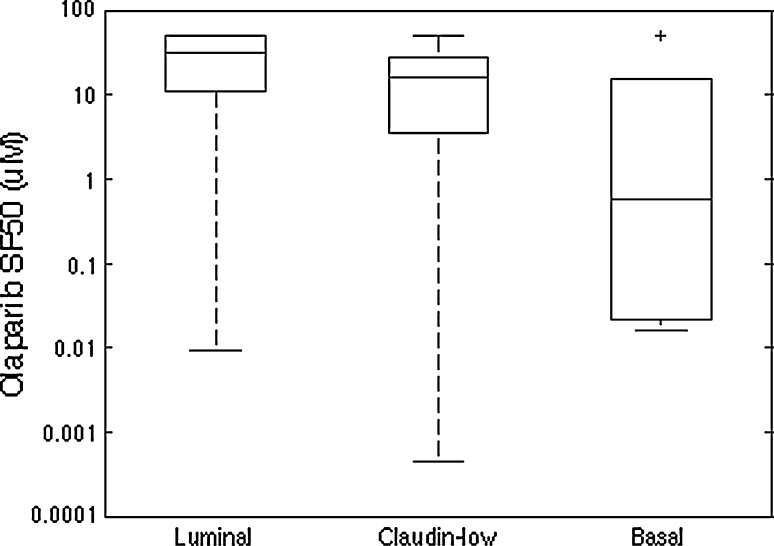
Poly(ADP-ribose) polymerase (PARP) is an enzyme involved in DNA repair. PARP inhibitors can act as chemosensitizers, or operate on the principle of synthetic lethality when used as single agent. Clinical trials have shown drugs in this class to be promising for BRCA mutation carriers. We postulated that inability to demonstrate response in non-BRCA carriers in which BRCA is inactivated by other mechanisms or with deficiency in homologous recombination for DNA repair is due to lack of molecular markers that define a responding subpopulation. We identified candidate markers for this purpose for olaparib (AstraZeneca) by measuring inhibitory effects of nine concentrations of olaparib in 22 breast cancer cell lines and identifying features in transcriptional and genome copy number profiles that were significantly correlated with response. We emphasized in this discovery process genes involved in DNA repair. We found that the cell lines that were sensitive to olaparib had a significant lower copy number of BRCA1 compared to the resistant cell lines (p value 0.012). In addition, we discovered seven genes from DNA repair pathways whose transcriptional levels were associated with response. These included five genes (BRCA1, MRE11A, NBS1, TDG, and XPA) whose transcript levels were associated with resistance and two genes (CHEK2 and MK2) whose transcript levels were associated with sensitivity. We developed an algorithm to predict response using the seven-gene transcription levels and applied it to 1,846 invasive breast cancer samples from 8 U133A/plus 2 (Affymetrix) data sets and found that 8-21 % of patients would be predicted to be responsive to olaparib. A similar response frequency was predicted in 536 samples analyzed on an Agilent platform. Importantly, tumors predicted to respond were enriched in basal subtype tumors. Our studies support clinical evaluation of the utility of our seven-gene signature as a predictor of response to olaparib.
聚(ADP-核糖)聚合酶(PARP)是一种参与 DNA 修复的酶。PARP 抑制剂可用作化疗增敏剂,或作为单一药物,基于合成致死原理发挥作用。临床试验表明,该类药物在 BRCA 突变携带者中具有广阔的应用前景。我们假设,在 BRCA 因其他机制失活或同源重组缺陷导致 DNA 修复的非 BRCA 携带者中,无法观察到疗效,这是因为缺乏可定义应答亚群的分子标志物。我们为此目的选择奥拉帕利(阿斯利康),通过测量 22 种乳腺癌细胞系中 9 种奥拉帕利浓度的抑制作用,确定与应答显著相关的转录和基因组拷贝数谱特征中的候选标志物。在这一发现过程中,我们特别强调了与 DNA 修复相关的基因。我们发现,对奥拉帕利敏感的细胞系中 BRCA1 的拷贝数明显低于耐药细胞系(p 值=0.012)。此外,我们还发现了 7 个来自 DNA 修复途径的基因,其转录水平与应答相关。这些基因包括 5 个(BRCA1、MRE11A、NBS1、TDG 和 XPA)的转录水平与耐药相关,以及 2 个(CHEK2 和 MK2)的转录水平与敏感相关。我们开发了一种使用这 7 个基因转录水平预测应答的算法,并将其应用于 8 个 U133A/plus 2(Affymetrix)数据集的 1846 例浸润性乳腺癌样本中,发现 8-21%的患者可能对奥拉帕利有反应。在 536 个在安捷伦平台上分析的样本中,预测到了类似的应答频率。重要的是,预测为应答的肿瘤在基底型肿瘤中富集。我们的研究支持对该 7 基因特征作为奥拉帕利应答预测因子的临床评估。