Departamento de Ingeniería Celular y Biocatálisis, Instituto de Biotecnología, Universidad Nacional Autónoma de México (UNAM), Cuernavaca, Morelos 62210, México.
BMC Genomics. 2012 Aug 10;13:385. doi: 10.1186/1471-2164-13-385.
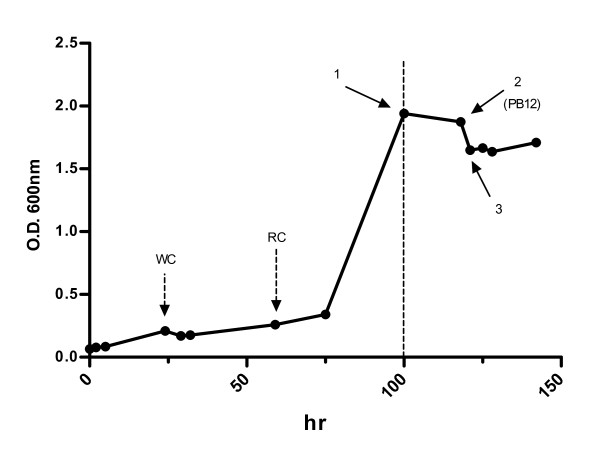
Escherichia coli strains lacking the phosphoenolpyruvate: carbohydrate phosphotransferase system (PTS), which is the major bacterial component involved in glucose transport and its phosphorylation, accumulate high amounts of phosphoenolpyruvate that can be diverted to the synthesis of commercially relevant products. However, these strains grow slowly in glucose as sole carbon source due to its inefficient transport and metabolism. Strain PB12, with 400% increased growth rate, was isolated after a 120 hours adaptive laboratory evolution process for the selection of faster growing derivatives in glucose. Analysis of the genetic changes that occurred in the PB12 strain that lacks PTS will allow a better understanding of the basis of its growth adaptation and, therefore, in the design of improved metabolic engineering strategies for enhancing carbon diversion into the aromatic pathways.
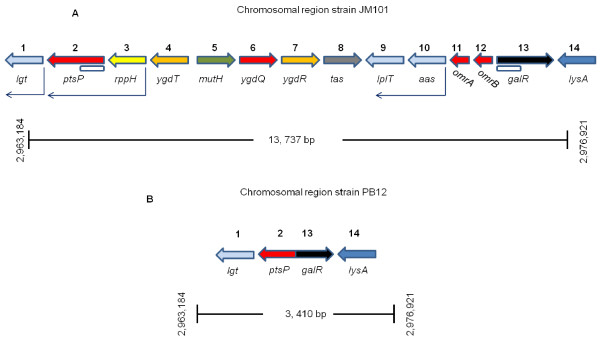
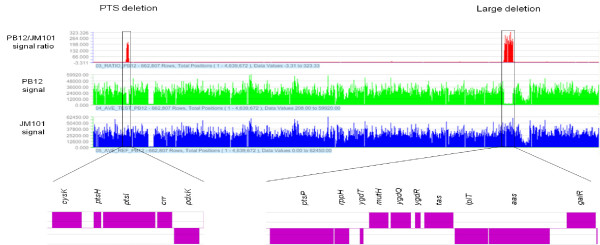
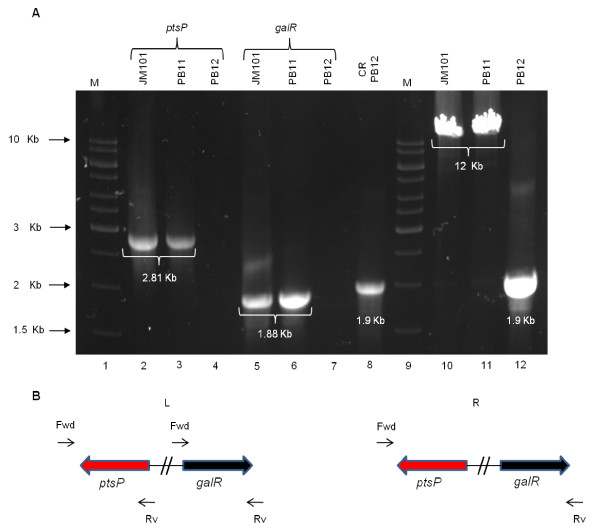
Whole genome analyses using two different sequencing methodologies: the Roche NimbleGen Inc. comparative genome sequencing technique, and high throughput sequencing with Illumina Inc. GAIIx, allowed the identification of the genetic changes that occurred in the PB12 strain. Both methods detected 23 non-synonymous and 22 synonymous point mutations. Several non-synonymous mutations mapped in regulatory genes (arcB, barA, rpoD, rna) and in other putative regulatory loci (yjjU, rssA and ypdA). In addition, a chromosomal deletion of 10,328 bp was detected that removed 12 genes, among them, the rppH, mutH and galR genes. Characterization of some of these mutated and deleted genes with their functions and possible functions, are presented.
The deletion of the contiguous rppH, mutH and galR genes that occurred simultaneously, is apparently the main reason for the faster growth of the evolved PB12 strain. In support of this interpretation is the fact that inactivation of the rppH gene in the parental PB11 strain substantially increased its growth rate, very likely by increasing glycolytic mRNA genes stability. Furthermore, galR inactivation allowed glucose transport by GalP into the cell. The deletion of mutH in an already stressed strain that lacks PTS is apparently responsible for the very high mutation rate observed.
缺乏磷酸烯醇丙酮酸:碳水化合物磷酸转移酶系统(PTS)的大肠杆菌菌株,PTS 是参与葡萄糖运输及其磷酸化的主要细菌成分,会积累大量的磷酸烯醇丙酮酸,这些丙酮酸可以被转移到商业相关产品的合成中。然而,由于其葡萄糖运输和代谢效率低下,这些菌株在以葡萄糖为唯一碳源时生长缓慢。经过 120 小时的适应性实验室进化过程,选择生长更快的葡萄糖衍生物,分离出生长速度提高 400%的 PB12 菌株。分析缺乏 PTS 的 PB12 菌株发生的遗传变化将有助于更好地理解其生长适应的基础,从而设计出改进的代谢工程策略,以增强碳向芳香途径的转移。
使用两种不同的测序方法(罗氏 NimbleGen Inc. 比较基因组测序技术和 Illumina Inc. GAIIx 的高通量测序)进行全基因组分析,鉴定出 PB12 菌株发生的遗传变化。两种方法均检测到 23 个非同义点突变和 22 个同义点突变。一些非同义突变映射到调节基因(arcB、barA、rpoD、rna)和其他假定的调节基因座(yjjU、rssA 和 ypdA)。此外,检测到 10328bp 的染色体缺失,该缺失消除了 12 个基因,其中包括 rppH、mutH 和 galR 基因。介绍了其中一些突变和缺失基因的功能和可能的功能特征。
同时发生的连续 rppH、mutH 和 galR 基因缺失显然是进化后的 PB12 菌株生长更快的主要原因。支持这一解释的事实是,在缺乏 PTS 的亲本 PB11 菌株中失活 rppH 基因显著提高了其生长速度,很可能是通过增加糖酵解 mRNA 基因的稳定性。此外,galR 的失活允许 GalP 将葡萄糖运入细胞。在已经受到 PTS 压力的菌株中缺失 mutH 显然是导致观察到的高突变率的原因。