Pilling Darrell, Gomer Richard H
Texas A&M University, College Station, TX, USA.
Methods Mol Biol. 2012;904:191-206. doi: 10.1007/978-1-61779-943-3_16.
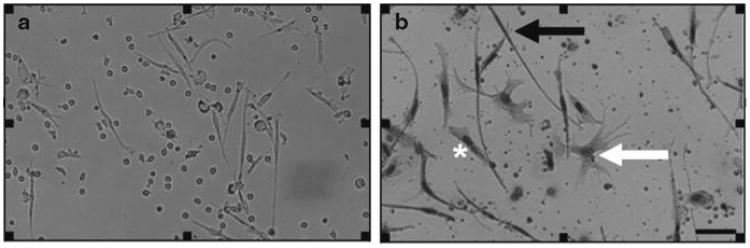
Monocytes are produced in the bone marrow and enter the blood. They generally leave the blood and enter a tissue, and then become macrophages. In healing wounds, circulating monocytes also enter the tissue and instead of becoming macrophages, can differentiate into fibroblast-like cells called fibrocytes. Fibrocytes are also present in the lesions associated with fibrosing diseases such as congestive heart failure, end stage kidney disease, and pulmonary fibrosis. We have found that culturing blood monocytes, or white blood cell preparations containing monocytes, in serum-free media permits some of the monocytes to differentiate into fibrocytes within 5 days, and that this differentiation is inhibited by the blood plasma protein serum amyloid P.
单核细胞在骨髓中产生并进入血液。它们通常离开血液进入组织,然后变成巨噬细胞。在愈合伤口时,循环中的单核细胞也进入组织,并且不会变成巨噬细胞,而是可以分化为称为纤维细胞的成纤维细胞样细胞。纤维细胞也存在于与纤维化疾病相关的病变中,如充血性心力衰竭、终末期肾病和肺纤维化。我们发现,在无血清培养基中培养血液单核细胞或含有单核细胞的白细胞制剂,可使一些单核细胞在5天内分化为纤维细胞,并且这种分化受到血浆蛋白血清淀粉样蛋白P的抑制。