Acupuncture and Tuina School, Chengdu University of Traditional Chinese Medicine, Chengdu, China.
BMC Complement Altern Med. 2012 Aug 15;12:123. doi: 10.1186/1472-6882-12-123.
In the field of acupuncture research, the topic of acupoint specificity has received increasing attention, but no unified conclusion has been reached on whether or not acupoint specificity exists. Furthermore, the majority of previous acupuncture neuroimaging studies have been performed using healthy subjects. In this study, patients with migraine were used to investigate acupoint specificity.
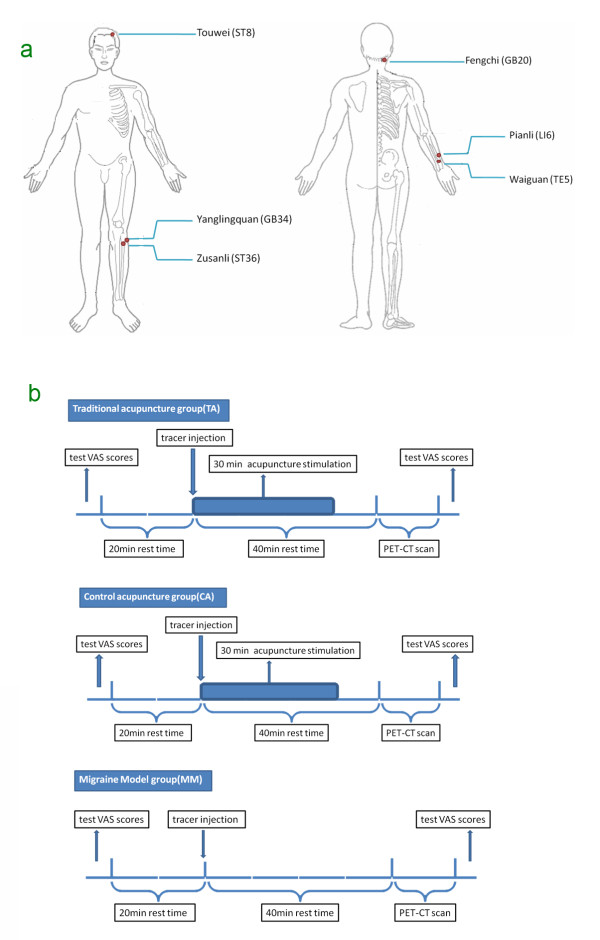
Thirty patients with migraine were enrolled and randomized into three groups: Traditional Acupuncture Group (TAG), Control Acupuncture Group (CAG), and Migraine Group (MG). The TAG was treated by acupuncture stimulation at Waiguan (TE5), Yang Lingquan (GB34), and Fengchi (GB20). The CAG was treated at Touwei (ST8), Pianli (LI6), and Zusanli (ST36). The MG received no treatment. Positron emission tomography with computed tomography (PET-CT) was used to test for differences in brain activation between the TAG and CAG versus MG, respectively.
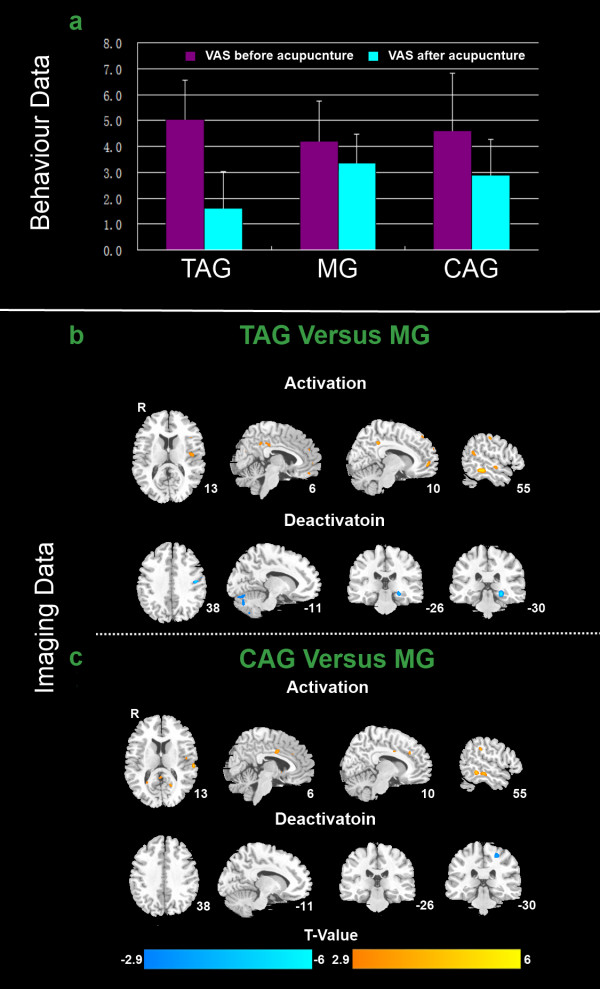
Traditional acupuncture treatment was more effective for pain reduction than control acupuncture treatment. The TAG showed higher brain metabolism than the MG in the middle temporal cortex (MTC), orbital frontal cortex (OFC), insula, middle frontal gyrus, angular gyrus, post-cingulate cortex (PCC), the precuneus, and the middle cingulate cortex (MCC). Metabolism decreased in the parahippocampus, hippocampus, fusiform gyrus, postcentral gyrus, and cerebellum in the TAG compared with the MG. In the CAG, metabolism increased compared with the MG in the MTC, supratemporal gyrus, supramarginal gyrus, and MCC, whereas metabolism decreased in the cerebellum.
Acupuncture stimulation of different points on similar body regions in migraine patients reduced pain and induced different levels of cerebral glucose metabolism in pain-related brain regions. These findings may support the functional specificity of migraine- treatment-related acupoint.
The number of our clinical trial registration is: ChiCTR-TRC-11001813, and the protocol and inclusion criteria have already been registered as ChiCTR-TRC-11001813.
在针灸研究领域,穴位特异性的话题受到越来越多的关注,但关于穴位是否具有特异性尚未得出统一结论。此外,大多数先前的针灸神经影像学研究都是在健康受试者中进行的。本研究采用偏头痛患者来探讨穴位特异性。
纳入 30 例偏头痛患者,随机分为传统针刺组(TAG)、对照针刺组(CAG)和偏头痛组(MG)。TAG 组针刺刺激外关(TE5)、阳陵泉(GB34)和风池(GB20)。CAG 组针刺刺激头维(ST8)、偏历(LI6)和足三里(ST36)。MG 组不接受治疗。正电子发射断层扫描与计算机断层扫描(PET-CT)用于测试分别针对 TAG 和 CAG 与 MG 之间的脑激活差异。
与对照针刺治疗相比,传统针刺治疗更能有效减轻疼痛。与 MG 相比,TAG 在中颞叶皮质(MTC)、眶额皮质(OFC)、岛叶、中额回、角回、后扣带皮层(PCC)、楔前叶和中扣带皮层(MCC)显示出更高的脑代谢。与 MG 相比,TAG 中内嗅皮层、海马体、梭状回、后中央回和小脑的代谢降低。与 MG 相比,CAG 在 MTC、颞上回、缘上回和 MCC 中代谢增加,而小脑代谢降低。
在偏头痛患者中对相似体区的不同穴位进行针刺刺激可减轻疼痛,并在与疼痛相关的脑区诱导不同程度的脑葡萄糖代谢。这些发现可能支持偏头痛治疗相关穴位的功能特异性。
我们的临床试验注册号为:ChiCTR-TRC-11001813,方案和纳入标准已经注册为 ChiCTR-TRC-11001813。