Department of Clinical Neuropsychology, VU University, Amsterdam, The Netherlands.
BMC Neurol. 2012 Aug 16;12:75. doi: 10.1186/1471-2377-12-75.
Although the development of early-onset dementia is a radical and invalidating experience for both patient and family there are hardly any non-pharmacological studies that focus on this group of patients. One type of a non-pharmacological intervention that appears to have a beneficial effect on cognition in older persons without dementia and older persons at risk for dementia is exercise. In view of their younger age early-onset dementia patients may be well able to participate in an exercise program. The main aim of the EXERCISE-ON study is to assess whether exercise slows down the progressive course of the symptoms of dementia.
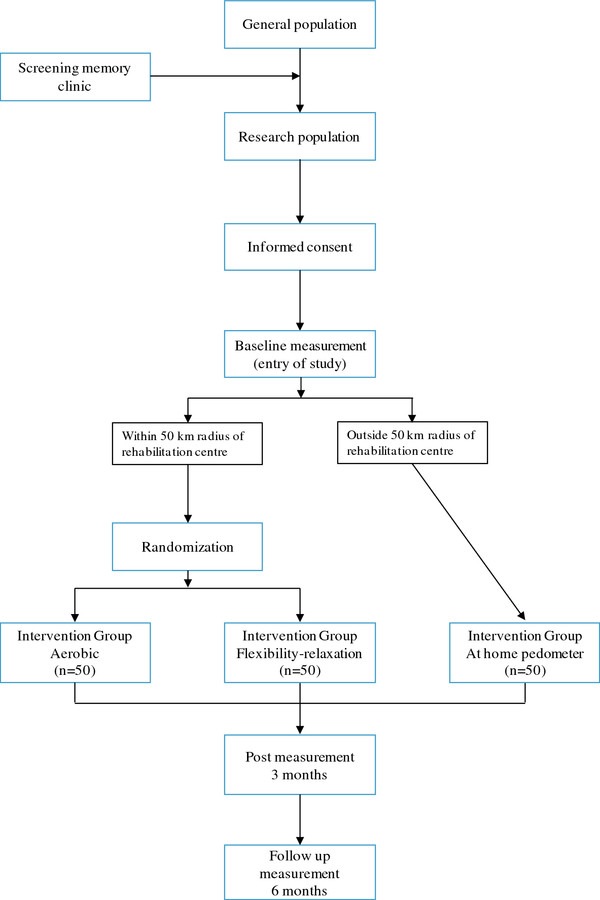
METHODS/DESIGN: One hundred and fifty patients with early-onset dementia are recruited. After completion of the baseline measurements, participants living within a 50 kilometre radius to one of the rehabilitation centres are randomly assigned to either an aerobic exercise program in a rehabilitation centre or a flexibility and relaxation program in a rehabilitation centre. Both programs are applied three times a week during 3 months. Participants living outside the 50 kilometre radius are included in a feasibility study where participants join in a daily physical activity program set at home making use of pedometers. Measurements take place at baseline (entry of the study), after three months (end of the exercise program) and after six months (follow-up). Primary outcomes are cognitive functioning; psychomotor speed and executive functioning; (instrumental) activities of daily living, and quality of life. Secondary outcomes include physical, neuropsychological, and rest-activity rhythm measures.
The EXERCISE-ON study is the first study to offer exercise programs to patients with early-onset dementia. We expect this study to supply evidence regarding the effects of exercise on the symptoms of early-onset dementia, influencing quality of life.
The present study is registered within The Netherlands National Trial Register (ref: NTR2124).
尽管早发性痴呆的发展对患者和家庭都是一种彻底的、使人丧失能力的经历,但几乎没有任何非药物研究关注这组患者。一种似乎对没有痴呆的老年人和有痴呆风险的老年人的认知有有益影响的非药物干预类型是锻炼。鉴于早发性痴呆患者年龄较轻,他们可能能够很好地参与锻炼计划。EXERCISE-ON 研究的主要目的是评估锻炼是否能减缓痴呆症状的进展过程。
方法/设计:招募了 150 名早发性痴呆患者。在完成基线测量后,居住在距离康复中心 50 公里范围内的参与者被随机分配到康复中心的有氧运动计划或康复中心的柔韧性和放松计划中。这两个方案均每周进行 3 次,持续 3 个月。居住在 50 公里半径以外的参与者将参加一项可行性研究,参与者在家中使用计步器参加每天的体育活动计划。测量在基线(研究开始时)、3 个月后(锻炼计划结束时)和 6 个月后(随访时)进行。主要结果是认知功能;心理运动速度和执行功能;(工具)日常生活活动和生活质量。次要结果包括身体、神经心理学和休息-活动节律测量。
EXERCISE-ON 研究是第一项为早发性痴呆患者提供锻炼计划的研究。我们期望这项研究能提供关于锻炼对早发性痴呆症状的影响的证据,从而影响生活质量。
本研究在荷兰国家试验注册中心(注册号:NTR2124)注册。