Swiss Tropical and Public Health Institute, Socinstrasse 57, Basel, CH-4002, Switzerland.
BMC Public Health. 2012 Aug 21;12:683. doi: 10.1186/1471-2458-12-683.
It is unclear how long it takes for health interventions to transition from research and development (R&D) to being used against diseases prevalent in resource-poor countries. We undertook an analysis of the time required to begin implementation of four vaccines and three malaria interventions. We evaluated five milestones for each intervention, and assessed if the milestones were associated with beginning implementation.
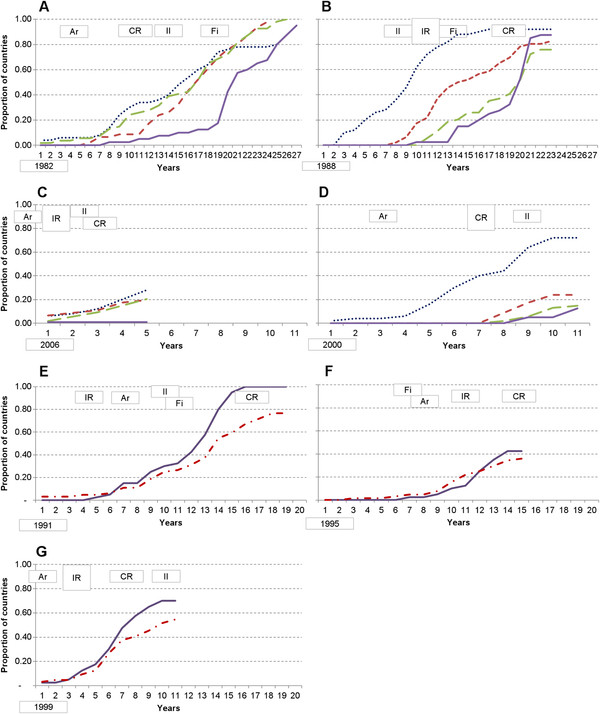
The authors screened World Health Organization (WHO) databases to determine the number of years between first regulatory approval of interventions, and countries beginning implementation. Descriptive analyses of temporal patterns and statistical analyses using logistic regression and Cox proportional hazard models were used to evaluate associations between five milestones and the beginning of implementation for each intervention. The milestones were: (A) presence of a coordinating group focused on the intervention; (B) availability of an intervention tailored to developing country health systems; (C) international financing commitment, and; (D) initial and (E) comprehensive WHO recommendations. Countries were categorized by World Bank income criteria.
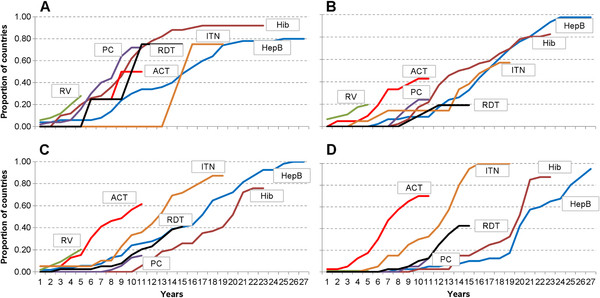
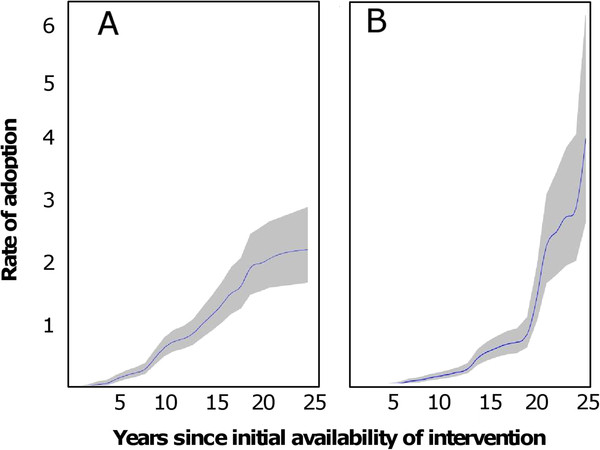
Five years after regulatory approval, no low-income countries (LICs) had begun implementing any of the vaccines, increasing to an average of only 4% of LICs after 10 years. Each malaria intervention was used by an average of 7% of LICs after five years and 37% after 10 years. Four of the interventions had similar implementation rates to hepatitis B vaccine (HepB), while one was slower and one was faster than HepB. A financing commitment and initial WHO recommendation appeared to be temporally associated with the beginning of implementation. The initial recommendation from WHO was the only milestone associated in all statistical analyses with countries beginning implementation (relative rate = 1.97, P < 0.001).
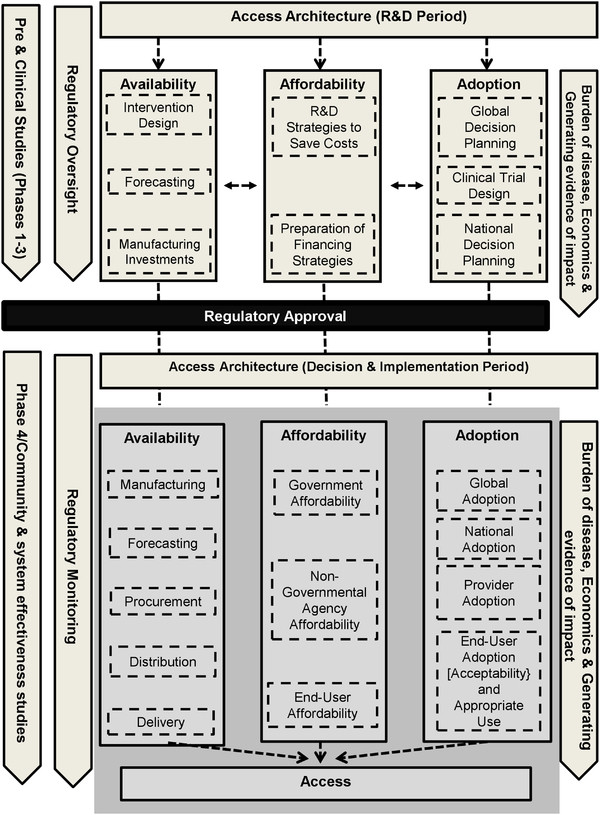
Although possible that four milestones were not associated with countries beginning implementation, we propose an alternative interpretation; that the milestones were not realized early enough in each intervention's development to shorten the time to beginning implementation. We discuss a framework built upon existing literature for consideration during the development of future interventions. Identifying critical milestones and their timing relative to R&D, promises to help new interventions realize their intended public health impact more rapidly.
尚不清楚卫生干预措施从研发(R&D)过渡到用于资源匮乏国家流行疾病需要多长时间。我们对四种疫苗和三种疟疾干预措施开始实施所需的时间进行了分析。我们评估了每种干预措施的五个里程碑,并评估了这些里程碑是否与开始实施相关。
作者筛选了世界卫生组织(WHO)数据库,以确定干预措施首次获得监管批准与国家开始实施之间的年数。采用描述性分析和逻辑回归及 Cox 比例风险模型的统计分析,评估了每个干预措施的五个里程碑与开始实施之间的关联。这些里程碑包括:(A)是否存在专注于干预措施的协调小组;(B)是否有针对发展中国家卫生系统的干预措施;(C)国际融资承诺;(D)初步和(E)全面的世卫组织建议。各国根据世界银行收入标准进行分类。
在监管批准后五年,没有低收入国家(LICs)开始实施任何疫苗,十年后平均只有 4%的 LICs 开始实施。每种疟疾干预措施在五年后平均有 7%的 LICs使用,十年后有 37%的 LICs使用。其中四种干预措施的实施率与乙肝疫苗(HepB)相似,一种比 HepB 慢,一种比 HepB 快。融资承诺和世卫组织的初步建议似乎与开始实施在时间上有关。世卫组织的初步建议是所有统计分析中唯一与国家开始实施相关的里程碑(相对比率=1.97,P<0.001)。
虽然四个里程碑可能与国家开始实施无关,但我们提出了另一种解释;即这些里程碑在每个干预措施的发展中没有尽早实现,从而延长了开始实施的时间。我们讨论了一个基于现有文献的框架,供未来干预措施的开发过程中考虑。确定关键里程碑及其与研发的时间关系,有望帮助新的干预措施更快地实现其预期的公共卫生影响。