Department of Medicine, Division of Cardio-Vascular Medicine, Kurume University School of Medicine, Kurume, Japan.
Diabetes Care. 2012 Dec;35(12):2618-25. doi: 10.2337/dc12-0087. Epub 2012 Aug 21.
Advanced glycation end products (AGEs) evoke inflammatory reactions, contributing to the development and progression of atherosclerosis. We investigated the relationship between serum AGE level and vascular inflammation.
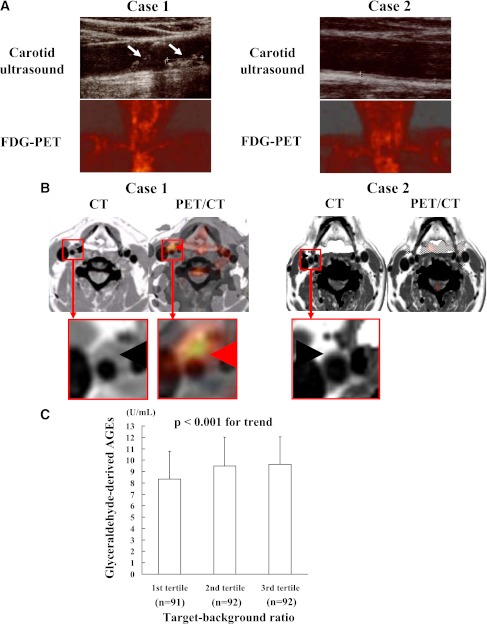
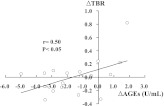
The study involved 275 outpatients at Kurume University, Japan (189 males and 86 females; mean age 61.2 ± 8.8 years) who underwent complete history and physical examinations and determinations of blood chemistry and anthropometric variables, including AGEs. Serum AGE level was examined by enzyme-linked immunosorbent assay. Vascular [(18)F]fluorodeoxyglucose (FDG) uptake, an index of vascular inflammation, was measured as blood-normalized standardized uptake value, known as the target-to-background ratio (TBR), by FDG-positron emission tomography (FDG-PET). Furthermore, we examined whether the changes in serum AGE level after treatment with oral hypoglycemia agents (OHAs) were correlated with those of TBR in another 18 subjects whose AGE value was >14.2 units/mL (mean ± 2 SD).
Mean serum AGE level and carotid TBR values were 9.15 ± 2.53 and 1.43 ± 0.22 units/mL, respectively. Multiple stepwise regression analysis revealed that TBR was independently correlated with AGEs (P < 0.001), carotid intima-media thickness (P < 0.01), and BMI (P < 0.02). When age- and sex-adjusted AGE values stratified by TBR tertiles were compared using ANCOVA, a significant trend was observed (P < 0.01). In addition, the changes in AGEs after OHA treatment were positively (r = 0.50, P < 0.05) correlated with those in TBR value.
The current study reveals that serum AGE level is independently associated with vascular inflammation evaluated by FDG-PET, suggesting that circulating AGE value may be a biomarker that could reflect vascular inflammation within an area of atherosclerosis.
糖基化终产物(AGEs)会引发炎症反应,从而促进动脉粥样硬化的发生和发展。我们研究了血清 AGE 水平与血管炎症之间的关系。
这项研究涉及日本久留米大学的 275 名门诊患者(男性 189 名,女性 86 名;平均年龄 61.2±8.8 岁),他们接受了完整的病史和体格检查,并进行了血液化学和人体测量学变量的测定,包括 AGEs。采用酶联免疫吸附试验检测血清 AGE 水平。通过正电子发射断层扫描(FDG-PET)测定血管内的氟脱氧葡萄糖摄取,即血管炎症的指标,以血管标准化摄取值(即目标与背景的比值,TBR)表示。此外,我们还在另外 18 名 AGE 值大于 14.2 单位/ml(均值±2 个标准差)的患者中,检查了口服降糖药物(OHAs)治疗后血清 AGE 值的变化与 TBR 变化之间是否存在相关性。
平均血清 AGE 水平和颈动脉 TBR 值分别为 9.15±2.53 和 1.43±0.22 单位/ml。多元逐步回归分析显示,TBR 与 AGEs(P<0.001)、颈动脉内膜中层厚度(P<0.01)和 BMI(P<0.02)独立相关。在使用 ANCOVA 比较按 TBR 三分位数分层的年龄和性别调整后的 AGE 值时,观察到显著的趋势(P<0.01)。此外,OHAs 治疗后 AGE 值的变化与 TBR 值的变化呈正相关(r=0.50,P<0.05)。
本研究表明,血清 AGE 水平与 FDG-PET 评估的血管炎症独立相关,提示循环 AGE 值可能是反映动脉粥样硬化区域血管炎症的生物标志物。