NuSirt Sciences Inc, 11020 Solway School Rd, Knoxville, TN, 37931, USA.
Nutr Metab (Lond). 2012 Aug 22;9(1):77. doi: 10.1186/1743-7075-9-77.
Sirtuins are important regulators of glucose and fat metabolism, and sirtuin activation has been proposed as a therapeutic target for insulin resistance and diabetes. We have shown leucine to increase mitochondrial biogenesis and fat oxidation via Sirt1 dependent pathways. Resveratrol is a widely recognized activator of Sirt; however, the biologically-effective high concentrations used in cell and animal studies are generally impractical or difficult to achieve in humans. Accordingly, we sought to determine whether leucine would exhibit synergy with low levels of resveratrol on sirtuin-dependent outcomes in adipocytes and in diet-induced obese (DIO) mice.
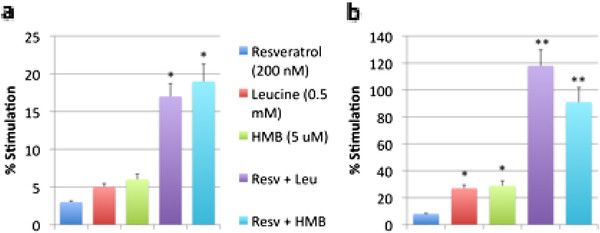
3T3-L1 mouse adipocytes were treated with Leucine (0.5 mM), β-hydroxy-β-methyl butyrate (HMB) (5 μM) or Resveratrol (200 nM) alone or in combination. In addition, diet-induced obese mice were treated for 6-weeks with low (2 g/kg diet) or high (10 g/kg diet) dose HMB, Leucine (24 g/kg diet; 200% of normal level) or low (12.5 mg/kg diet) or high (225 mg/kg diet) dose resveratrol, alone or as combination with leucine-resveratrol or HMB-resveratrol.
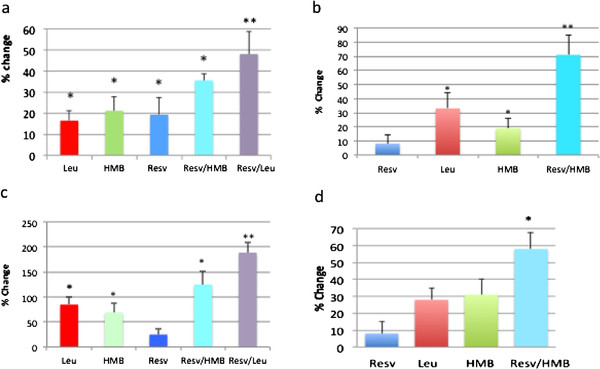
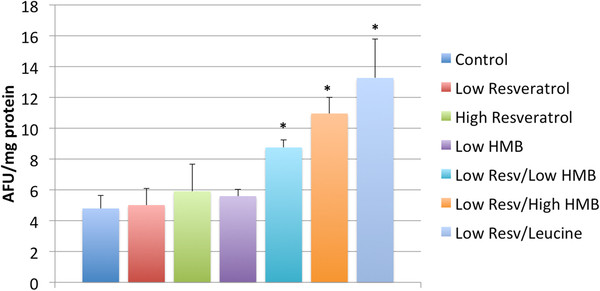
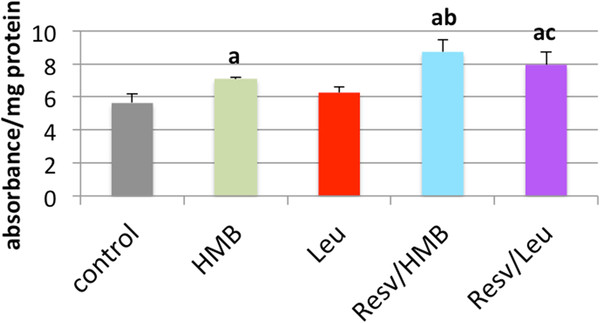
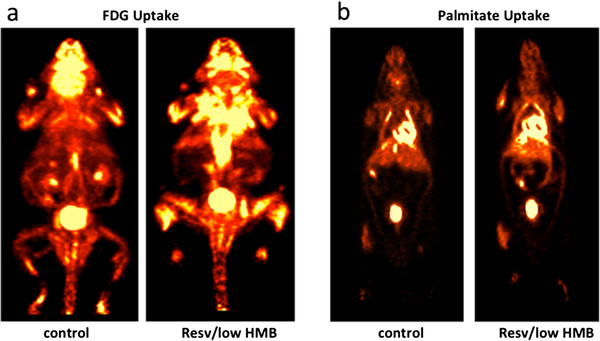
Fatty acid oxidation, AMPK, Sirt1 and Sirt3 activity in 3T3-L1 adipocytes and in muscle cells, were significantly increased by the combinations compared to the individual treatments. Similarly, 6-week feeding of low-dose resveratrol combined with either leucine or its metabolite HMB to DIO mice increased adipose Sirt1 activity, muscle glucose and palmitate uptake (measured via PET/CT), insulin sensitivity (HOMAIR), improved inflammatory stress biomarkers (CRP, IL-6, MCP-1, adiponectin) and reduced adiposity comparable to the effects of high dose resveratrol, while low-dose resveratrol exerted no independent effect.
These data demonstrate that either leucine or its metabolite HMB may be combined with a low concentration of resveratrol to exert synergistic effects on Sirt1-dependent outcomes; this may result in more practical dosing of resveratrol in the management of obesity, insulin-resistance and diabetes.
沉默调节蛋白是葡萄糖和脂肪代谢的重要调节剂,沉默调节蛋白的激活已被提议作为胰岛素抵抗和糖尿病的治疗靶点。我们已经证明亮氨酸可以通过 Sirt1 依赖途径增加线粒体生物发生和脂肪氧化。白藜芦醇是一种广泛认可的 Sirt 激活剂;然而,细胞和动物研究中使用的生物有效高浓度通常在实践中不切实际或难以在人体中实现。因此,我们试图确定亮氨酸是否会与低水平的白藜芦醇在脂肪细胞和饮食诱导肥胖(DIO)小鼠中的 Sirtuin 依赖性结果上表现出协同作用。
用亮氨酸(0.5mM)、β-羟基-β-甲基丁酸(HMB)(5μM)或白藜芦醇(200nM)单独或联合处理 3T3-L1 小鼠脂肪细胞。此外,用低(2g/kg 饮食)或高(10g/kg 饮食)剂量 HMB、亮氨酸(24g/kg 饮食;正常水平的 200%)或低(12.5mg/kg 饮食)或高(225mg/kg 饮食)剂量白藜芦醇单独或与亮氨酸-白藜芦醇或 HMB-白藜芦醇联合治疗饮食诱导肥胖的小鼠 6 周。
与单独治疗相比,脂肪酸氧化、3T3-L1 脂肪细胞和肌肉细胞中的 AMPK、Sirt1 和 Sirt3 活性均显著增加。同样,6 周喂养低剂量白藜芦醇与亮氨酸或其代谢物 HMB 联合用于 DIO 小鼠可增加脂肪组织 Sirt1 活性、肌肉葡萄糖和棕榈酸摄取(通过 PET/CT 测量)、胰岛素敏感性(HOMAIR)、改善炎症应激生物标志物(CRP、IL-6、MCP-1、脂联素)并降低肥胖,与高剂量白藜芦醇的效果相当,而低剂量白藜芦醇没有独立作用。
这些数据表明,亮氨酸或其代谢物 HMB 可以与低浓度的白藜芦醇联合使用,对 Sirt1 依赖性结果产生协同作用;这可能导致在肥胖、胰岛素抵抗和糖尿病的管理中更实际地使用白藜芦醇剂量。