Hua Feng, Wang Xiang, Zhu Lei
Department of Pulmonary Medicine, Zhongshan Hospital, Fudan University, Shanghai, People's Republic of China.
J Emerg Med. 2013 Feb;44(2):434-9. doi: 10.1016/j.jemermed.2012.02.073. Epub 2012 Aug 24.
Recent clinical data suggest that treatment with terlipressin (TP) may be more advantageous for septic shock than catecholamines. However, it is unknown whether TP would be effective for acute respiratory distress syndrome (ARDS) patients with shock.
The aim of this study was to compare the impact of TP vs. dopamine on hemodynamic variables and vascular endothelial growth factor (VEGF) in ARDS patients with shock.
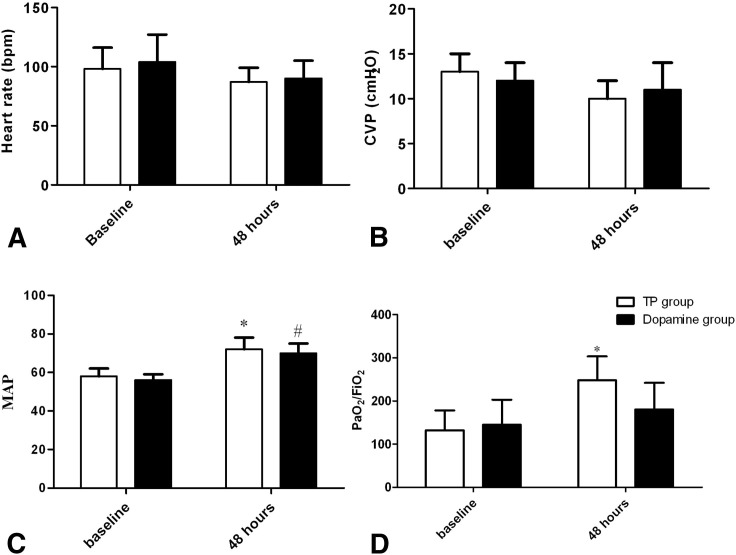
We studied 32 ARDS patients with shock despite fluid loading, who were randomized to receive TP (16 patients) or dopamine (16 patients). TP was administered as a continuous intravenous dose of 1.3 μg/kg/h and dopamine was administered in doses up to 20 μg/kg/min to maintain a mean arterial pressure of 70 ± 5 mm Hg for 48 h. Hemodynamic changes, ratio of partial pressure of arterial oxygen to fraction of inspired oxygen (PaO(2)/FiO(2)), and VEGF were recorded prospectively.
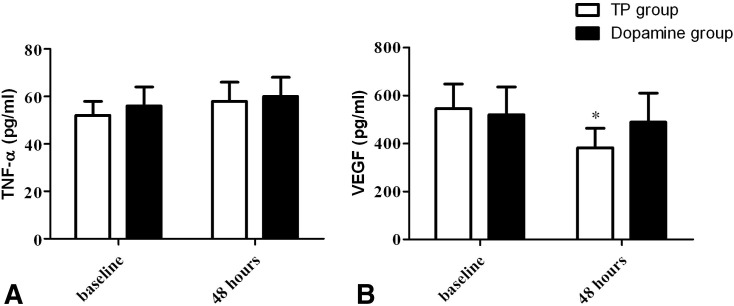
There was a significant correlation between the plasma VEGF level and the lung injury score at baseline (r = 0.387, p < 0.01). VEGF concentrations significantly decreased from baseline levels in the TP group (p < 0.05) at 48 h; there was no difference in the dopamine group (p > 0.05) at 48 h vs. baseline. There was no significant difference in the tumor necrosis factor-α concentration between the groups.
TP treatment has the potential to inhibit VEGF and improve oxygenation in patients with shock in the early stage of ARDS.
近期临床数据表明,与儿茶酚胺类药物相比,特利加压素(TP)治疗感染性休克可能更具优势。然而,TP对伴有休克的急性呼吸窘迫综合征(ARDS)患者是否有效尚不清楚。
本研究旨在比较TP与多巴胺对伴有休克的ARDS患者血流动力学变量和血管内皮生长因子(VEGF)的影响。
我们研究了32例尽管进行了液体复苏仍伴有休克的ARDS患者,将其随机分为接受TP治疗组(16例患者)和多巴胺治疗组(16例患者)。TP以1.3μg/kg/h的持续静脉输注剂量给药,多巴胺以高达20μg/kg/min的剂量给药,维持平均动脉压在70±5mmHg达48小时。前瞻性记录血流动力学变化、动脉血氧分压与吸入氧分数之比(PaO₂/FiO₂)以及VEGF。
基线时血浆VEGF水平与肺损伤评分之间存在显著相关性(r = 0.387,p < 0.01)。TP组在48小时时VEGF浓度较基线水平显著降低(p < 0.05);多巴胺组在48小时时与基线相比无差异(p > 0.05)。两组间肿瘤坏死因子-α浓度无显著差异。
TP治疗有可能抑制ARDS早期休克患者的VEGF并改善氧合。