Institute for Microbiology and Biotechnology, University of Bonn, Meckenheimer Allee 168, 53115 Bonn, Germany.
Archaea. 2012;2012:315153. doi: 10.1155/2012/315153. Epub 2012 Aug 15.
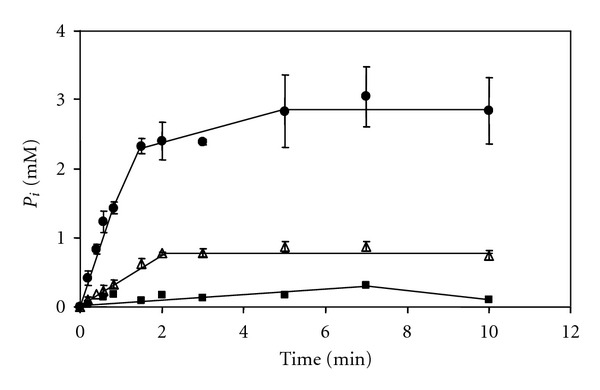
The thermophilic methanogen Methanosaeta thermophila uses acetate as sole substrate for methanogenesis. It was proposed that the acetate activation reaction that is needed to feed acetate into the methanogenic pathway requires the hydrolysis of two ATP, whereas the acetate activation reaction in Methanosarcina sp. is known to require only one ATP. As these organisms live at the thermodynamic limit that sustains life, the acetate activation reaction in Mt. thermophila seems too costly and was thus reevaluated. It was found that of the putative acetate activation enzymes one gene encoding an AMP-forming acetyl-CoA synthetase was highly expressed. The corresponding enzyme was purified and characterized in detail. It catalyzed the ATP-dependent formation of acetyl-CoA, AMP, and pyrophosphate (PP(i)) and was only moderately inhibited by PP(i). The breakdown of PP(i) was performed by a soluble pyrophosphatase. This enzyme was also purified and characterized. The pyrophosphatase hydrolyzed the major part of PP(i) (K(M) = 0.27 ± 0.05 mM) that was produced in the acetate activation reaction. Activity was not inhibited by nucleotides or PP(i). However, it cannot be excluded that other PP(i)-dependent enzymes take advantage of the remaining PP(i) and contribute to the energy balance of the cell.
嗜热产甲烷菌 Methanosaeta thermophila 以乙酸盐作为唯一的甲烷生成基质。有人提出,将乙酸盐激活反应所需的两个 ATP 水解,以将乙酸盐引入甲烷生成途径,而 Methanosarcina sp. 的乙酸盐激活反应则只需要一个 ATP。由于这些生物体生活在维持生命的热力学极限下,Mt. thermophila 中的乙酸盐激活反应似乎代价过高,因此需要重新评估。结果发现,在假定的乙酸盐激活酶中,一个基因编码形成 AMP 的乙酰辅酶 A 合成酶高度表达。该对应的酶被详细地纯化和表征。它催化 ATP 依赖性的乙酰辅酶 A、AMP 和焦磷酸 (PP(i)) 的形成,并且仅被 PP(i)中度抑制。PP(i)的分解由可溶性焦磷酸酶完成。该酶也被纯化和表征。焦磷酸酶水解了在乙酸盐激活反应中产生的大部分 PP(i)(K(M)=0.27±0.05mM)。核苷酸或 PP(i)没有抑制活性。然而,不能排除其他依赖于 PP(i)的酶利用剩余的 PP(i)并有助于细胞的能量平衡。