Marine Stewardship Council, London, United Kingdom.
PLoS One. 2012;7(8):e43765. doi: 10.1371/journal.pone.0043765. Epub 2012 Aug 21.
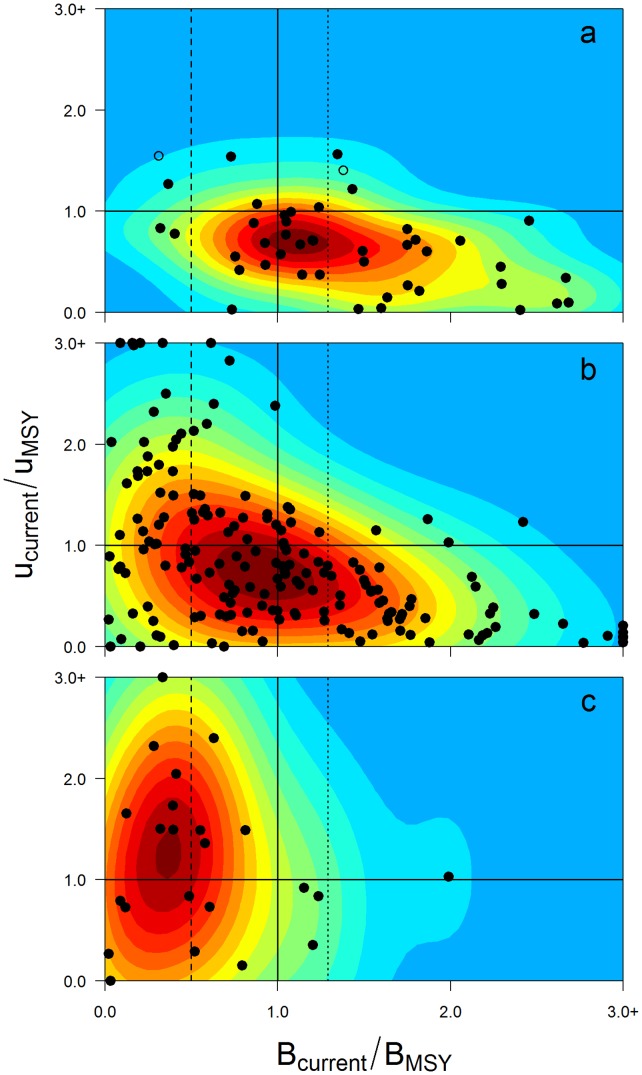
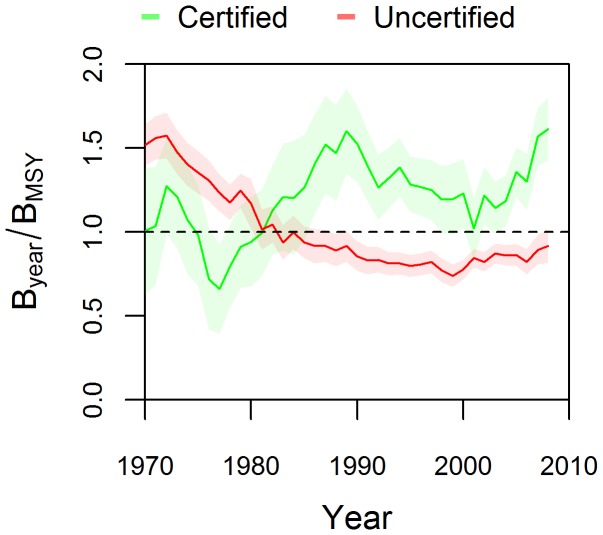
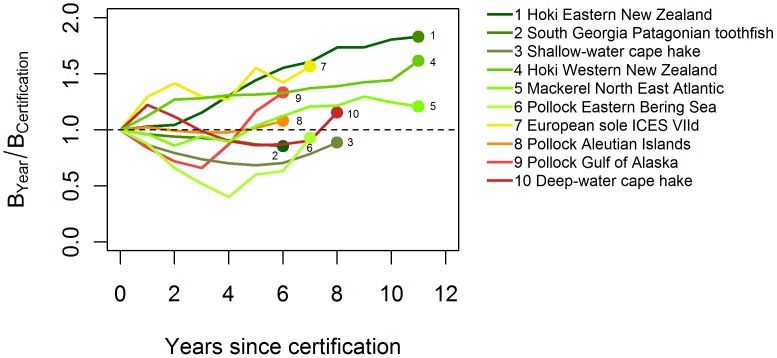
Concerns over fishing impacts on marine populations and ecosystems have intensified the need to improve ocean management. One increasingly popular market-based instrument for ecological stewardship is the use of certification and eco-labeling programs to highlight sustainable fisheries with low environmental impacts. The Marine Stewardship Council (MSC) is the most prominent of these programs. Despite widespread discussions about the rigor of the MSC standards, no comprehensive analysis of the performance of MSC-certified fish stocks has yet been conducted. We compared status and abundance trends of 45 certified stocks with those of 179 uncertified stocks, finding that 74% of certified fisheries were above biomass levels that would produce maximum sustainable yield, compared with only 44% of uncertified fisheries. On average, the biomass of certified stocks increased by 46% over the past 10 years, whereas uncertified fisheries increased by just 9%. As part of the MSC process, fisheries initially go through a confidential pre-assessment process. When certified fisheries are compared with those that decline to pursue full certification after pre-assessment, certified stocks had much lower mean exploitation rates (67% of the rate producing maximum sustainable yield vs. 92% for those declining to pursue certification), allowing for more sustainable harvesting and in many cases biomass rebuilding. From a consumer's point of view this means that MSC-certified seafood is 3-5 times less likely to be subject to harmful fishing than uncertified seafood. Thus, MSC-certification accurately identifies healthy fish stocks and conveys reliable information on stock status to seafood consumers.
对渔业活动对海洋生物种群和生态系统的影响的担忧,促使人们加强海洋管理。作为一种生态管理的市场手段,使用认证和生态标签计划来突出具有低环境影响的可持续渔业,正变得越来越流行。海洋管理委员会(MSC)是这些计划中最著名的。尽管人们广泛讨论了 MSC 标准的严格性,但尚未对 MSC 认证鱼类种群的表现进行全面分析。我们比较了 45 个认证种群的现状和丰度趋势与 179 个未认证种群的趋势,发现 74%的认证渔业的生物量水平高于产生最大可持续产量的水平,而未认证渔业的这一比例仅为 44%。平均而言,过去 10 年,认证种群的生物量增加了 46%,而未认证渔业仅增加了 9%。作为 MSC 过程的一部分,渔业最初要经过一个保密的预评估过程。当将认证渔业与那些在预评估后拒绝进行全面认证的渔业进行比较时,认证渔业的平均开发率要低得多(产生最大可持续产量的 67%,而拒绝进行认证的渔业为 92%),从而可以进行更可持续的捕捞,在许多情况下还可以恢复生物量。从消费者的角度来看,这意味着 MSC 认证的海鲜受到有害捕捞的可能性要比未认证的海鲜低 3-5 倍。因此,MSC 认证准确地识别了健康的鱼类种群,并向海鲜消费者传达了关于种群状况的可靠信息。