Institute and Department of Psychiatry, Laboratory of Neuroscience, LIM27, University of Sao Paulo, Rua Ovidio Pires de Campos, 785, Sao Paulo, SP, Brazil.
J Transl Med. 2012 Aug 28;10:175. doi: 10.1186/1479-5876-10-175.
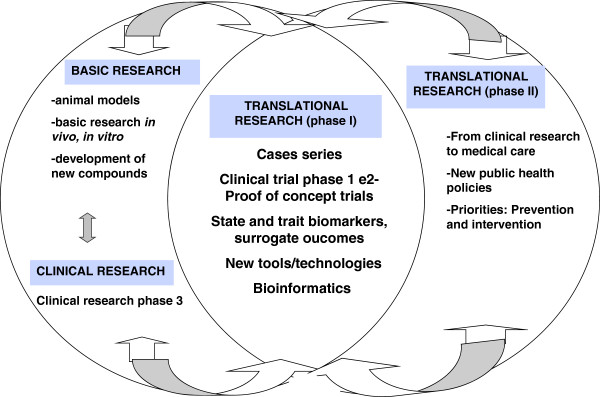
Personalized treatments have become a primary goal in translational psychiatric research. They include the identification of neural circuits associated with psychiatric disorders and definition of treatment according to individual characteristics. Many new tools and technologies have been developed but further efforts are required to provide clues on how these scientific advances in psychiatry may be translated into more effective therapeutic approaches. Obstacles to the progress of translational psychiatry also involve numerous scientific, financial, ethical, logistics and regulatory aspects. Also, the goal of DSM-5 to expand "signs and symptoms" classification to incorporate biological measures may help the development of new multifactorial and dimensional models able to better understand the pathophysiology of psychiatric disorders and develop improved treatments. Finally, a better understanding on the significant response variability, cognitive functioning, role of comorbidities and treatment-resistant cases are critical for the development of prevention and intervention strategies that are more effective.
个性化治疗已成为转化精神病学研究的主要目标。它们包括确定与精神障碍相关的神经回路,并根据个体特征定义治疗方法。已经开发出许多新的工具和技术,但仍需要进一步努力,以提供有关如何将精神病学中的这些科学进展转化为更有效的治疗方法的线索。转化精神病学的进展也涉及许多科学、财务、道德、物流和监管方面的问题。此外,DSM-5 将“症状和体征”分类扩展到纳入生物测量的目标可能有助于开发新的多因素和多维模型,从而更好地理解精神障碍的病理生理学,并开发出改进的治疗方法。最后,更好地理解显著的反应变异性、认知功能、合并症的作用和治疗抵抗病例,对于制定更有效的预防和干预策略至关重要。