Center for Infectious Disease Control, National Institute for Public Health and the Environment-RIVM, PO Box 1, 3720 BA Bilthoven, the Netherlands.
Emerg Infect Dis. 2012 Sep;18(9):1405-13. doi: 10.3201/eid1809.111578.
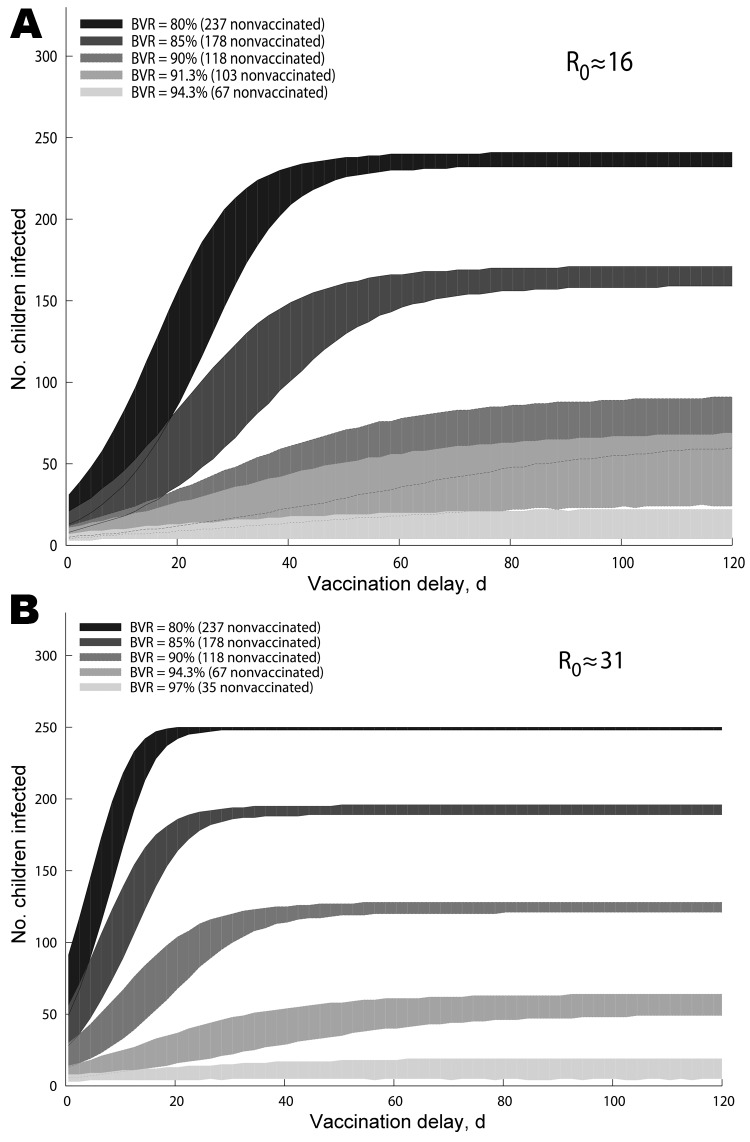
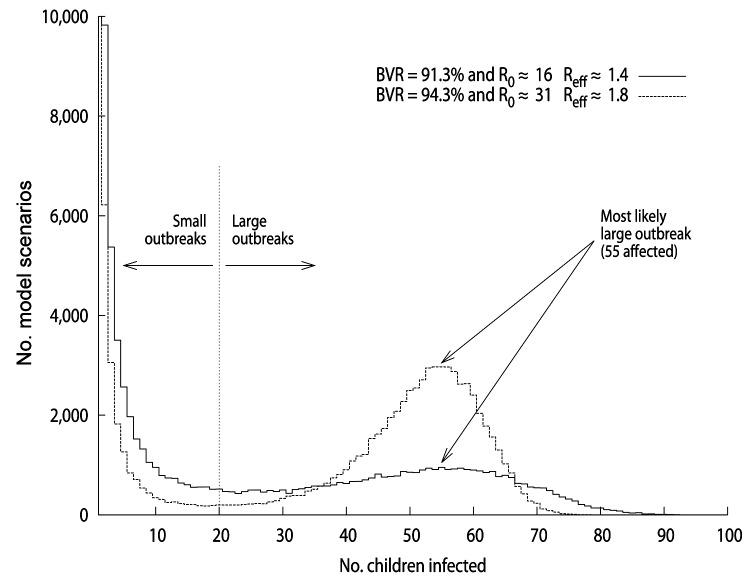
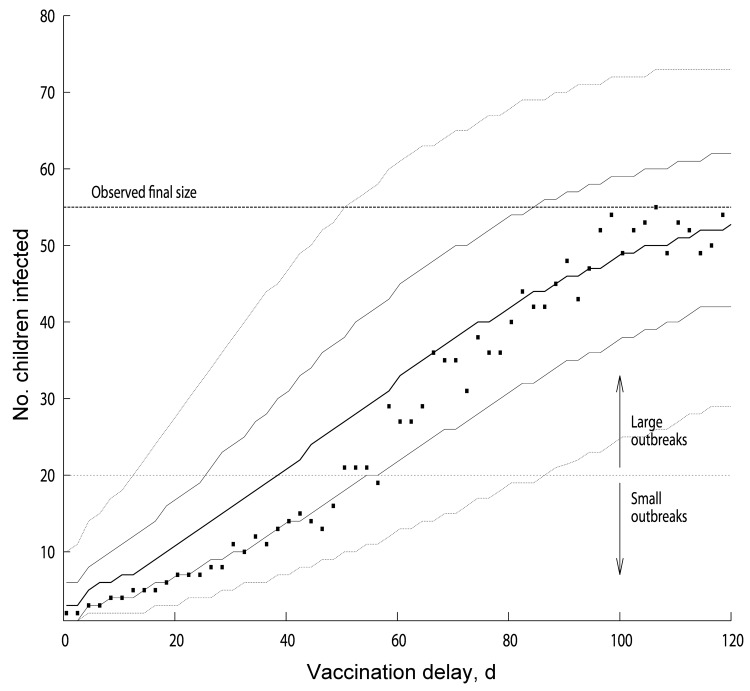
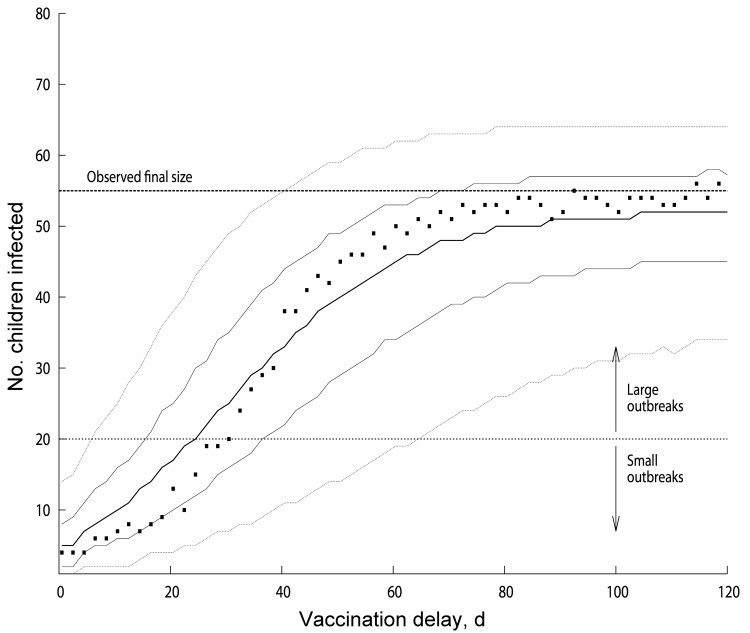
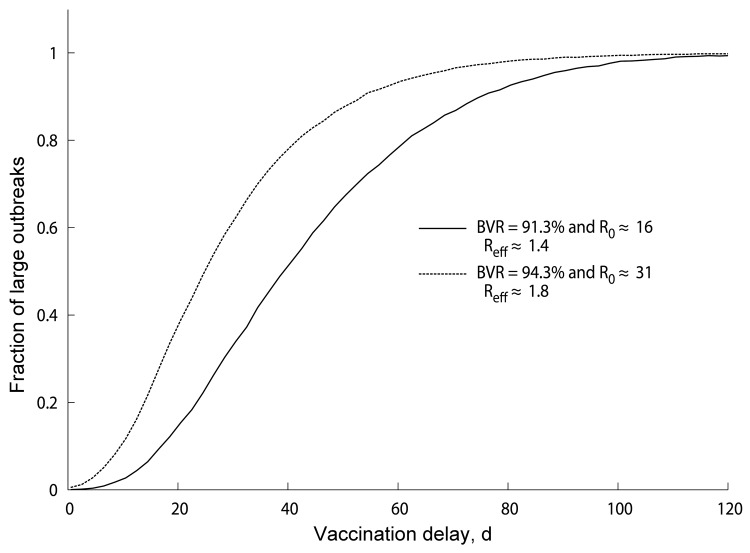
Despite high vaccination coverage in most European countries, large community outbreaks of measles do occur, normally clustered around schools and resulting from suboptimal vaccination coverage. To determine whether or when it is worth implementing outbreak-response vaccination campaigns in schools, we used stochastic outbreak models to reproduce a public school outbreak in Germany, where no vaccination campaign was implemented. We assumed 2 scenarios covering the baseline vaccination ratio range (91.3%-94.3%) estimated for that school and computed outbreaks assuming various vaccination delays. In one scenario, reacting (i.e., implementing outbreak-response vaccination campaigns) within 12-24 days avoided large outbreaks and reacting within 50 days reduced outbreak size. In the other scenario, reacting within 6-14 days avoided large outbreaks and reacting within 40 days reduced the outbreak size. These are realistic time frames for implementing school outbreak response vaccination campaigns. High baseline vaccination ratios extended the time needed for effective response.
尽管大多数欧洲国家的疫苗接种率很高,但麻疹仍会在社区大规模爆发,通常集中在学校周围,而且是由于疫苗接种率不理想所致。为了确定是否值得在学校开展暴发疫情应对疫苗接种活动,我们使用随机暴发模型重现了德国一所未开展疫苗接种活动的公立学校暴发疫情。我们假设了两种情况,分别涵盖了该校估计的基础疫苗接种率范围(91.3%-94.3%),并根据不同的疫苗接种延迟情况计算了疫情暴发的情况。在一种情况下,在 12-24 天内做出反应(即实施暴发疫情应对疫苗接种活动)可以避免大规模暴发,而在 50 天内做出反应可以减少疫情规模。在另一种情况下,在 6-14 天内做出反应可以避免大规模暴发,在 40 天内做出反应可以减少疫情规模。这些都是实施学校暴发疫情应对疫苗接种活动的现实时间框架。高基础疫苗接种率延长了有效应对所需的时间。