Mitchell W Kyle, Williams John, Atherton Philip, Larvin Mike, Lund John, Narici Marco
Division of Surgery, School of Postgraduate Entry Medicine and Health, University of Nottingham Derby, UK.
Front Physiol. 2012 Jul 11;3:260. doi: 10.3389/fphys.2012.00260. eCollection 2012.
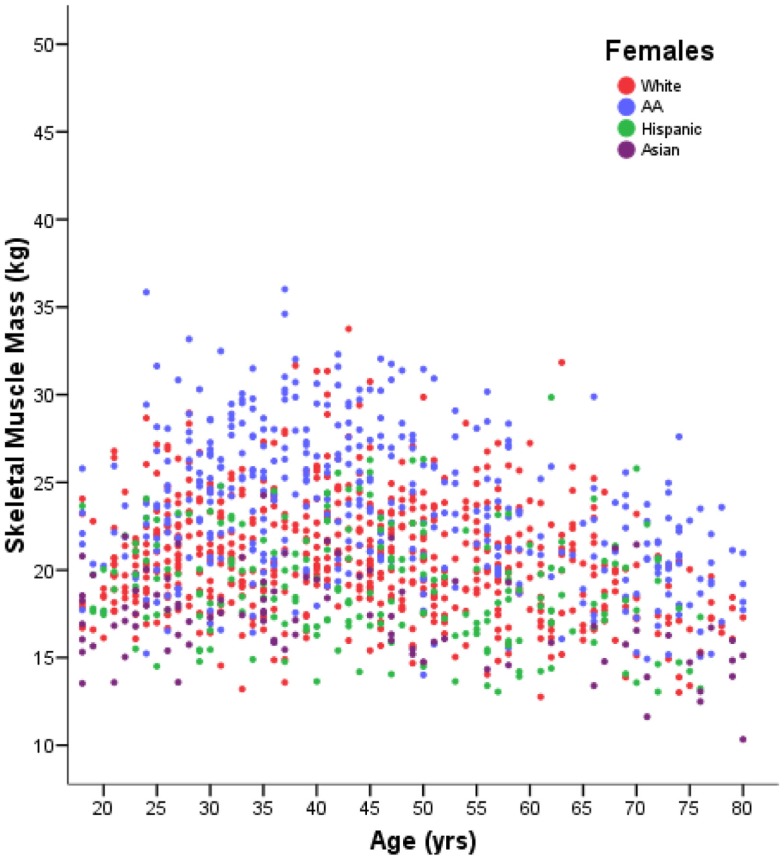
Changing demographics make it ever more important to understand the modifiable risk factors for disability and loss of independence with advancing age. For more than two decades there has been increasing interest in the role of sarcopenia, the age-related loss of muscle or lean mass, in curtailing active and healthy aging. There is now evidence to suggest that lack of strength, or dynapenia, is a more constant factor in compromised wellbeing in old age and it is apparent that the decline in muscle mass and the decline in strength can take quite different trajectories. This demands recognition of the concept of muscle quality; that is the force generating per capacity per unit cross-sectional area (CSA). An understanding of the impact of aging on skeletal muscle will require attention to both the changes in muscle size and the changes in muscle quality. The aim of this review is to present current knowledge of the decline in human muscle mass and strength with advancing age and the associated risk to health and survival and to review the underlying changes in muscle characteristics and the etiology of sarcopenia. Cross-sectional studies comparing young (18-45 years) and old (>65 years) samples show dramatic variation based on the technique used and population studied. The median of values of rate of loss reported across studies is 0.47% per year in men and 0.37% per year in women. Longitudinal studies show that in people aged 75 years, muscle mass is lost at a rate of 0.64-0.70% per year in women and 0.80-00.98% per year in men. Strength is lost more rapidly. Longitudinal studies show that at age 75 years, strength is lost at a rate of 3-4% per year in men and 2.5-3% per year in women. Studies that assessed changes in mass and strength in the same sample report a loss of strength 2-5 times faster than loss of mass. Loss of strength is a more consistent risk for disability and death than is loss of muscle mass.
人口结构的变化使得了解随着年龄增长导致残疾和失去独立能力的可改变风险因素变得愈发重要。二十多年来,人们对肌肉减少症(与年龄相关的肌肉或瘦体重流失)在阻碍积极健康老龄化方面的作用越来越感兴趣。现在有证据表明,力量不足,即肌力减退,是老年健康受损中一个更为持续的因素,而且很明显,肌肉量的下降和力量的下降可能会有截然不同的轨迹。这就需要认识到肌肉质量的概念;即每单位横截面积(CSA)的每容量产生的力。要理解衰老对骨骼肌的影响,需要关注肌肉大小的变化和肌肉质量的变化。本综述的目的是介绍关于随着年龄增长人体肌肉量和力量下降的现有知识以及相关的健康和生存风险,并回顾肌肉特征的潜在变化和肌肉减少症的病因。比较年轻(18 - 45岁)和老年(>65岁)样本的横断面研究表明,根据所使用的技术和研究的人群不同,结果差异很大。各研究报告的肌肉量流失率的中位数在男性中为每年0.47%,在女性中为每年0.37%。纵向研究表明,在75岁的人群中,女性肌肉量每年以0.64 - 0.70%的速度流失,男性为每年0.80 - 0.98%。力量流失得更快。纵向研究表明,在75岁时,男性力量每年以3 - 4%的速度流失,女性为每年2.5 - 3%。在同一样本中评估肌肉量和力量变化的研究报告称,力量流失速度比肌肉量流失速度快2 - 5倍。与肌肉量流失相比,力量流失是导致残疾和死亡的更一致的风险因素。