Immunology and Reproduction Biology Lab, Medical School & State Key Laboratory of Pharmaceutical Biotechnology and Jiangsu Key Laboratory of Molecular Medicine, Nanjing University, Nanjing, Jiangsu, China.
PLoS One. 2012;7(8):e43268. doi: 10.1371/journal.pone.0043268. Epub 2012 Aug 24.
MicroRNAs (miRNAs) expression is altered in cancer cells, and miRNAs could serve as diagnostic and prognostic biomarker for cancer patients. This study was designed to analyze circulating miRNAs expression in the malignant pleural effusion (MPE) and their association with patient survival in non-small cell lung cancer (NSCLC).
Pleural effusion from 184 patients with NSCLC and MPE were collected. MiRNA microarray and bioinformatics interpretation were used to evaluate miRNA expression profiles in 10 NSCLC patients with different survival prognosis. Associations were validated in 184 patients (randomly classified into training and validation set with equal number in each group) using quantitative RT-PCR. Risk scores were formulated based on the expression signature of miRNAs. Clinical data, such as patient survival, were collected for correlation analysis.
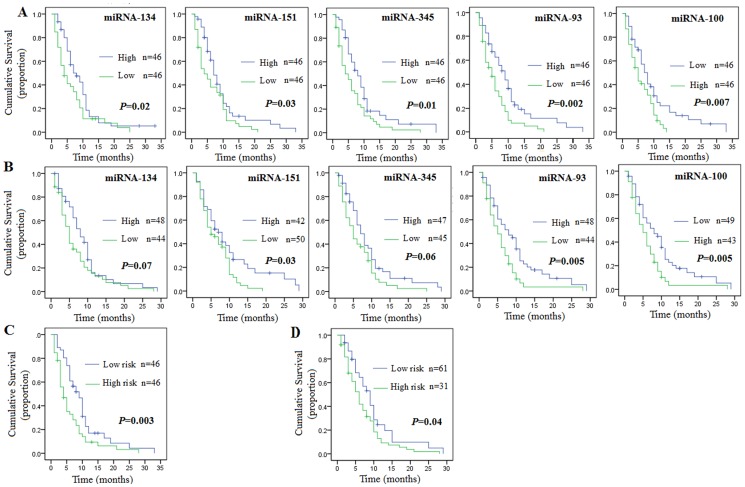
Thirty-three miRNAs were found to be altered more than two-fold by microarray in malignant effusions between longer-survival and shorter-survival groups, and levels of five miRNAs (miRNA-93, miRNA-100, miRNA-134, miRNA-151 and miRNA-345) were significantly associated with overall survival. High expression of miR-100 and low expression of miRNA-93, miRNA-134, miRNA-151 and miRNA-345 were associated with poor survival in both the training and validation cohort. Patients with high risk scores had overall poor survival compared to the patients with low risk scores. Risk score was an independent predictor of patient survival.
Expression patterns of miRNAs are systematically altered in MPE of patient with NSCLC. The five miRNA signature from the effusion may serve as a predictor for the overall survival of patients with lung cancers.
微小 RNA(miRNAs)在癌细胞中的表达发生改变,miRNAs 可以作为癌症患者的诊断和预后生物标志物。本研究旨在分析恶性胸腔积液(MPE)中循环 miRNAs 的表达,并分析其与非小细胞肺癌(NSCLC)患者生存的关系。
收集 184 例 NSCLC 患者的胸腔积液。采用 miRNA 微阵列和生物信息学解释方法,评估 10 例不同生存预后 NSCLC 患者的 miRNA 表达谱。采用定量 RT-PCR 在 184 例患者中(随机分为训练组和验证组,每组人数相等)验证相关性。根据 miRNA 表达特征制定风险评分。收集临床资料,如患者生存情况,进行相关性分析。
在较长生存期和较短生存期组之间,恶性胸腔积液中发现 33 个 miRNA 的表达差异超过两倍,其中 5 个 miRNA(miRNA-93、miRNA-100、miRNA-134、miRNA-151 和 miRNA-345)的水平与总生存率显著相关。miR-100 高表达和 miRNA-93、miRNA-134、miRNA-151 和 miRNA-345 低表达与训练组和验证组患者的总生存率均相关。高风险评分患者的总生存率明显低于低风险评分患者。风险评分是患者生存的独立预测因子。
NSCLC 患者 MPE 中的 miRNA 表达模式发生了系统性改变。来自胸腔积液的 5 个 miRNA 特征可能作为肺癌患者总生存率的预测指标。