Department of Economics, Faculty of Liberal Arts and Professional Studies, York University, 4700 Keele Street, Toronto, ON, M3J 1P3, Canada.
Global Health. 2012 Sep 3;8:31. doi: 10.1186/1744-8603-8-31.
Pakistan is highly vulnerable to climate change due to its geographic location, high dependence on agriculture and water resources, low adaptive capacity of its people, and weak system of emergency preparedness. This paper is the first ever attempt to rank the agro-ecological zones in Pakistan according to their vulnerability to climate change and to identify the potential health repercussions of each manifestation of climate change in the context of Pakistan.
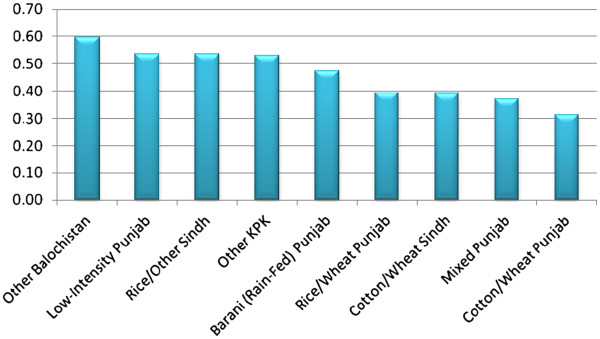
A climate change vulnerability index is constructed as an un-weighted average of three sub-indices measuring (a) the ecological exposure of each region to climate change, (b) sensitivity of the population to climate change and (c) the adaptive capacity of the population inhabiting a particular region. The regions are ranked according to the value of this index and its components. Since health is one of the most important dimensions of human wellbeing, this paper also identifies the potential health repercussions of each manifestations of climate change and links it with the key manifestations of climate change in the context of Pakistan.
The results indicate that Balochistan is the most vulnerable region with high sensitivity and low adaptive capacity followed by low-intensity Punjab (mostly consisting of South Punjab) and Cotton/Wheat Sindh. The health risks that each of these regions face depend upon the type of threat that they face from climate change. Greater incidence of flooding, which may occur due to climate variability, poses the risk of diarrhoea and gastroenteritis; skin and eye Infections; acute respiratory infections; and malaria. Exposure to drought poses the potential health risks in the form of food insecurity and malnutrition; anaemia; night blindness; and scurvy. Increases in temperature pose health risks of heat stroke; malaria; dengue; respiratory diseases; and cardiovascular diseases.
The study concludes that geographical zones that are more exposed to climate change in ecological and geographic terms- such as Balochistan, Low-Intensity Punjab, and Cotton-Wheat Sindh -also happen to be the most deprived regions in Pakistan in terms of socio-economic indicators, suggesting that the government needs to direct its efforts to the socio-economic uplift of these lagging regions to reduce their vulnerability to the adverse effects of climate change.
由于地理位置、高度依赖农业和水资源、人民适应能力低以及应急准备系统薄弱,巴基斯坦极易受到气候变化的影响。本文首次尝试根据气候变化脆弱性对巴基斯坦的农业生态区进行排名,并确定气候变化对巴基斯坦的每种表现形式对潜在健康的影响。
构建了一个气候变化脆弱性指数,作为衡量以下三个分指数的无权重平均值:(a)每个地区对气候变化的生态暴露程度;(b)人口对气候变化的敏感性;(c)居住在特定地区的人口的适应能力。根据该指数及其组成部分的值对地区进行排名。由于健康是人类福祉的最重要方面之一,本文还确定了气候变化的每种表现形式对潜在健康的影响,并将其与巴基斯坦背景下气候变化的主要表现形式联系起来。
结果表明,俾路支省是最脆弱的地区,敏感性高,适应能力低,其次是强度较低的旁遮普省(主要由南旁遮普省组成)和棉花/小麦信德省。这些地区面临的健康风险取决于它们面临的气候变化威胁类型。由于气候变化引起的洪水,可能会导致腹泻和肠胃炎、皮肤和眼部感染、急性呼吸道感染和疟疾。干旱会造成粮食不安全和营养不良、贫血、夜盲症和坏血病等潜在的健康风险。温度升高会带来中暑、疟疾、登革热、呼吸道疾病和心血管疾病等健康风险。
该研究得出结论,在生态和地理方面更容易受到气候变化影响的地理区域,如俾路支省、低强度旁遮普省和棉花/小麦信德省,也是巴基斯坦在社会经济指标方面最贫困的地区,这表明政府需要将其努力指向这些落后地区的社会经济提升,以减少它们对气候变化不利影响的脆弱性。