1Department of Epidemiology, Institute for Global Tobacco Control, Johns Hopkins Bloomberg School of Public Health, 2213 McElderry Street, 4th Floor, Baltimore, MD 21205, USA.
Tob Control. 2013 May;22(3):164-71. doi: 10.1136/tobaccocontrol-2011-050298. Epub 2012 Sep 2.
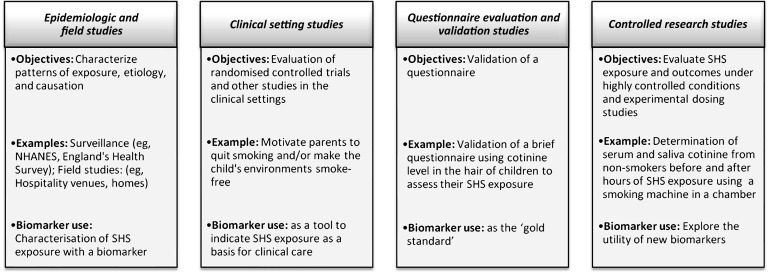
Secondhand smoke exposure (SHSe) is a known cause of many adverse health effects in adults and children. Increasingly, SHSe assessment is an element of tobacco control research and implementation worldwide. In spite of decades of development of approaches to assess SHSe, there are still unresolved methodological issues; therefore, a multidisciplinary expert meeting was held to catalogue the approaches to assess SHSe and with the goal of providing a set of uniform methods for future use by investigators and thereby facilitate comparisons of findings across studies. The meeting, held at Johns Hopkins, in Baltimore, Maryland, USA, was supported by the Flight Attendant Medical Research Institute (FAMRI). A series of articles were developed to summarise what is known about self-reported, environmental and biological SHSe measurements. Non-smokers inhale toxicants in SHS, which are mainly products of combustion of organic materials and are not specific to tobacco smoke exposure. Biomarkers specific to SHSe are nicotine and its metabolites (e.g., cotinine), and metabolites of 4-(methylnitrosamino)-1-(3-pyridyl)-1-butanone (NNK). Cotinine is the preferred blood, saliva and urine biomarker for SHSe. Cotinine and nicotine can also be measured in hair and toenails. NNAL (4-[methylnitrosamino]-1-[3-pyridyl]-1-butanol), a metabolite of NNK, can be determined in the urine of SHS-exposed non-smokers. The selection of a particular biomarker of SHSe and the analytic biological medium depends on the scientific or public health question of interest, study design and setting, subjects, and funding. This manuscript summarises the scientific evidence on the use of biomarkers to measure SHSe, analytical methods, biological matrices and their interpretation.
二手烟暴露(SHSe)是导致成人和儿童许多健康不良影响的已知原因。在全球范围内,SHSe 评估越来越成为烟草控制研究和实施的一个要素。尽管几十年来一直在开发评估 SHSe 的方法,但仍存在未解决的方法学问题;因此,召开了一次多学科专家会议,对评估 SHSe 的方法进行分类,并旨在为未来的研究人员提供一套统一的方法,从而促进对研究结果的比较。该会议在美国马里兰州巴尔的摩的约翰霍普金斯大学举行,得到了飞行服务员医学研究所(FAMRI)的支持。一系列文章的编写旨在总结有关自我报告、环境和生物 SHSe 测量的已知信息。非吸烟者会吸入 SHS 中的有毒物质,这些物质主要是有机材料燃烧的产物,并非仅来自烟草烟雾暴露。SHSe 特有的生物标志物是尼古丁及其代谢物(例如,可替宁)以及 4-(甲基亚硝氨基)-1-(3-吡啶基)-1-丁酮(NNK)的代谢物。可替宁是用于 SHSe 的首选血液、唾液和尿液生物标志物。可替宁和尼古丁也可以在头发和脚趾甲中测量。NNK 的代谢物 NNAL(4-[甲基亚硝氨基]-1-[3-吡啶基]-1-丁醇)可在暴露于 SHS 的非吸烟者的尿液中检测到。选择特定的 SHSe 生物标志物和分析生物介质取决于感兴趣的科学或公共卫生问题、研究设计和设置、研究对象和资金。本文总结了使用生物标志物测量 SHSe、分析方法、生物基质及其解释的科学证据。