Research and Evaluation Division, BRAC Centre, Dhaka, Bangladesh.
Reprod Health. 2012 Sep 3;9:18. doi: 10.1186/1742-4755-9-18.
The status of men's knowledge of and awareness to maternal, neonatal and child health care are largely unknown in Bangladesh and the effect of community focused interventions in improving men's knowledge is largely unexplored. This study identifies the extent of men's knowledge and awareness on maternal, neonatal and child health issues between intervention and control groups.
This cross sectional comparative study was carried out in six rural districts of Bangladesh in 2008. BRAC health programme operates 'improving maternal, neonatal and child survival' intervention in four of the above-mentioned six districts. The intervention comprises a number of components including improving awareness of family planning, identification of pregnancy, providing antenatal, delivery and postnatal care, newborn care, under-5 child healthcare, referral of complications and improving clinical management in health facilities. In addition, communities are empowered through social mobilization and advocacy on best practices in maternal, neonatal and child health. Three groups were identified: intervention (2 years exposure); transitional (6 months exposure) and control. Data were collected by interviewing 7,200 men using a structured questionnaire.
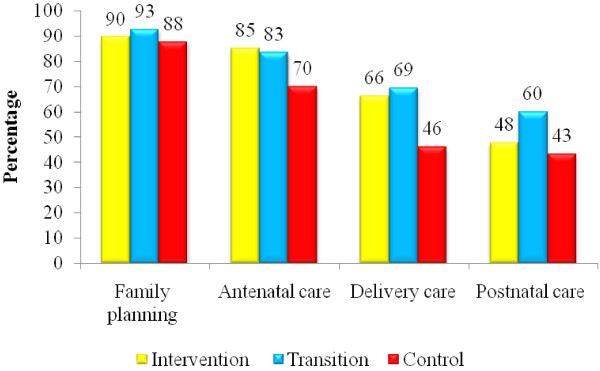
Men prefer to gather in informal sites to interact socially. Overall men's knowledge on maternal care was higher in intervention than control groups, for example, advice on tetanus injection should be given during antenatal care (intervention = 50%, control = 7%). There were low levels of knowledge about birth preparedness (buying delivery kit = 18%, arranging emergency transport = 13%) and newborn care (wrapping = 25%, cord cutting with sterile blade = 36%, cord tying with sterile thread = 11%) in the intervention. Men reported joint decision-making for delivery care relatively frequently (intervention = 66%, control = 46%, p < 0.001).
Improvement in men's knowledge in intervention district is likely. Emphasis of behaviour change communications messages should be placed on birth preparedness for clean delivery and referral and on newborn care. These messages may be best directed to men by targeting informal meeting places like market places and tea stalls.
在孟加拉国,男性对孕产妇、新生儿和儿童保健知识的了解和认识程度在很大程度上是未知的,而针对男性的社区重点干预措施对提高其知识水平的效果在很大程度上也尚未得到探索。本研究旨在确定干预组和对照组之间男性对孕产妇、新生儿和儿童健康问题的了解和认识程度。
本横断面对比研究于 2008 年在孟加拉国的六个农村地区进行。BRAC 健康项目在上述六个地区中的四个地区开展了“改善孕产妇、新生儿和儿童生存”干预措施。该干预措施包括许多组成部分,包括提高对计划生育的认识、识别怀孕、提供产前、分娩和产后护理、新生儿护理、5 岁以下儿童保健、并发症转诊以及改善卫生机构的临床管理。此外,通过社会动员和倡导孕产妇、新生儿和儿童保健方面的最佳实践来增强社区的能力。确定了三组:干预组(2 年暴露)、过渡组(6 个月暴露)和对照组。通过使用结构化问卷对 7200 名男性进行访谈来收集数据。
男性更喜欢在非正式场所聚集互动。总体而言,干预组男性对孕产妇保健的知识高于对照组,例如,应在产前护理期间给予破伤风注射建议(干预组=50%,对照组=7%)。关于生育准备(购买分娩包=18%,安排紧急交通=13%)和新生儿护理(包裹=25%,用无菌刀片切割脐带=36%,用无菌线结扎脐带=11%)的知识水平较低。男性报告在分娩护理方面相对频繁地进行联合决策(干预组=66%,对照组=46%,p<0.001)。
干预地区男性知识水平有所提高。行为改变交流信息的重点应放在清洁分娩和转诊的生育准备以及新生儿护理上。这些信息可以通过瞄准市场和茶馆等非正式聚会场所,直接传达给男性。