Department of Mathematics, University of Miami, Coral Gables, Miami, FL 33124-4250, USA.
J Theor Biol. 2013 Jan 7;316:25-34. doi: 10.1016/j.jtbi.2012.08.024. Epub 2012 Aug 29.
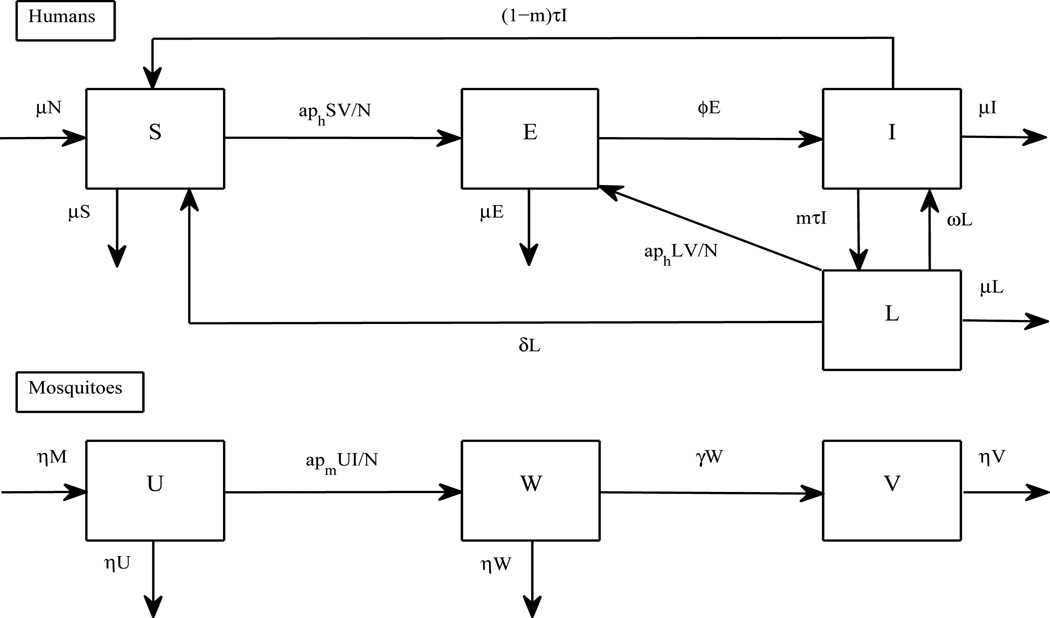
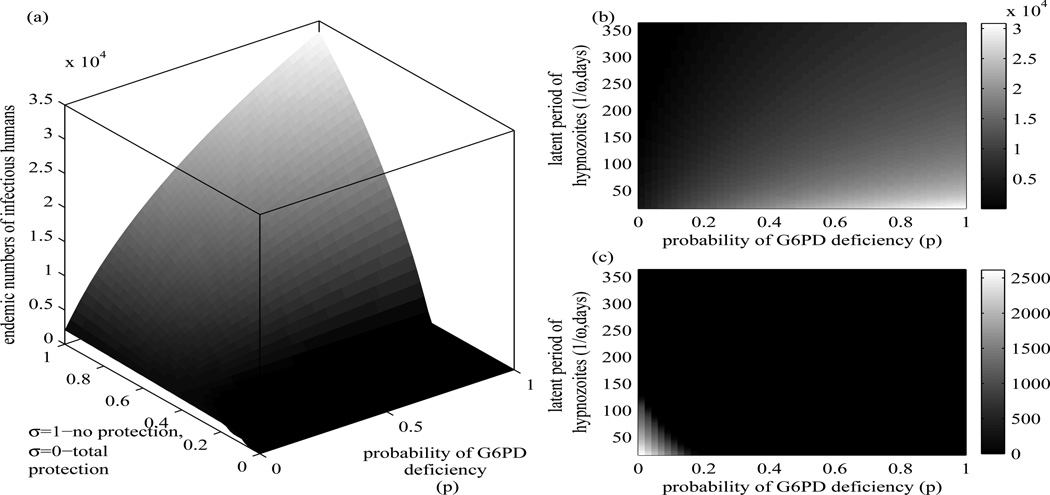
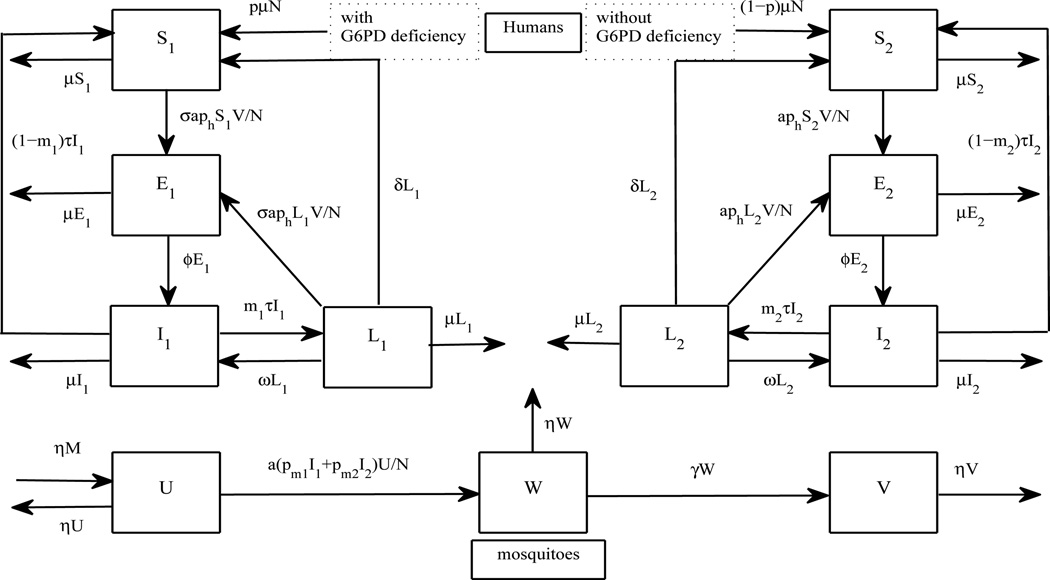
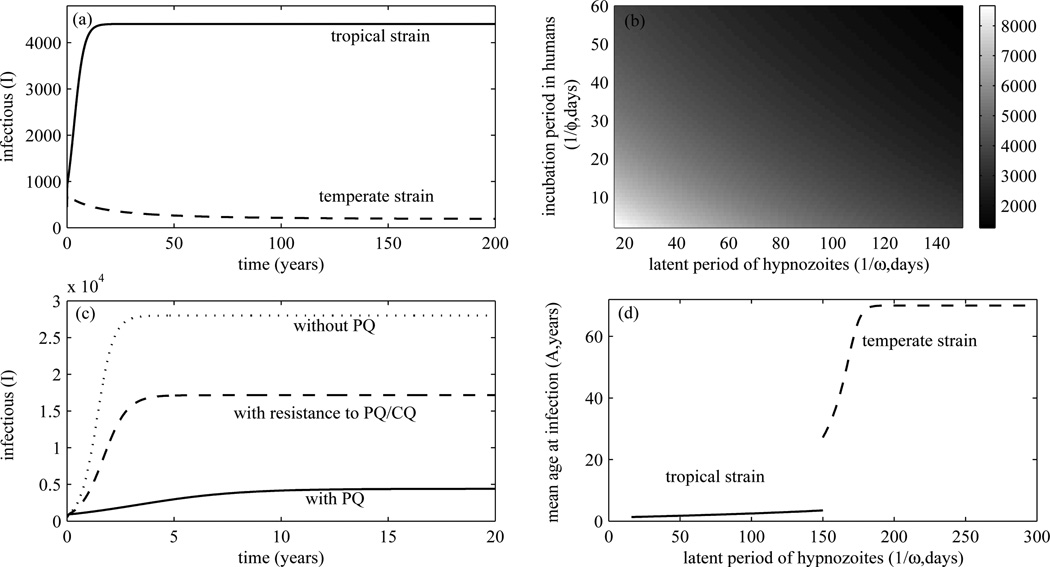
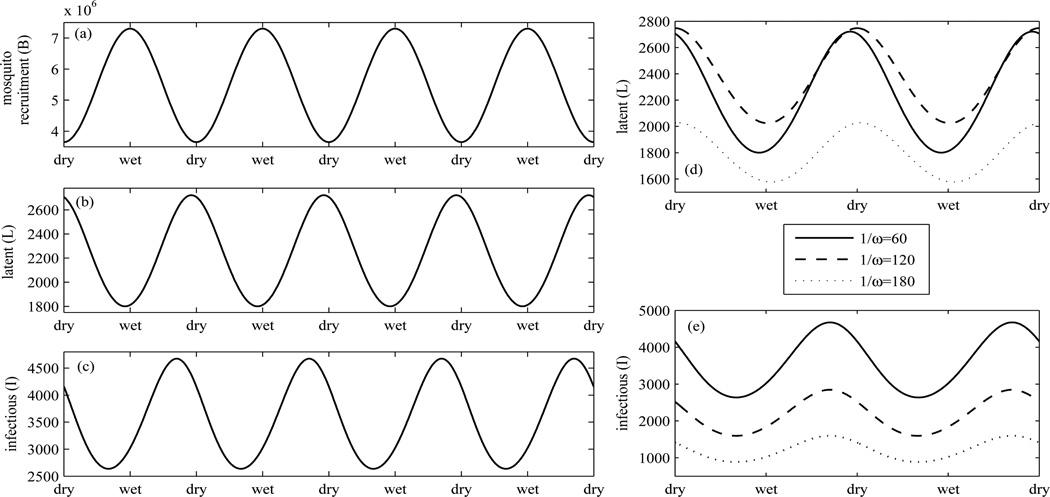
Plasmodium vivax (P. vivax) is one of the most important human malaria species that is geographically widely endemic and causes social and economic burden globally. However, its consequences have long been neglected and underestimated as it has been mistakenly considered a benign and inconsequential malaria species as compared to Plasmodium falciparum. One of the important differences between P. falciparum and P. vivax is the formation of P. vivax latent-stage parasites (hypnozoites) that can cause relapses after a course of treatment. In this work, mathematical modeling is employed to investigate how patterns of incubation periods and relapses of P. vivax, variation in treatment, and seasonal abundance of mosquitoes influence the number of humans infected with P. vivax and the mean age at infection of humans in tropical and temperate regions. The model predicts that: (i) the number of humans infected with P. vivax may increase when an incubation period of parasites in humans and a latent period of hypnozoites decrease; (ii) without primaquine, the only licensed drug to prevent relapses, P. vivax may be highly prevalent; (iii) the mean age at infection of humans may increase when a latent period of hypnozoites increases; (iv) the number of infectious humans may peak at a few months before the middle of each dry season and the number of hypnozoite carriers may peak at nearly the middle of each dry season. In addition, glucose-6-phosphate-dehydrogenase (G6PD) deficiency, which is the most common enzyme defect in humans that may provide some protection against P. vivax infection and severity, is taken into account to study its impact on the number of humans infected with P. vivax. Modeling results indicate that the increased number of infected humans may result from a combination of a larger proportion of humans with G6PD deficiency in the population, a lesser protection of G6PD deficiency to P. vivax infection, and a shorter latent period of hypnozoites.
间日疟原虫(P. vivax)是最重要的人类疟疾物种之一,其分布广泛,在全球范围内造成社会和经济负担。然而,由于其长期以来被误认为是比恶性疟原虫(Plasmodium falciparum)更为良性和无足轻重的疟疾物种,因此其后果一直被忽视和低估。恶性疟原虫和间日疟原虫的一个重要区别是间日疟原虫潜伏期寄生虫(休眠子)的形成,这些寄生虫在治疗后会引起复发。在这项工作中,我们采用数学建模来研究间日疟潜伏期和复发模式、治疗方法的变化以及蚊子季节性丰度如何影响感染间日疟原虫的人数以及热带和温带地区人类感染的平均年龄。模型预测:(i)当人体寄生虫潜伏期和休眠子潜伏期减小时,感染间日疟原虫的人数可能会增加;(ii)如果没有预防复发的唯一许可药物伯氨喹,间日疟原虫的流行率可能会很高;(iii)当休眠子潜伏期增加时,人类感染的平均年龄可能会增加;(iv)在每个旱季中期前的几个月,传染性人类数量可能达到峰值,休眠子携带者数量可能在每个旱季中期达到峰值。此外,葡萄糖-6-磷酸脱氢酶(G6PD)缺乏症,这是人类最常见的酶缺陷,可能对间日疟原虫感染和严重程度提供一定的保护,我们也考虑了它对感染间日疟原虫的人数的影响。建模结果表明,感染人数的增加可能是由于人群中 G6PD 缺乏症的比例增加、G6PD 缺乏症对间日疟原虫感染的保护作用降低以及休眠子潜伏期缩短的综合作用所致。